Begin of page section:
Page sections:

  • Go to contents (Accesskey 1)
  • Go to position marker (Accesskey 2)
  • Go to main navigation (Accesskey 3)
  • Go to sub navigation (Accesskey 4)
  • Go to additional information (Accesskey 5)
  • Go to page settings (user/language) (Accesskey 8)
  • Go to search (Accesskey 9)

End of this page section. Go to overview of page sections

Begin of page section:
Page settings:

English en
Deutsch de
Search
Login

End of this page section. Go to overview of page sections

Begin of page section:
Search:

Search for details about Uni Graz
Close

End of this page section. Go to overview of page sections


Search

Begin of page section:
Main navigation:

Page navigation:

  • University

    University
    • About the University
    • Organisation
    • Faculties
    • Library
    • Working at University of Graz
    • Campus
    Developing solutions for the world of tomorrow - that is our mission. Our students and our researchers take on the great challenges of society and carry the knowledge out.
  • Research Profile

    Research Profile
    • Our Expertise
    • Research Questions
    • Research Portal
    • Promoting Research
    • Research Transfer
    • Ethics in Research
    • Commission for Scientific Integrity
    Scientific excellence and the courage to break new ground. Research at the University of Graz creates the foundations for making the future worth living.
  • Studies

    Studies
    • Prospective Students
    • Students
    • Registration for Study Programme (Winter semester 2026/27)
  • Community

    Community
    • International
    • Location
    • Research and Business
    • Alumni
    The University of Graz is a hub for international research and brings together scientists and business experts. Moreover, it fosters the exchange and cooperation in study and teaching.
Topics
  • Sustainable University
  • Researchers answer
  • Work for us
Close menu

End of this page section. Go to overview of page sections

Begin of page section:
You are here:

University of Graz News Sprachwechsel

End of this page section. Go to overview of page sections

Friday, 10 March 2023

Sprachwechsel

Lächelndes Mädchen mit Schulbüchern in der Hand steht vor einer Tafel mit mathematischen Formeln

Wie kann man zweisprachigen Mathematik-Unterricht besser gestalten kann? Mit dieser Frage beschäftigt sich ein Forschungsprojekt, das sowohl vom österreichischen Wissenschaftsfonds FWF als auch von der deutschen Forschungsgesellschaft DFG gefördert wird. Foto: pexels.com

Forscher untersuchen, wie man bilingualen Mathematik-Unterricht besser gestalten kann

Zweisprachiges Lernen bedeutet, dass man in der Schule einer Unterrichtssprache ausgesetzt ist, die nicht die eigene Muttersprache ist. Der Wechsel zwischen der Sprache des Lernens und der Sprache, in der man das Wissen abruft und anwendet, führt oft zu mehr Fehlern. Diese schlechteren Leistungen werden als „Sprachwechselkosten“ bezeichnet.

Mit diesem Thema beschäftigen sich Roland Grabner (Uni Graz) und Henrik Saalbach (Universität Leipzig) seit mehr als zehn Jahren. Nun haben die Forscher ein gemeinsames Projekt zu Sprachwechselkosten in der Mathematik lanciert. Es wird sowohl vom österreichischen Wissenschaftsfonds FWF als auch von der deutschen Forschungsgesellschaft DFG gefördert.

„Sprachwechselkosten wurden in bisherigen Studien hauptsächlich bei relativ einfachen mathematischen Inhalten untersucht, etwa beim Lernen neuer Rechenaufgaben. Über Sprachwechselkosten bei schwierigeren Mathematikaufgaben ist bisher aber nahezu nichts bekannt“, erklärt Grabner. Darüber hinaus gibt es bisher kaum Befunde dazu, wie lange diese Sprachwechselkosten andauern, wie sie sich auf darauf aufbauendes Lernen auswirken und inwiefern der Wechsel unterschiedlich viel „kostet“, je nachdem, welche Fähigkeiten die Lernenden mitbringen.  

„Aus dem Projekt erhoffen wir uns nicht nur wichtige grundlagenwissenschaftliche Befunde, sondern auch relevante Impulse für die Gestaltung bilingualer Bildung“, so Grabner weiter. Bei ihrer Zusammenarbeit profitieren beide Wissenschafter sehr davon, dass die Universität Leipzig und die Universität Graz seit geraumer Zeit eng verbunden sind. Einerseits über eine langjährige, strategische Partnerschaft, andererseits auch über die Hochschul-Allianz Arqus. „Das ermöglichte es uns, die Kooperation zu intensivieren und zu erweitern“, hebt Saalbach die Bedeutung der Zusammenarbeit hervor.
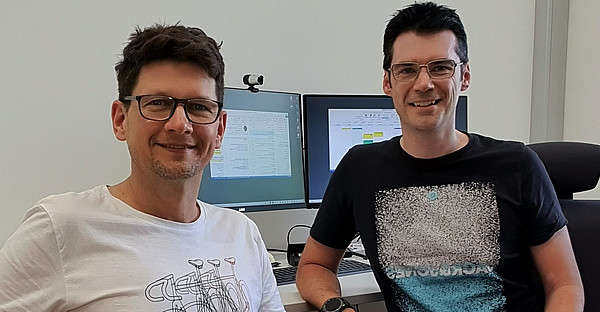

Henrik Saalbach (links) und Roland Grabner sitzen vor einem Computer und schauen in die Kamera
Henrik Saalbach, Universität Leipzig, und Roland Grabner, Universität Graz, (v.l.) arbeiten seit vielen Jahren gemeinsam. Nun forschen sie gemeinsam zu zweisprachigem Mathematik-Unterricht. Foto: privat.
created by Lina Hörügel/Universität Leipzig & Gerhild Leljak

Related news

Complying with the norm: Why Do Standards Shape Our Lives, Elisabeth Staudegger?

Standards determine whether a sheet of paper fits in a printer or whether a charging plug can power multiple devices. These standards shape our everyday lives. But who actually sets these standards? Where are the weaknesses, and how could science help to improve them? Elisabeth Staudegger, Head of the ‘Law and IT’ Department at the Institute for Legal Foundations at the University of Graz, host the Academic Standards Day on 16 June. Here she relays how sciences can contribute to the topic of standardisation and reveals her personal favourite standard.

More body awareness than a culture war

In Italy, sex education lessons will in future only be permitted with parental consent, and will be banned entirely in nurseries and primary schools. At the same time, Pride Month highlights why knowledge about the body, relationships, boundaries and diversity is important for young people. A study by the University of Graz shows how important knowledge about the body, contraception, relationship skills and protection against violence is

Will Austria win the World Cup? Mathematician reveals calculation method

Michael Fischer uses the football tournament as a practical example for highschool lessons.

Survival strategies: How plants respond to drought

According to Geosphere Austria, this spring was the driest in Austria since records began around 170 years ago. The low rainfall put particular pressure on the agricultural sector. And climate change is set to make the situation even worse in the coming decades. We asked Johannes Liesche, a professor at the Department of Biology at the University of Graz, how plants react to water shortages and how they survive periods of drought.

Begin of page section:
Additional information:

University of Graz
Universitaetsplatz 3
8010 Graz
Austria
  • Contact
  • Web Editors
  • Moodle
  • UNIGRAZonline
  • Imprint
  • Data Protection Declaration
  • Accessibility Declaration
Weatherstation
Uni Graz

End of this page section. Go to overview of page sections

End of this page section. Go to overview of page sections

Begin of page section:

End of this page section. Go to overview of page sections