Begin of page section:
Page sections:

  • Go to contents (Accesskey 1)
  • Go to position marker (Accesskey 2)
  • Go to main navigation (Accesskey 3)
  • Go to sub navigation (Accesskey 4)
  • Go to additional information (Accesskey 5)
  • Go to page settings (user/language) (Accesskey 8)
  • Go to search (Accesskey 9)

End of this page section. Go to overview of page sections

Begin of page section:
Page settings:

English en
Deutsch de
Search
Login

End of this page section. Go to overview of page sections

Begin of page section:
Search:

Search for details about Uni Graz
Close

End of this page section. Go to overview of page sections


Search

Begin of page section:
Main navigation:

Page navigation:

  • University

    University
    • About the University
    • Organisation
    • Faculties
    • Library
    • Working at University of Graz
    • Campus
    Developing solutions for the world of tomorrow - that is our mission. Our students and our researchers take on the great challenges of society and carry the knowledge out.
  • Research Profile

    Research Profile
    • Our Expertise
    • Research Questions
    • Research Portal
    • Promoting Research
    • Research Transfer
    • Ethics in Research
    Scientific excellence and the courage to break new ground. Research at the University of Graz creates the foundations for making the future worth living.
  • Studies

    Studies
    • Prospective Students
    • Students
  • Community

    Community
    • International
    • Location
    • Research and Business
    • Alumni
    The University of Graz is a hub for international research and brings together scientists and business experts. Moreover, it fosters the exchange and cooperation in study and teaching.
  • Spotlight
Topics
  • Our digital Advent calendar
  • Sustainable University
  • Researchers answer
  • Work for us
Close menu

End of this page section. Go to overview of page sections

Begin of page section:
You are here:

University of Graz News Sprachgebrauch

End of this page section. Go to overview of page sections

Friday, 21 May 2021

Sprachgebrauch

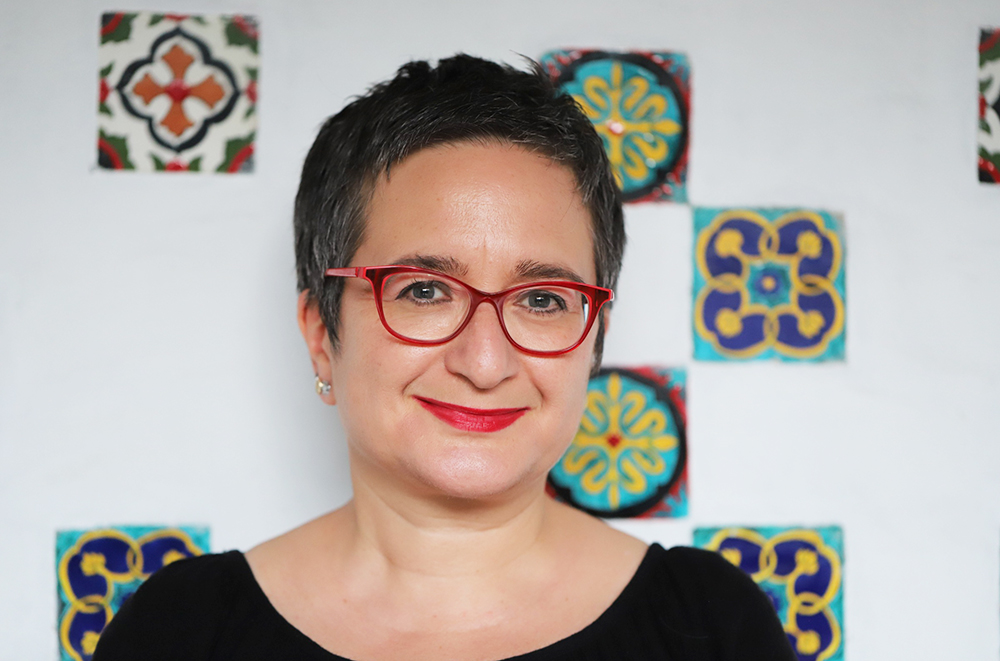
Şebnem Bahadır beschäftigt sich mit den Biographien und „Migrationswunden“ von SprachmittlerInnen. Foto: Karim Berzig

Şebnem Bahadır beschäftigt sich mit den Biographien und „Migrationswunden“ von SprachmittlerInnen. Foto: Karim Berzig

Stimme der AkteurInnen hörbar machen: Şebnem Bahadır, neue Professorin für Translationswissenschaft

Es ist oft das Unausgesprochene und dennoch sagt es viel. Auch beim Übersetzen und Dolmetschen. Şebnem Bahadır, seit Dezember 2020 Professorin für Translationswissenschaft mit Schwerpunkt Translation, Migration und Minderheiten, kennt das aus ihrer Forschung und Lehre sowie aus der eigenen Praxis als Dolmetscherin. „Zwischenmenschliche Interaktion und Körper spielen eine entscheidende Rolle. Vieles sprechen wir nicht aus, deuten es durch Gesten und Mimik an und senden körperliche Signale“, schildert die Forscherin. Es ist also mehr als Worte. Bahadır geht es um ein ganzheitliches Bild einer Kommunikationssituation.

Entsprechend ihrem Interesse und zugleich dem Schwerpunkt der Professur hat die gebürtige Türkin aus Deutschland die AkteurInnen einer mehrsprachigen Gesellschaft im Blick. Daher ist ihr der partizipative Aspekt ein besonderes Anliegen: „Ich will die Stimme der MigrantInnen hörbar machen und die Forschungsergebnisse an die Beteiligten zurückspielen.“ In einem künftigen Forschungsprojekt will sich Bahadır zudem die Biographien und „Migrationswunden“ von MittlerInnen genauer anschauen.

Der Mehrsprachigkeit als gesellschaftliches Transformationspotential werde, so Bahadır – selbst mit Türkisch, Englisch, Französisch und Deutsch viersprachig –, nach wie vor nicht ausreichend Gehör geschenkt: „Dolmetsch- und Übersetzungspraktiken sind bei Migrantenkindern und -jugendlichen ein fester Bestandteil ihres Alltags.“
Der Fokus auf die handelnden Personen schließt in Lehre und Forschung die Beteiligung der DolmetscherInnen mit ein. „Nehmen wir die Psychotherapie: Auch eine professionelle DolmetscherIn, die ihre Arbeit nach bestimmten Regeln durchführt, ist Teil des Beziehungsgefüges in der Therapiesituation“, betont die Wissenschafterin.

Nach der pandemiebedingten virtuellen Einstiegsphase will Şebnem Bahadır, sie war zuvor an der Universität Mainz tätig, nun bald auch physisch an der Universität Graz ankommen. Obgleich, wie sie einräumt, die Online-Angebote innovative Möglichkeiten eröffneten: „Es braucht eine gute Mischung. Blended Learning bietet auch Vorteile und sollte daher in Zukunft erhalten bleiben.“

>> Institut für Theoretische und Angewandte Translationswissenschaft

created by Andreas Schweiger

Related news

Semester abroad without barriers: University of Graz wins award for promoting inclusion

The University of Graz has been awarded the Internationalization Award for its new inclusion initiative. Students with fewer opportunities now also receive financial support for their semester abroad outside Europe.

Fair distribution: Researchers determine just greenhouse gas budgets for all EU regions

Ten years ago, on 12 December 2015, the Paris Climate Agreement was signed at the UN Climate Conference. In order to limit global warming to well below two degrees, only a certain amount of CO2 may be emitted worldwide. While the focus was originally on national emission targets, more than 200 subnational regions and almost 300 cities have now adopted their own targets. But how many emissions are they fairly entitled to? Researchers at the University of Graz have now developed transparent criteria for fair distribution at the subnational level for the first time and determined corresponding greenhouse gas budgets for all European regions. The paper was published today in the scientific journal Nature Communications.

Chemical Christmas show at the University of Graz: An explosive evening at the Schauspielh

At the beginning of December, the University of Graz transformed the theater into a laboratory: as part of “Chemical Life,” teacher training students staged a chemical Christmas show for Styrian school classes—complete with ethanol rockets, nitrogen snow, and glowing effects. An evening designed to inspire interest in studying chemistry.

Train by train: Koralm railway accelerates exchange between the Universities

Lectures at the University of Klagenfurt in the morning, seminars at the University of Graz in the afternoon: Austria's longest tunnel and a journey time of around 45 minutes make it easy. The Koralm railway increases the speed of networking between the two university locations. The collaboration builds on existing cooperation - for example in the areas of teacher training, Slavic studies and as employers, the universities are well coordinated.

Begin of page section:
Additional information:

University of Graz
Universitaetsplatz 3
8010 Graz
Austria
  • Contact
  • Web Editors
  • Moodle
  • UNIGRAZonline
  • Imprint
  • Data Protection Declaration
  • Accessibility Declaration
Weatherstation
Uni Graz

End of this page section. Go to overview of page sections

End of this page section. Go to overview of page sections

Begin of page section:

End of this page section. Go to overview of page sections