



Begin of page section:
Page sections:

  • Go to contents (Accesskey 1)
  • Go to position marker (Accesskey 2)
  • Go to main navigation (Accesskey 3)
  • Go to sub navigation (Accesskey 4)
  • Go to additional information (Accesskey 5)
  • Go to page settings (user/language) (Accesskey 8)
  • Go to search (Accesskey 9)

End of this page section. Go to overview of page sections

Begin of page section:
Page settings:

English en
Deutsch de
Search
Login

End of this page section. Go to overview of page sections

Begin of page section:
Search:

Search for details about Uni Graz
Close

End of this page section. Go to overview of page sections


Search

Begin of page section:
Main navigation:

Page navigation:

  • University

    University
    • About the University
    • Organisation
    • Faculties
    • Library
    • Working at University of Graz
    • Campus
    Developing solutions for the world of tomorrow - that is our mission. Our students and our researchers take on the great challenges of society and carry the knowledge out.
  • Research Profile

    Research Profile
    • Our Expertise
    • Research Questions
    • Research Portal
    • Promoting Research
    • Research Transfer
    • Ethics in Research
    • Commission for Scientific Integrity
    Scientific excellence and the courage to break new ground. Research at the University of Graz creates the foundations for making the future worth living.
  • Studies

    Studies
    • Prospective Students
    • Students
    • Registration for Study Programme (Winter semester 2026/27)
  • Community

    Community
    • International
    • Location
    • Research and Business
    • Alumni
    The University of Graz is a hub for international research and brings together scientists and business experts. Moreover, it fosters the exchange and cooperation in study and teaching.
Topics
  • Sustainable University
  • Researchers answer
  • Work for us
Close menu

End of this page section. Go to overview of page sections

Begin of page section:
You are here:

University of Graz News Sprache = Kapital (?)

End of this page section. Go to overview of page sections

Thursday, 17 May 2018

Sprache = Kapital (?)

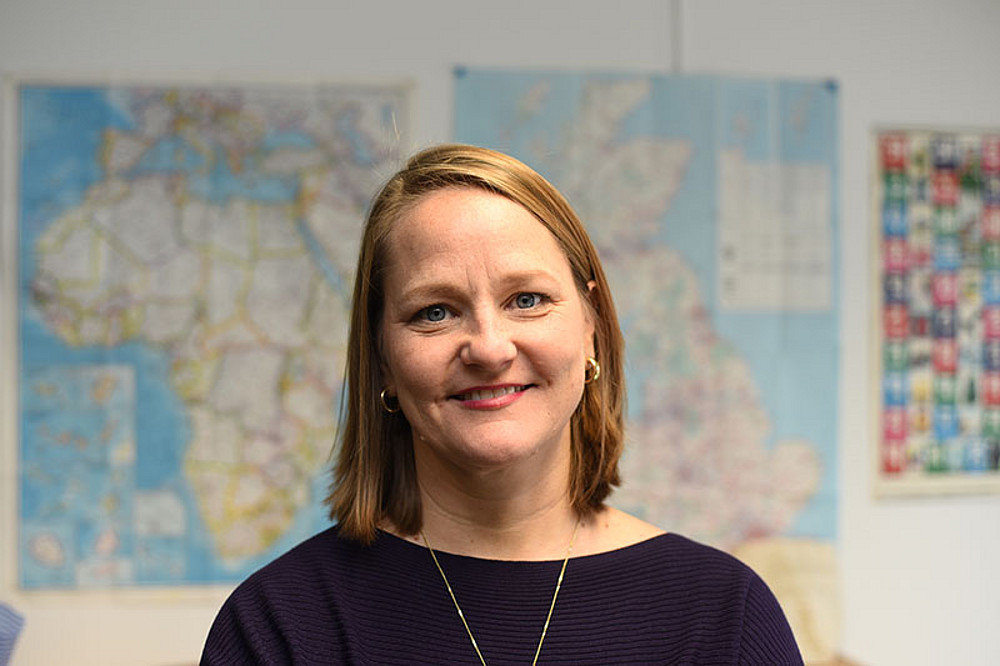
Elizabeth Erling erforscht, wie Englisch gelehrt wird und als Unterrichtsmedium verwendet wird. Foto: Uni Graz/Tzivanopoulos. ©Uni Graz/Tzivanopoulos
©Uni Graz/Tzivanopoulos

Elizabeth Erling erforscht, wie Englisch gelehrt wird und als Unterrichtsmedium verwendet wird. Foto: Uni Graz/Tzivanopoulos.

Elizabeth Erling untersucht den englischen Unterricht und seinen Stellenwert

„Gute Englischkenntnisse sind kein Allheilmittel“, widerspricht Elizabeth Erling einer Annahme, die vor allem in Ländern mit niedrigem oder mittleren Einkommen weit verbreitet ist. Die Professorin für Fachdidaktik Englisch, die seit Oktober 2017 an der Universität Graz lehrt und forscht, hat sich verschiedene Lehrsysteme weltweit angesehen und verglichen, wie Englisch gelehrt wird und als Unterrichtsmedium verwendet wird. Im Rahmen eines English Language Teaching-Projekts in Bangladesch wurde für sie zum Beispiel ersichtlich, dass die dortige Bevölkerung bessere Englisch-Sprachkenntnisse mit der Hoffnung auf Entwicklungsmöglichkeiten für Land und Leute verknüpft und ein allgemeiner wirtschaftlicher Aufschwung davon erwartet wird. „Wenn die Straßen, die zur Schule führen, aber einen großen Teil des Jahres überflutet sind, stellt sich schon die Frage: In welchem Ausmaß können Sprachunterrichtsprogramme überhaupt einen Wandel erwirken?“, bringt Erling die Schwierigkeit auf den Punkt. Außerdem müsse Englisch so unterrichtet werden, dass das Bildungssystem generell gestärkt wird. „Ganz entscheidend für die Entwicklung des menschlichen Kapitals dieser Länder ist es, auch die Lese- und Schreibfähigkeit in den einzelnen Landessprachen zu fördern“, so Erling.

Die Beziehung zwischen Sprache und wirtschaftlicher Entwicklung ist ein Schwerpunkt der Amerikanerin, die in Georgia, Edinburgh und Mainz angewandte Sprachwissenschaft, Deutsch und Englisch studiert hat und bis 2017 an der Open University in England tätig war. Andere soziolinguistische Themen sind ebenfalls im Forschungsgebiet der Fachdidaktikerin zu finden. Sie widmet sich außerdem zentralen Themen, die mit englischem Sprachunterricht einhergehen: Motivation, Identität und Inklusion. Nach Forschungsaufenthalten in Indien und Ghana möchte Erling nun in ihrem neuen Zuhause Österreich daran anknüpfen: „Mich interessiert, ob es in verschiedenen Schulen Unterschiede im Englisch-Unterricht gibt. Welche Erwartungen sind mit Fremdsprachenkenntnissen verbunden, wo werden SchülerInnen gefordert, wo vielleicht auch begrenzt hinsichtlich ihres sozioökonomischen Hintergrunds, des Schultyps und der Sprache?“, formuliert Erling. Die Wissenschafterin beschäftigt sich beispielsweise auch mit der Frage, welches Potenzial der Englische Sprachunterricht in Österreich hat, um Sprachkompetenz insgesamt zu erweitern und interkulturelles Verständnis zu fördern. Neue Projekte in diesem Bereich sind gerade am Enstehen.

created by Gerhild Leljak

Related news

When stress melts away in your mouth: nicotine pouches are widespread among Styrian students

Sociologists at the University of Graz, in collaboration with VIVID – the Centre for Addiction Prevention, have carried out a survey involving more than 600 participants. Around a quarter of them use these products. The ability to use them discreetly and flexibly is a key motivation.

Desert sand, microplastics, cancer cells: David Clases awarded ERC grant for analytical method

Nanoparticles trapped in polar ice can reveal a great deal about the climate 100,000 years ago. Chemist David Clases is developing unique methods to analyse them in detail. He will now adapt these methods for use with larger particles in order to glean even more information about Earth’s history. The method can be used for a wide range of other purposes – for example, in medical diagnostics or the investigation of environmental pollution. Clases has been awarded a Proof-of-Concept Grant by the European Research Council (ERC) for this work.

Staying fit during the holidays: summer sports on the University of Graz campus

The Kleeblattlauf is not the end of the fitness term. Following last year’s successful launch, the University of Graz is once again offering summer sports on campus this year. From 30 June to 16 July 2026, there will be a free exercise programme in the open air. On the shady Südwiese (between the main building and Universitätsplatz 2), anyone interested can get in shape in the afternoons with body workouts, fascia training and yoga.

Getting even hotter: Researchers predict global warming of 1.7 degrees by 2027

While Europe is currently sweltering in the heat, global temperatures are also rising towards concerning record levels. In 2026, Earth’s surface air temperature is expected to reach 1.62 degrees, and in 2027 even 1.71 degrees Celsius above pre-industrial levels. The long-term temperature rise – an average over a 20-year period – is predicted to exceed the 1.5-degree threshold of the Paris Agreement as of 2026 already. For the first time, researchers at the University of Graz have been able to make such a forecast so far in advance. The intensifying El Niño climate event favors forecast skill and thereby facilitates a reliable computation.

Begin of page section:
Additional information:

University of Graz
Universitaetsplatz 3
8010 Graz
Austria
  • Contact
  • Web Editors
  • Moodle
  • UNIGRAZonline
  • Imprint
  • Data Protection Declaration
  • Accessibility Declaration
Weatherstation
Uni Graz

End of this page section. Go to overview of page sections

End of this page section. Go to overview of page sections

Begin of page section:

End of this page section. Go to overview of page sections


