Begin of page section:
Page sections:

  • Go to contents (Accesskey 1)
  • Go to position marker (Accesskey 2)
  • Go to main navigation (Accesskey 3)
  • Go to sub navigation (Accesskey 4)
  • Go to additional information (Accesskey 5)
  • Go to page settings (user/language) (Accesskey 8)
  • Go to search (Accesskey 9)

End of this page section. Go to overview of page sections

Begin of page section:
Page settings:

English en
Deutsch de
Search
Login

End of this page section. Go to overview of page sections

Begin of page section:
Search:

Search for details about Uni Graz
Close

End of this page section. Go to overview of page sections


Search

Begin of page section:
Main navigation:

Page navigation:

  • University

    University
    • About the University
    • Organisation
    • Faculties
    • Library
    • Working at University of Graz
    • Campus
    Developing solutions for the world of tomorrow - that is our mission. Our students and our researchers take on the great challenges of society and carry the knowledge out.
  • Research Profile

    Research Profile
    • Our Expertise
    • Research Questions
    • Research Portal
    • Promoting Research
    • Research Transfer
    • Ethics in Research
    Scientific excellence and the courage to break new ground. Research at the University of Graz creates the foundations for making the future worth living.
  • Studies

    Studies
    • Prospective Students
    • Students
  • Community

    Community
    • International
    • Location
    • Research and Business
    • Alumni
    The University of Graz is a hub for international research and brings together scientists and business experts. Moreover, it fosters the exchange and cooperation in study and teaching.
  • Spotlight
Topics
  • Our digital Advent calendar
  • Sustainable University
  • Researchers answer
  • Work for us
Close menu

End of this page section. Go to overview of page sections

Begin of page section:
You are here:

University of Graz News Sprache = Kapital (?)

End of this page section. Go to overview of page sections

Thursday, 17 May 2018

Sprache = Kapital (?)
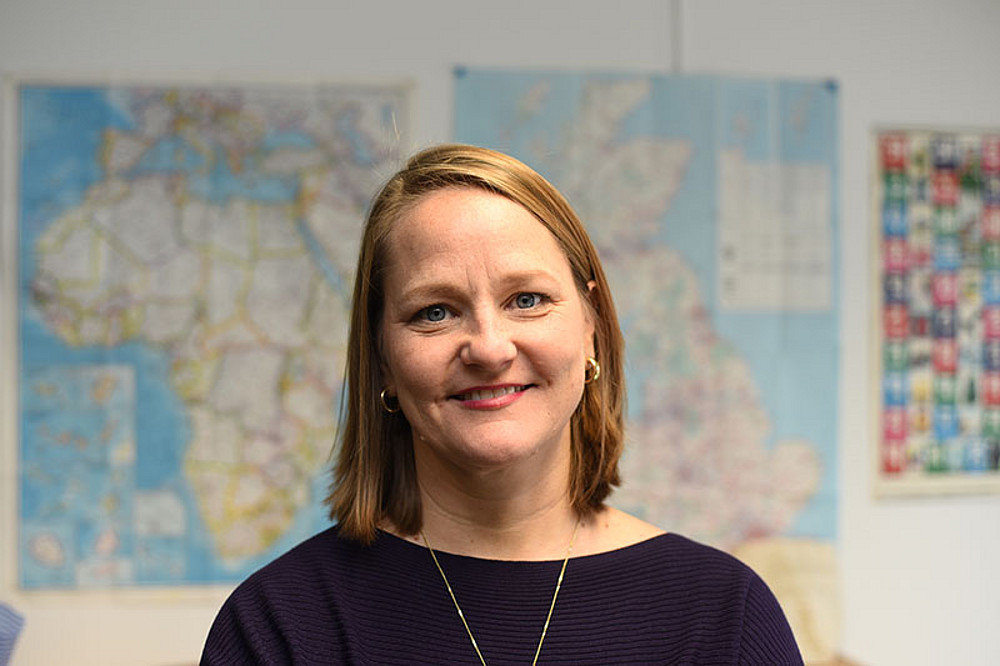
Elizabeth Erling erforscht, wie Englisch gelehrt wird und als Unterrichtsmedium verwendet wird. Foto: Uni Graz/Tzivanopoulos. ©Uni Graz/Tzivanopoulos

Elizabeth Erling erforscht, wie Englisch gelehrt wird und als Unterrichtsmedium verwendet wird. Foto: Uni Graz/Tzivanopoulos.

Elizabeth Erling untersucht den englischen Unterricht und seinen Stellenwert

„Gute Englischkenntnisse sind kein Allheilmittel“, widerspricht Elizabeth Erling einer Annahme, die vor allem in Ländern mit niedrigem oder mittleren Einkommen weit verbreitet ist. Die Professorin für Fachdidaktik Englisch, die seit Oktober 2017 an der Universität Graz lehrt und forscht, hat sich verschiedene Lehrsysteme weltweit angesehen und verglichen, wie Englisch gelehrt wird und als Unterrichtsmedium verwendet wird. Im Rahmen eines English Language Teaching-Projekts in Bangladesch wurde für sie zum Beispiel ersichtlich, dass die dortige Bevölkerung bessere Englisch-Sprachkenntnisse mit der Hoffnung auf Entwicklungsmöglichkeiten für Land und Leute verknüpft und ein allgemeiner wirtschaftlicher Aufschwung davon erwartet wird. „Wenn die Straßen, die zur Schule führen, aber einen großen Teil des Jahres überflutet sind, stellt sich schon die Frage: In welchem Ausmaß können Sprachunterrichtsprogramme überhaupt einen Wandel erwirken?“, bringt Erling die Schwierigkeit auf den Punkt. Außerdem müsse Englisch so unterrichtet werden, dass das Bildungssystem generell gestärkt wird. „Ganz entscheidend für die Entwicklung des menschlichen Kapitals dieser Länder ist es, auch die Lese- und Schreibfähigkeit in den einzelnen Landessprachen zu fördern“, so Erling.

Die Beziehung zwischen Sprache und wirtschaftlicher Entwicklung ist ein Schwerpunkt der Amerikanerin, die in Georgia, Edinburgh und Mainz angewandte Sprachwissenschaft, Deutsch und Englisch studiert hat und bis 2017 an der Open University in England tätig war. Andere soziolinguistische Themen sind ebenfalls im Forschungsgebiet der Fachdidaktikerin zu finden. Sie widmet sich außerdem zentralen Themen, die mit englischem Sprachunterricht einhergehen: Motivation, Identität und Inklusion. Nach Forschungsaufenthalten in Indien und Ghana möchte Erling nun in ihrem neuen Zuhause Österreich daran anknüpfen: „Mich interessiert, ob es in verschiedenen Schulen Unterschiede im Englisch-Unterricht gibt. Welche Erwartungen sind mit Fremdsprachenkenntnissen verbunden, wo werden SchülerInnen gefordert, wo vielleicht auch begrenzt hinsichtlich ihres sozioökonomischen Hintergrunds, des Schultyps und der Sprache?“, formuliert Erling. Die Wissenschafterin beschäftigt sich beispielsweise auch mit der Frage, welches Potenzial der Englische Sprachunterricht in Österreich hat, um Sprachkompetenz insgesamt zu erweitern und interkulturelles Verständnis zu fördern. Neue Projekte in diesem Bereich sind gerade am Enstehen.

created by Gerhild Leljak

Related news

Chemical Christmas show at the University of Graz: An explosive evening at the Schauspielh

At the beginning of December, the University of Graz transformed the theater into a laboratory: as part of “Chemical Life,” teacher training students staged a chemical Christmas show for Styrian school classes—complete with ethanol rockets, nitrogen snow, and glowing effects. An evening designed to inspire interest in studying chemistry.

Train by train: Koralm railway accelerates exchange between the Universities

Lectures at the University of Klagenfurt in the morning, seminars at the University of Graz in the afternoon: Austria's longest tunnel and a journey time of around 45 minutes make it easy. The Koralm railway increases the speed of networking between the two university locations. The collaboration builds on existing cooperation - for example in the areas of teacher training, Slavic studies and as employers, the universities are well coordinated.

On the trail of the Big Bang: University of Graz receives 1.5 million euros for doctoral programmes

The Austrian Science Fund FWF has selected the Doctoral Programme in Theoretical Particle Physics at the University of Graz for funding from the Doc.funds. Six young scientists will be funded for 3.5 years. They will gain fundamentally new insights into the origins of the world.

From trans women and knee prostheses: sports science prizes awarded

Walking better with a prosthesis, successfully getting rid of excess weight, training more effectively, more fairness for trans people in sport: these were the topics addressed by the students at the University of Graz who were awarded the sports science prizes for their Master's theses on 3 December 2025.

Begin of page section:
Additional information:

University of Graz
Universitaetsplatz 3
8010 Graz
Austria
  • Contact
  • Web Editors
  • Moodle
  • UNIGRAZonline
  • Imprint
  • Data Protection Declaration
  • Accessibility Declaration
Weatherstation
Uni Graz

End of this page section. Go to overview of page sections

End of this page section. Go to overview of page sections

Begin of page section:

End of this page section. Go to overview of page sections