



Begin of page section:
Page sections:

  • Go to contents (Accesskey 1)
  • Go to position marker (Accesskey 2)
  • Go to main navigation (Accesskey 3)
  • Go to sub navigation (Accesskey 4)
  • Go to additional information (Accesskey 5)
  • Go to page settings (user/language) (Accesskey 8)
  • Go to search (Accesskey 9)

End of this page section. Go to overview of page sections

Begin of page section:
Page settings:

English en
Deutsch de
Search
Login

End of this page section. Go to overview of page sections

Begin of page section:
Search:

Search for details about Uni Graz
Close

End of this page section. Go to overview of page sections


Search

Begin of page section:
Main navigation:

Page navigation:

  • University

    University
    • About the University
    • Organisation
    • Faculties
    • Library
    • Working at University of Graz
    • Campus
    Developing solutions for the world of tomorrow - that is our mission. Our students and our researchers take on the great challenges of society and carry the knowledge out.
  • Research Profile

    Research Profile
    • Our Expertise
    • Research Questions
    • Research Portal
    • Promoting Research
    • Research Transfer
    • Ethics in Research
    • Commission for Scientific Integrity
    Scientific excellence and the courage to break new ground. Research at the University of Graz creates the foundations for making the future worth living.
  • Studies

    Studies
    • Prospective Students
    • Students
    • Welcome Weeks for First Year Students
  • Community

    Community
    • International
    • Location
    • Research and Business
    • Alumni
    The University of Graz is a hub for international research and brings together scientists and business experts. Moreover, it fosters the exchange and cooperation in study and teaching.
Topics
  • Sustainable University
  • Researchers answer
  • Work for us
Close menu

End of this page section. Go to overview of page sections

Begin of page section:
You are here:

University of Graz News Research for teaching and learning: Graz University becomes an international hotspot

End of this page section. Go to overview of page sections

Monday, 11 August 2025

Research for teaching and learning: Graz University becomes an international hotspot

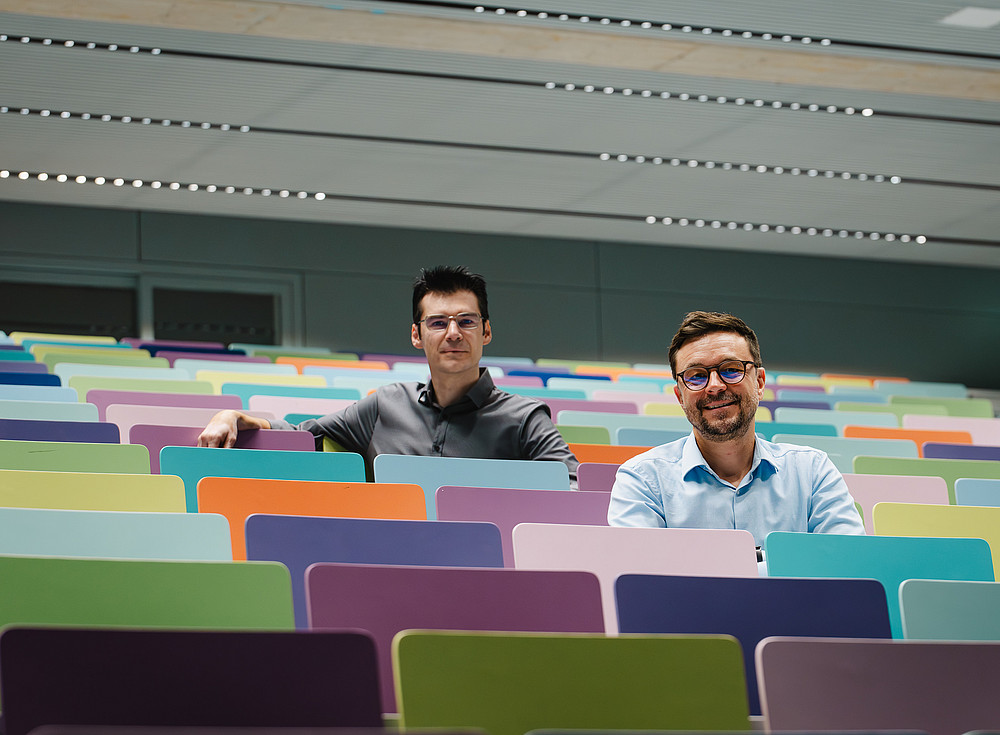
Two men sit in the middle of an empty university lecture hall, on colorful chairs and smiling at the camera. ©Uni Graz/Tzivanopoulos
©Uni Graz/Tzivanopoulos

Roland Grabner and Stephan Vogel are investigating which processes in the brain play a role in learning. Photo: University of Graz/Tzivanopoulos

Education experts are celebrating the 40th anniversary of the EARLI research organization with a conference at Graz University. Over 2,500 researchers from around the world will present the latest findings in brain research, digital learning, and the social aspects of education.

Learning accompanies us throughout our lives – from our first steps to graduation and beyond. What happens in the brain during this process? Which techniques support the learning process? And what role does the family or social environment play? Teaching and learning research deals with these and many other questions.

Experts on this topic have been meeting for 40 years at major conferences organized by the European Association for Research on Learning and Instruction (EARLI). The organization will celebrate its anniversary in August at a conference at the University of Graz. “We are expecting around 2,500 participants,” says Lucia Mason, president of EARLI. The program includes numerous presentations of current research results from a wide range of areas in teaching and learning research.

Focus on the brain

Scientists from the University of Graz will present their work in the field of neuroscientific learning research, among other things. Stephan Vogel, for example, uses EEG and MRI to investigate what happens in our brains when we perceive numbers or quantities. “This process is crucial for understanding mathematical concepts,” explains the psychologist and neuroscientist. His knowledge is being incorporated into a joint project with the University of Education Styria: The aim is to digitally record the numerical comprehension of preschool children and develop targeted support measures.

His colleague Roland Grabner, on the other hand, is researching how talents develop from aptitudes. To this end, he studies people who excel at chess and mathematics, among other things, and explores questions such as: What skills and personality traits are required for this, and how do the brains of experts work? Another focus is on bilingual learning. Grabner wants to find out: "What cognitive challenges arise when you don't learn mathematics in your native language? And how much additional learning is necessary to achieve the same level of performance?“

From research to the classroom

International networking among scientists not only promotes the exchange of knowledge, but also helps to bring research results into the classroom more quickly. ”Our experts play an active role in curriculum development in their home countries," says EARLI President Mason. “Their knowledge has been crucial to the development of digital learning tools such as those used in many schools today.” Researchers are also increasingly focusing on the social aspects of learning. “How important are relationships for success in education? Whether it's family, friends, or bonds with teachers, all of these factors influence learning outcomes,” explains Mason.

What can education researchers expect at the conference in Graz? “We maintain close contacts with colleagues from neighboring disciplines here,” says Stephan Vogel. “The EARLI conference at the University of Graz is a unique opportunity to raise the international profile of the diverse and high-quality education research conducted at our university,” adds Roland Grabner. That is why the university research network FUTURE EDUCATION will be represented several times in the conference program.

Do you want to not only learn, but also understand how people learn? Would you like to help shape the education of tomorrow? Then study psychology, education, or teaching at the University of Graz.

created by Roman Vilgut

Related news

A fresh start, a calling, holidays: what draws people from other career paths to teaching

They used to develop software; now they teach maths in the classroom. Career changers are expected to help address the shortage of qualified teachers in Austria’s schools. In their doctoral theses at the Institute for Educational Research and Teacher Training at the University of Graz, Melanie Gürentz and Claudia Mair examined how these new teachers perceive their new professional roles.

Talent Talks bridge the gap in career guidance

The Styrian Chamber of Commerce (WKO Steiermark), the Styrian Chamber of Labour (AK Steiermark) and the AMS are joining forces when it comes to training young people and, through the “Talent Talks”, are creating a seamless pathway to career guidance. This takes preparation and follow-up support – just in time for the start of the term and the scheme’s tenth anniversary – to a whole new level. A new survey conducted by the Talent Centre among 2,687 former participants to mark the anniversary shows just how important this development is. Of the young people who received follow-up support from the Talent Report, 74.6 per cent stated that they had a good understanding of their own strengths and talents following the Talent Check. Without follow-up support, the figure was 66.5 per cent – a significant difference of 8.1 percentage points.

ERC Starting Grants: three million euros for two researchers at the University of Graz

Two researchers from the University of Graz have secured prestigious and generously funded grants from the EU. Starting Grants from the European Research Council (ERC), each worth 1.5 million euros, have been awarded to the human geographer Heide Bruckner and the social scientist Silvana Weiss.

Austria’s emissions rose in 2025: University of Graz researchers analyse the causes

The Environment Agency Austria has today published the figures for the country’s greenhouse gas emissions in 2025. While emissions fell sharply year on year from 2022 to 2024, they rose again by just under 0.7 per cent in 2025. Researchers at the University of Graz have analysed how much of this increase was due to structural changes in the economy and how much was attributable to external factors over which there is little control. “In 2025, the colder winter compared with 2024 increased emissions by 0.81 per cent, while the weak economy reduced them by 0.38 per cent. If we factor out these influences, we find an underlying increase of 0.26 per cent compared with the previous year,” reports economist Karl Steininger. “This clearly means that Austria is not on track to meet its climate targets, which require a substantial reduction in emissions by 2030.”

Begin of page section:
Additional information:

University of Graz
Universitaetsplatz 3
8010 Graz
Austria
  • Contact
  • Web Editors
  • Moodle
  • UNIGRAZonline
  • Imprint
  • Data Protection Declaration
  • Accessibility Declaration
Weatherstation
Uni Graz

End of this page section. Go to overview of page sections

End of this page section. Go to overview of page sections

Begin of page section:

End of this page section. Go to overview of page sections