Begin of page section:
Page sections:

  • Go to contents (Accesskey 1)
  • Go to position marker (Accesskey 2)
  • Go to main navigation (Accesskey 3)
  • Go to sub navigation (Accesskey 4)
  • Go to additional information (Accesskey 5)
  • Go to page settings (user/language) (Accesskey 8)
  • Go to search (Accesskey 9)

End of this page section. Go to overview of page sections

Begin of page section:
Page settings:

English en
Deutsch de
Search
Login

End of this page section. Go to overview of page sections

Begin of page section:
Search:

Search for details about Uni Graz
Close

End of this page section. Go to overview of page sections


Search

Begin of page section:
Main navigation:

Page navigation:

  • University

    University
    • About the University
    • Organisation
    • Faculties
    • Library
    • Working at University of Graz
    • Campus
    Developing solutions for the world of tomorrow - that is our mission. Our students and our researchers take on the great challenges of society and carry the knowledge out.
  • Research Profile

    Research Profile
    • Our Expertise
    • Research Questions
    • Research Portal
    • Promoting Research
    • Research Transfer
    • Ethics in Research
    • Commission for Scientific Integrity
    Scientific excellence and the courage to break new ground. Research at the University of Graz creates the foundations for making the future worth living.
  • Studies

    Studies
    • Prospective Students
    • Students
    • Registration for Study Programme (Winter semester 2026/27)
  • Community

    Community
    • International
    • Location
    • Research and Business
    • Alumni
    The University of Graz is a hub for international research and brings together scientists and business experts. Moreover, it fosters the exchange and cooperation in study and teaching.
Topics
  • Sustainable University
  • Researchers answer
  • Work for us
Close menu

End of this page section. Go to overview of page sections

Begin of page section:
You are here:

University of Graz News Save, invest or guarantee: What Austrians expect from the state

End of this page section. Go to overview of page sections

Monday, 22 June 2026

Save, invest or guarantee: What Austrians expect from the state

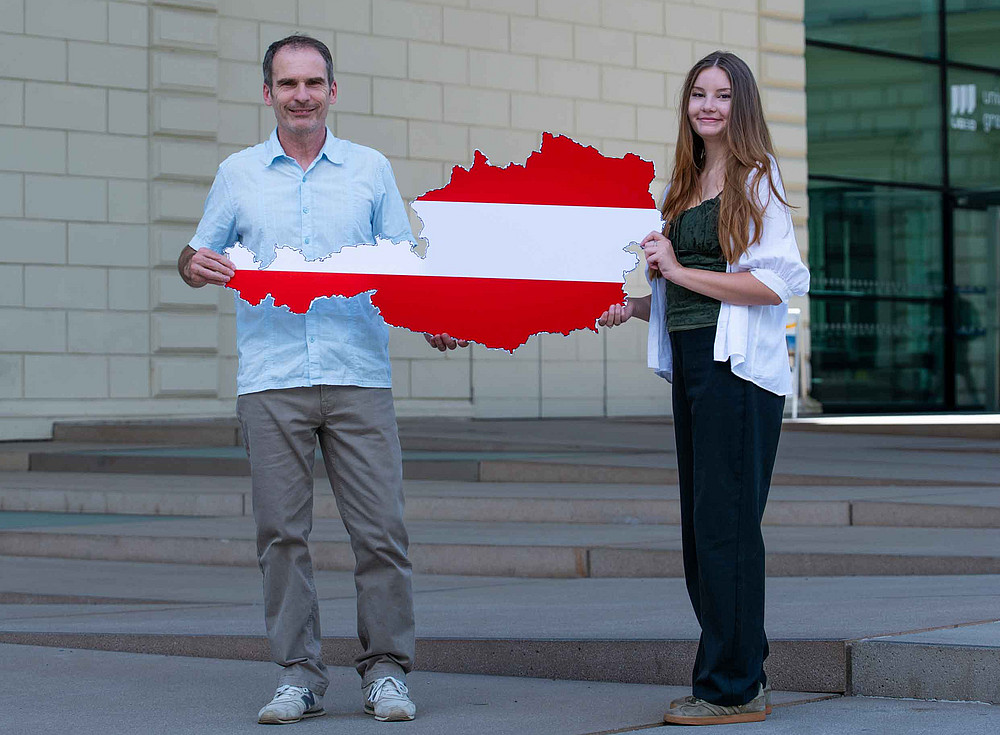
Zwei Erwachsene mittleren Alters stehen nebeneinander im Freien, halten eine Zeitung in der Hand und blicken gemeinsam in die Kamera. ©Uni Graz/Tzivanopoulos

Markus Hadler und Petra Müller analysieren die Einstellungen der Österreicher:innen. Foto: Uni Graz/Tzivanopoulos

Austria needs to make savings. But where? And what should the Republic actually be spending its money on? The answers are provided by the initial findings of a major study involving the University of Graz. 99 per cent of those surveyed are in favour of the state ensuring healthcare provision. Almost three-quarters would like to see more public funding for education, whilst only around three per cent are in favour of cuts in this sector.

“The political debate surrounding the austerity budget appears to be highly polarised,” observes Markus Hadler, a sociologist at the University of Graz. But what do Austrians think about where investment and spending cuts should be made? Between February and April this year, more than 1,400 people answered these questions as part of the Austrian Social Survey. This Austria-wide survey regularly gauges the attitudes of people aged 16 and over and is conducted by Markus Hadler and Petra Müller from the University of Graz, together with colleagues from the universities of Salzburg and Linz, as well as the Austrian Academy of Sciences.
“The population is largely in agreement on the fundamental responsibilities of the state,” summarises Hadler. “The differences begin when it comes to the question of where additional investment, stricter regulation or savings should be made.”

Healthcare

99 per cent of respondents believe the public sector is responsible for ensuring healthcare provision. 95.8 per cent expect older people to be guaranteed an adequate standard of living. “More than 80 per cent are convinced that the state must provide support for students from lower-income families, control prices, ensure gender equality and impose strict environmental regulations on industry,” says Petra Müller, citing further results.

Cuts

There is less agreement when it comes to the specific allocation of public funds. Hadler explains the divide: “Whilst around seven in ten are in favour of cuts to the national budget in principle, at the same time 78.4 per cent would like to see higher spending on healthcare and 71.2 per cent on education – that is, on both schools and universities.” More than half are in favour of the state spending more on pensions. Cuts are most readily accepted in the areas of unemployment benefit, as well as in culture and the arts.

Promoting innovation

According to the study, clear preferences emerged regarding measures to improve the economic situation – depending on support for a particular party. The strongest support is for the promotion of innovation: 83 per cent welcome state aid for the development of new products and technologies. Employment programmes and support for industrial sectors to safeguard jobs also receive majority approval. There is little support for a general reduction in working hours to create additional jobs.

created by Andreas Schweiger

Related news

Complying with the norm: Why Do Standards Shape Our Lives, Elisabeth Staudegger?

Standards determine whether a sheet of paper fits in a printer or whether a charging plug can power multiple devices. These standards shape our everyday lives. But who actually sets these standards? Where are the weaknesses, and how could science help to improve them? Elisabeth Staudegger, Head of the ‘Law and IT’ Department at the Institute for Legal Foundations at the University of Graz, host the Academic Standards Day on 16 June. Here she relays how sciences can contribute to the topic of standardisation and reveals her personal favourite standard.

More body awareness than a culture war

In Italy, sex education lessons will in future only be permitted with parental consent, and will be banned entirely in nurseries and primary schools. At the same time, Pride Month highlights why knowledge about the body, relationships, boundaries and diversity is important for young people. A study by the University of Graz shows how important knowledge about the body, contraception, relationship skills and protection against violence is

Will Austria win the World Cup? Mathematician reveals calculation method

Michael Fischer uses the football tournament as a practical example for highschool lessons.

Survival strategies: How plants respond to drought

According to Geosphere Austria, this spring was the driest in Austria since records began around 170 years ago. The low rainfall put particular pressure on the agricultural sector. And climate change is set to make the situation even worse in the coming decades. We asked Johannes Liesche, a professor at the Department of Biology at the University of Graz, how plants react to water shortages and how they survive periods of drought.

Begin of page section:
Additional information:

University of Graz
Universitaetsplatz 3
8010 Graz
Austria
  • Contact
  • Web Editors
  • Moodle
  • UNIGRAZonline
  • Imprint
  • Data Protection Declaration
  • Accessibility Declaration
Weatherstation
Uni Graz

End of this page section. Go to overview of page sections

End of this page section. Go to overview of page sections

Begin of page section:

End of this page section. Go to overview of page sections