Begin of page section:
Page sections:

  • Go to contents (Accesskey 1)
  • Go to position marker (Accesskey 2)
  • Go to main navigation (Accesskey 3)
  • Go to sub navigation (Accesskey 4)
  • Go to additional information (Accesskey 5)
  • Go to page settings (user/language) (Accesskey 8)
  • Go to search (Accesskey 9)

End of this page section. Go to overview of page sections

Begin of page section:
Page settings:

English en
Deutsch de
Search
Login

End of this page section. Go to overview of page sections

Begin of page section:
Search:

Search for details about Uni Graz
Close

End of this page section. Go to overview of page sections


Search

Begin of page section:
Main navigation:

Page navigation:

  • University

    University
    • About the University
    • Organisation
    • Faculties
    • Library
    • Working at University of Graz
    • Campus
    Developing solutions for the world of tomorrow - that is our mission. Our students and our researchers take on the great challenges of society and carry the knowledge out.
  • Research Profile

    Research Profile
    • Our Expertise
    • Research Questions
    • Research Portal
    • Promoting Research
    • Research Transfer
    • Ethics in Research
    • Commission for Scientific Integrity
    Scientific excellence and the courage to break new ground. Research at the University of Graz creates the foundations for making the future worth living.
  • Studies

    Studies
    • Prospective Students
    • Students
    • Registration for Study Programme (Winter semester 2026/27)
  • Community

    Community
    • International
    • Location
    • Research and Business
    • Alumni
    The University of Graz is a hub for international research and brings together scientists and business experts. Moreover, it fosters the exchange and cooperation in study and teaching.
Topics
  • Sustainable University
  • Researchers answer
  • Work for us
Close menu

End of this page section. Go to overview of page sections

Begin of page section:
You are here:

University of Graz News Spannende Experimente

End of this page section. Go to overview of page sections

Tuesday, 02 December 2014

Spannende Experimente

Mit Knallgas, ...

Mit Knallgas, ...

Kunstschnee,

Kunstschnee,

Molekülmodellen und vielem mehr zeigten die SchülerInnen, wie spannend der Chemie-Unterricht sein kann ...

Molekülmodellen und vielem mehr zeigten die SchülerInnen, wie spannend der Chemie-Unterricht sein kann ...

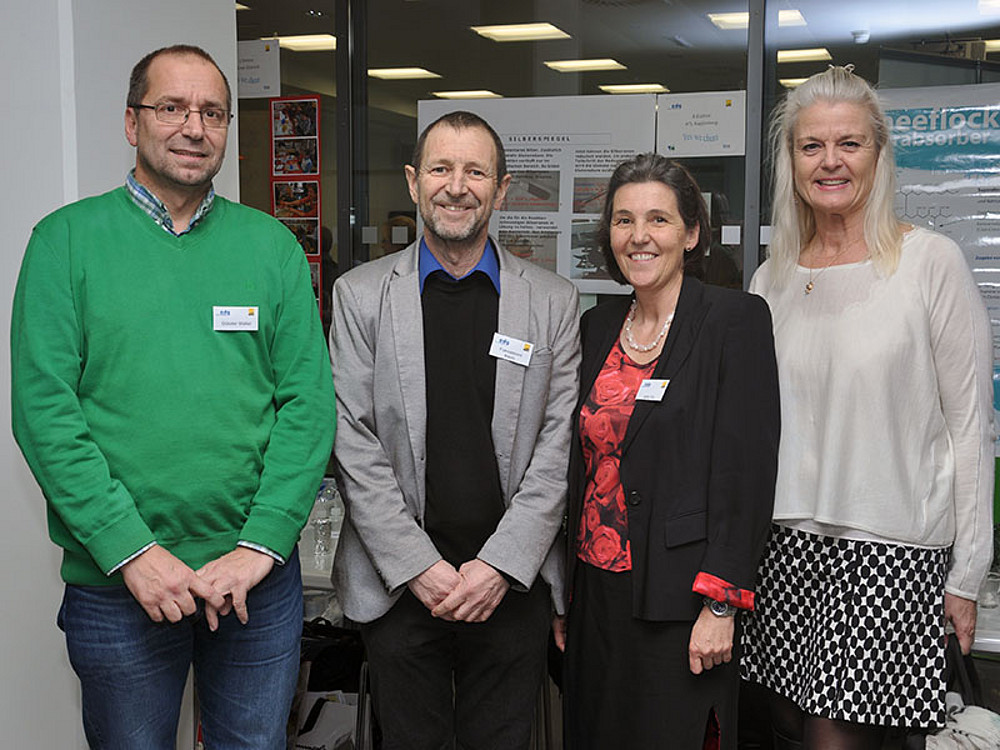
Walter Gössler, Leiter des RFDZ Chemie, Kevin Francesconi, Leiter des Instituts für Chemie der Uni Graz, Pia Jaritz, Lehrende am BG BRG Carneri und RFDZ Chemie, sowie Corinna Martin vom Fachverband der Chemischen Industrie Österreichs (v.l.) freuten si

Walter Gössler, Leiter des RFDZ Chemie, Kevin Francesconi, Leiter des Instituts für Chemie der Uni Graz, Pia Jaritz, Lehrende am BG BRG Carneri und RFDZ Chemie, sowie Corinna Martin vom Fachverband der Chemischen Industrie Österreichs (v.l.) freuten sich über die tolle Veranstaltung. Fotos: Uni Graz/Pichler

SchülerInnen führten vor, wie lebendig Chemie-Unterricht sein kann

SchülerInnen aus acht steirischen Schulen demonstrierten am 1. Dezember 2014 an der Uni Graz in verschiedensten Experimenten, wo überall Chemie im Spiel ist und was sich im naturwissenschaftlichen Unterricht so alles erleben lässt - von der Kunstschnee-Produktion über das Versilbern von Christbaum-Kugeln bis hin zum explosiven Wasserstoff.

Die Veranstaltung mit dem Titel „Yes – we chem“ entstand als gemeinsame Initiative des Fachverbands der Chemischen Industrie Österreichs, des Verbands der ChemielehrerInnen Österreichs und des Regionalen Fachdidaktikzentrums (RFDZ) Chemie. Die SchülerInnen im Alter zwischen neun und 19 Jahren, ihre LehrerInnen sowie die OrganisatorInnen, allen voran Mag. Pia Jaritz, Lehrende am BG BRG Carneri und RFDZ Chemie, freuten sich über das rege Interesse der zahlreichen BesucherInnen.

Die Eröffnung wurde vom Chor der Musikmittelschule Ferdinandeum unter der Leitung von Norbert Rauscher gestaltet, wobei die SchülerInnen ihre Liedtexte dem Thema Chemie gewidmet hatten. Außerdem erwartete die BesucherInnen die Premiere eines Films, der in Zusammenarbeit von Universität und Schule entstanden ist: Er dokumentiert die Herstellung von Papier und demonstriert anhand von Experimenten die bemerkenswerten Eigenschaften dieses „Materials“.

Das RFDZ Chemie wurde 2008 in Graz gegründet. Kooperationspartner sind neben der Karl-Franzens-Universität die Pädagogische Hochschule und die Kirchliche Pädagogische Hochschule Steiermark, die TU Graz und der Landesschulrat Steiermark. Zentrales Anliegen der Einrichtung ist die Verbindung von Theorie und Praxis durch eine intensive Zusammenarbeit zwischen den Ausbildungsstätten für LehrerInnen und den Schulen.

created by Gudrun Pichler

Related news

Sport beyond the World Cup: the TV channel “Welt der Wunder” features diabetes research from the University of Graz

Keeping blood sugar levels in check during physical exertion is a particular challenge for people with type 1 diabetes. Othmar Moser examines how those affected manage to balance physical activity, sport and their metabolic disorder.

"Mathematics explains the world"

How can life be quantified? And what can science reveal that remains hidden from the naked eye? The 14th European Conference on Mathematical and Theoretical Biology at the University of Graz is dedicated to these questions. From 13 to 17 July, around 1,300 researchers from all over the world will gather on campus to discuss models, biological processes and the future of data-driven medicine. Klemens Fellner, Dean of the Faculty of Natural Sciences and Mathematics and a mathematician, talks about the language that explains the world

Internationally up-to-date: University of Graz offers new degree programmes in art studies

From the Old Masters to AI art – three newly designed degree programmes offer students at the University of Graz fresh perspectives on artistic production. In addition to historical art, the programmes place a greater emphasis on contemporary and global developments. The registration period is open.

The Nazi elite school Napola: Historian seeks memories and personal documents

They were to be brought up to become the future elite of National Socialism: boys and girls aged ten and over who, following the ‘Anschluss’ of Austria to the German Reich, attended a so-called Napola (short for Nationalpolitische Lehranstalt; also known as NPEA, Nationalpolitische Erziehungsanstalt). There were nine such institutions in what is now Austria between 1939 and 1945.

Begin of page section:
Additional information:

University of Graz
Universitaetsplatz 3
8010 Graz
Austria
  • Contact
  • Web Editors
  • Moodle
  • UNIGRAZonline
  • Imprint
  • Data Protection Declaration
  • Accessibility Declaration
Weatherstation
Uni Graz

End of this page section. Go to overview of page sections

End of this page section. Go to overview of page sections

Begin of page section:

End of this page section. Go to overview of page sections