



Begin of page section:
Page sections:

  • Go to contents (Accesskey 1)
  • Go to position marker (Accesskey 2)
  • Go to main navigation (Accesskey 3)
  • Go to sub navigation (Accesskey 4)
  • Go to additional information (Accesskey 5)
  • Go to page settings (user/language) (Accesskey 8)
  • Go to search (Accesskey 9)

End of this page section. Go to overview of page sections

Begin of page section:
Page settings:

English en
Deutsch de
Search
Login

End of this page section. Go to overview of page sections

Begin of page section:
Search:

Search for details about Uni Graz
Close

End of this page section. Go to overview of page sections


Search

Begin of page section:
Main navigation:

Page navigation:

  • University

    University
    • About the University
    • Organisation
    • Faculties
    • Library
    • Working at University of Graz
    • Campus
    Developing solutions for the world of tomorrow - that is our mission. Our students and our researchers take on the great challenges of society and carry the knowledge out.
  • Research Profile

    Research Profile
    • Our Expertise
    • Research Questions
    • Research Portal
    • Promoting Research
    • Research Transfer
    • Ethics in Research
    • Commission for Scientific Integrity
    Scientific excellence and the courage to break new ground. Research at the University of Graz creates the foundations for making the future worth living.
  • Studies

    Studies
    • Prospective Students
    • Students
    • Registration for Study Programme (Winter semester 2026/27)
  • Community

    Community
    • International
    • Location
    • Research and Business
    • Alumni
    The University of Graz is a hub for international research and brings together scientists and business experts. Moreover, it fosters the exchange and cooperation in study and teaching.
Topics
  • Sustainable University
  • Researchers answer
  • Work for us
Close menu

End of this page section. Go to overview of page sections

Begin of page section:
You are here:

University of Graz News Sunnier and warmer: what the weather station at the University of Graz reveals

End of this page section. Go to overview of page sections

Friday, 28 June 2024

Sunnier and warmer: what the weather station at the University of Graz reveals

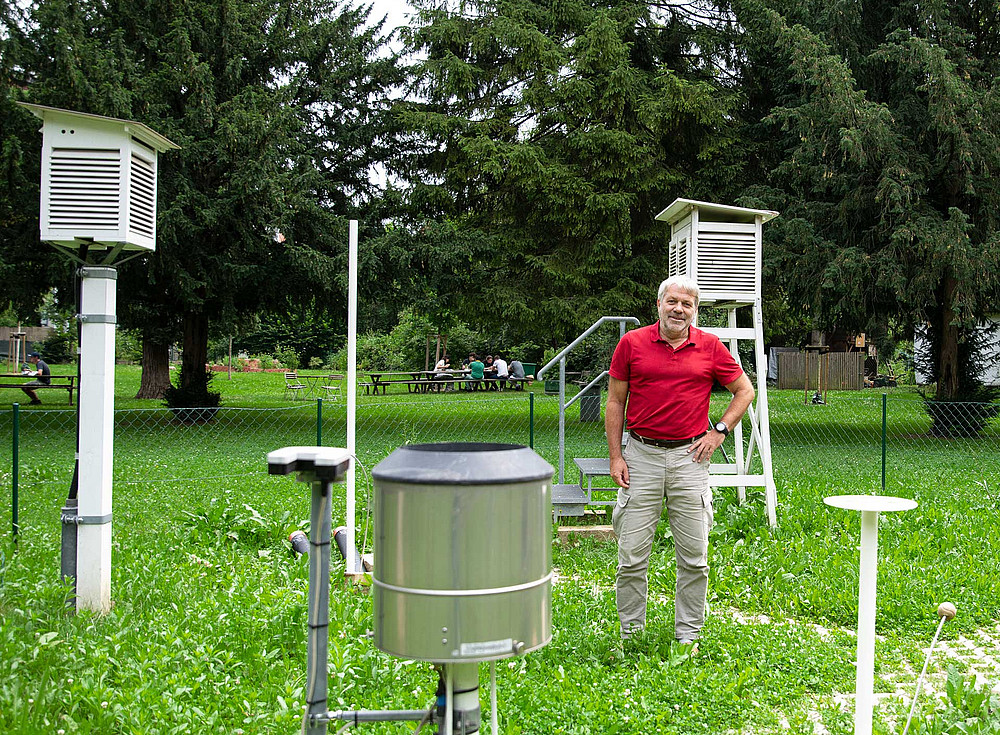
Ulrich Foelsche ©Uni Graz/Tzivanopoulos

Ulrich Foelsche from the Institute of Physics is the scientific director of the weather station at the University of Graz. Photo: Uni Graz/Tzivanopoulos

Anyone calling up the official weather for Graz ends up at the University of Graz. This is because the meteorological station, in cooperation with GeoSphere Austria, provides the current values for the provincial capital, which can be found on many media portals - including the footer of the University of Graz website.

Data for weather and climate studies has been collected on campus since 1891. Albeit at different locations. Until the Graz Center of Physics was completed, the station was moved from the meadow near the main building to near the Center for Molecular Biosciences. "It is on average 0.3 degrees Celsius cooler there," explains atmospheric physicist Ulrich Foelsche, scientific director of the station. This is why measurements were taken at both locations in parallel for a while.
Nonetheless, the temperature curve is continuously rising, as Foelsche confirms: "In the past 50 years, the average annual temperature has risen by two degrees to 12.2 degrees, and in summer by as much as three degrees. This means that we are now in a different climate zone."

In addition to temperature, humidity, air pressure, precipitation, wind speed and direction as well as sunshine duration are measured. The latter has increased by ten percent since the 1960s and is also fueling global warming because - an almost paradoxical situation - air quality has improved. "Less turbidity allows more sunlight through and leads to less cloud formation," explains Foelsche.
The station at the University of Graz was accepted as a Centennial Observing Station of the World Meteorological Organization, as the series of measurements go back more than 130 years. And even further back: the scientists are currently evaluating weather data recorded by a Graz family from 1780 and at the "Alte Uni" in Hofgasse from 1836.

Records in measurement history at the University of Graz

Even though summer arrived on June 19, 2024 with 33.6 degrees, the record was set in 2013 on July 29 and August 8 with 38.1 degrees.
The coldest days were minus 23.7 degrees on 24 January 1903 and 3 February 1929. The station recorded its wettest day to date on 30 July 2021, when it poured 113 liters per square meter.

► Learn more about the meteorological station
created by Andreas Schweiger

Related news

Complying with the norm: Why Do Standards Shape Our Lives, Elisabeth Staudegger?

Standards determine whether a sheet of paper fits in a printer or whether a charging plug can power multiple devices. These standards shape our everyday lives. But who actually sets these standards? Where are the weaknesses, and how could science help to improve them? Elisabeth Staudegger, Head of the ‘Law and IT’ Department at the Institute for Legal Foundations at the University of Graz, host the Academic Standards Day on 16 June. Here she relays how sciences can contribute to the topic of standardisation and reveals her personal favourite standard.

More body awareness than a culture war

In Italy, sex education lessons will in future only be permitted with parental consent, and will be banned entirely in nurseries and primary schools. At the same time, Pride Month highlights why knowledge about the body, relationships, boundaries and diversity is important for young people. A study by the University of Graz shows how important knowledge about the body, contraception, relationship skills and protection against violence is

Will Austria win the World Cup? Mathematician reveals calculation method

Michael Fischer uses the football tournament as a practical example for highschool lessons.

Survival strategies: How plants respond to drought

According to Geosphere Austria, this spring was the driest in Austria since records began around 170 years ago. The low rainfall put particular pressure on the agricultural sector. And climate change is set to make the situation even worse in the coming decades. We asked Johannes Liesche, a professor at the Department of Biology at the University of Graz, how plants react to water shortages and how they survive periods of drought.

Begin of page section:
Additional information:

University of Graz
Universitaetsplatz 3
8010 Graz
Austria
  • Contact
  • Web Editors
  • Moodle
  • UNIGRAZonline
  • Imprint
  • Data Protection Declaration
  • Accessibility Declaration
Weatherstation
Uni Graz

End of this page section. Go to overview of page sections

End of this page section. Go to overview of page sections

Begin of page section:

End of this page section. Go to overview of page sections


