Begin of page section:
Page sections:

  • Go to contents (Accesskey 1)
  • Go to position marker (Accesskey 2)
  • Go to main navigation (Accesskey 3)
  • Go to sub navigation (Accesskey 4)
  • Go to additional information (Accesskey 5)
  • Go to page settings (user/language) (Accesskey 8)
  • Go to search (Accesskey 9)

End of this page section. Go to overview of page sections

Begin of page section:
Page settings:

English en
Deutsch de
Search
Login

End of this page section. Go to overview of page sections

Begin of page section:
Search:

Search for details about Uni Graz
Close

End of this page section. Go to overview of page sections


Search

Begin of page section:
Main navigation:

Page navigation:

  • University

    University
    • About the University
    • Organisation
    • Faculties
    • Library
    • Working at University of Graz
    • Campus
    Developing solutions for the world of tomorrow - that is our mission. Our students and our researchers take on the great challenges of society and carry the knowledge out.
  • Research Profile

    Research Profile
    • Our Expertise
    • Research Questions
    • Research Portal
    • Promoting Research
    • Research Transfer
    • Ethics in Research
    Scientific excellence and the courage to break new ground. Research at the University of Graz creates the foundations for making the future worth living.
  • Studies

    Studies
    • Prospective Students
    • Students
  • Community

    Community
    • International
    • Location
    • Research and Business
    • Alumni
    The University of Graz is a hub for international research and brings together scientists and business experts. Moreover, it fosters the exchange and cooperation in study and teaching.
  • Spotlight
Topics
  • Our digital Advent calendar
  • Sustainable University
  • Researchers answer
  • Work for us
Close menu

End of this page section. Go to overview of page sections

Begin of page section:
You are here:

University of Graz News Sonnenstürme

End of this page section. Go to overview of page sections

Friday, 10 January 2014

Sonnenstürme

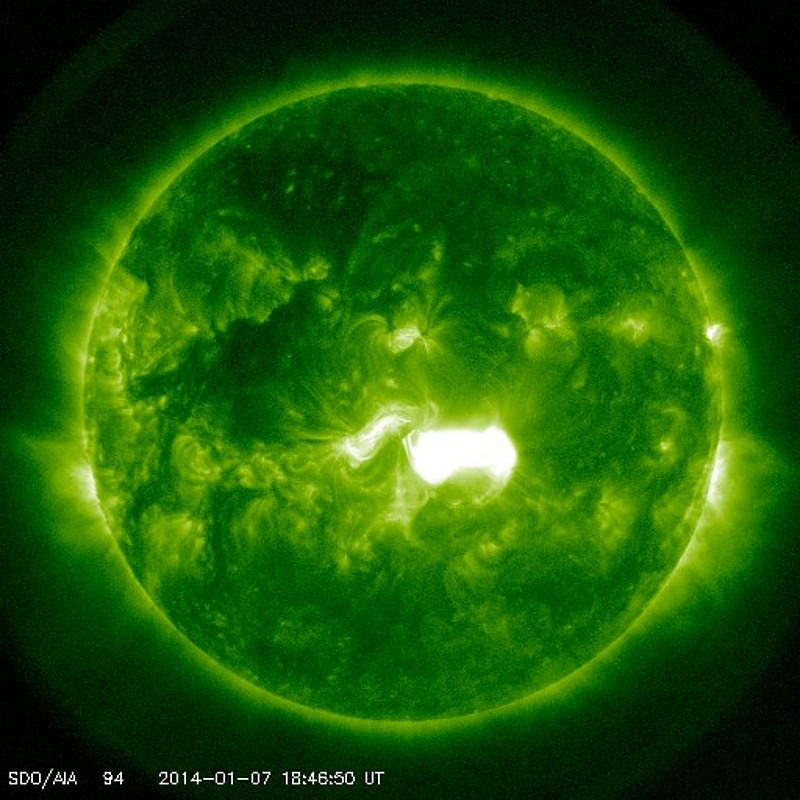
Die Sonne im Extremen UV bei 9.4 nm: Koronaler Massenauswurf, aufgenommen vom NASA Sonnensatelliten SDO am 7. Jänner 2014. Foto: NASA SDO

Die Sonne im Extremen UV bei 9.4 nm: Koronaler Massenauswurf, aufgenommen vom NASA Sonnensatelliten SDO am 7. Jänner 2014. Foto: NASA SDO

Neues internationales Forschungsprojekt mit federführender Beteiligung der Uni Graz soll die Vorhersage des Weltraumwetters verbessern

Eine Wetterkapriole im Weltraum macht aktuell Schlagzeilen. Am 7. Jänner 2014 um 19:30 Uhr MEZ beobachteten Observatorien, unter anderem jenes der Uni Graz auf der Kanzelhöhe in Kärnten, einen hochenergetischen Strahlungsblitz auf der Sonne. Dieser sogenannte Flare war mit koronalen Massenauswürfen verbunden, bei denen Plasma ins All geschleudert wurde. Der Schwall geladener Teilchen, als Sonnensturm bezeichnet, raste in der Folge durch den Weltraum. Seine Ausläufer erreichten am 9. Jänner die Erde, wo seine Auswirkungen allerdings schwächer ausfielen als erwartet. Sonnenstürme können nicht nur in hohen Breiten Polarlichter hervorrufen, sondern auch GPS-Signale stören, Stromausfälle verursachen oder dafür verantwortlich sein, dass Flüge, die über Polrouten geführt werden, einer erhöhten Strahlungsdosis ausgesetzt werden. Die Vorhersage des Weltraumwetters ist demnach von zunehmender Bedeutung.


Auf diesem Gebiet kommt der Karl-Franzens-Universität Graz mit dem Observatorium Kanzelhöhe für Sonnen- und Umweltforschung eine entscheidende Rolle zu. Es ist die Hauptstation für die Sonnenbeobachtung in Europa m Rahmen des Programms „Space Situational Awareness“ der Europäischen Weltraumbehörde ESA. Dort machen WissenschafterInnen Sonnenausbrüche mittels automatischer Bilderkennung in Echtzeit ausfindig und senden Warnmeldungen aus.

Aktuelle Informationen zum Weltraumwetter veröffentlicht das Observatorium Kanzelhöhe unter www.weltraumwetter.at


Neues Forschungsprojekt

Mit 13. Jänner 2014 startet ein weiteres internationales Projekt mit federführender Beteiligung der Uni Graz: „VarSITI (Variability of the Sun and Its Terrestrial Impact) soll zu einem besseren Verständnis der Physik der solar-terrestrischen Beziehung, sprich des Weltraumwetters und seiner Auswirkungen auf die Erde, führen“, erklärt Ass.-Prof. Dr. Manuela Temmer vom Institut für Physik der Karl-Franzens-Universität. Sie ist Ko-Leiterin des fünfjährigen Programms, an dem WissenschafterInnen aus aller Welt beteiligt sind. Um die Vorhersage des Weltraumwetters verbessern zu können, müssen die physikalischen Phänomene und Prozesse auf dem 150 Millionen Kilometer langen Weg der Teilchen von der Sonne zur Erde noch näher erforscht werden.

created by Gudrun Pichler

Related news

Chemical Christmas show at the University of Graz: An explosive evening at the Schauspielh

At the beginning of December, the University of Graz transformed the theater into a laboratory: as part of “Chemical Life,” teacher training students staged a chemical Christmas show for Styrian school classes—complete with ethanol rockets, nitrogen snow, and glowing effects. An evening designed to inspire interest in studying chemistry.

Train by train: Koralm railway accelerates exchange between the Universities

Lectures at the University of Klagenfurt in the morning, seminars at the University of Graz in the afternoon: Austria's longest tunnel and a journey time of around 45 minutes make it easy. The Koralm railway increases the speed of networking between the two university locations. The collaboration builds on existing cooperation - for example in the areas of teacher training, Slavic studies and as employers, the universities are well coordinated.

On the trail of the Big Bang: University of Graz receives 1.5 million euros for doctoral programmes

The Austrian Science Fund FWF has selected the Doctoral Programme in Theoretical Particle Physics at the University of Graz for funding from the Doc.funds. Six young scientists will be funded for 3.5 years. They will gain fundamentally new insights into the origins of the world.

From trans women and knee prostheses: sports science prizes awarded

Walking better with a prosthesis, successfully getting rid of excess weight, training more effectively, more fairness for trans people in sport: these were the topics addressed by the students at the University of Graz who were awarded the sports science prizes for their Master's theses on 3 December 2025.

Begin of page section:
Additional information:

University of Graz
Universitaetsplatz 3
8010 Graz
Austria
  • Contact
  • Web Editors
  • Moodle
  • UNIGRAZonline
  • Imprint
  • Data Protection Declaration
  • Accessibility Declaration
Weatherstation
Uni Graz

End of this page section. Go to overview of page sections

End of this page section. Go to overview of page sections

Begin of page section:

End of this page section. Go to overview of page sections