



Begin of page section:
Page sections:

  • Go to contents (Accesskey 1)
  • Go to position marker (Accesskey 2)
  • Go to main navigation (Accesskey 3)
  • Go to sub navigation (Accesskey 4)
  • Go to additional information (Accesskey 5)
  • Go to page settings (user/language) (Accesskey 8)
  • Go to search (Accesskey 9)

End of this page section. Go to overview of page sections

Begin of page section:
Page settings:

English en
Deutsch de
Search
Login

End of this page section. Go to overview of page sections

Begin of page section:
Search:

Search for details about Uni Graz
Close

End of this page section. Go to overview of page sections


Search

Begin of page section:
Main navigation:

Page navigation:

  • University

    University
    • About the University
    • Organisation
    • Faculties
    • Library
    • Working at University of Graz
    • Campus
    Developing solutions for the world of tomorrow - that is our mission. Our students and our researchers take on the great challenges of society and carry the knowledge out.
  • Research Profile

    Research Profile
    • Our Expertise
    • Research Questions
    • Research Portal
    • Promoting Research
    • Research Transfer
    • Ethics in Research
    • Commission for Scientific Integrity
    Scientific excellence and the courage to break new ground. Research at the University of Graz creates the foundations for making the future worth living.
  • Studies

    Studies
    • Prospective Students
    • Students
    • Post-registration Law
  • Community

    Community
    • International
    • Location
    • Research and Business
    • Alumni
    The University of Graz is a hub for international research and brings together scientists and business experts. Moreover, it fosters the exchange and cooperation in study and teaching.
Topics
  • Sustainable University
  • Researchers answer
  • Work for us
Close menu

End of this page section. Go to overview of page sections

Begin of page section:
You are here:

University of Graz News Smartphone statt Pilgerstab

End of this page section. Go to overview of page sections

Monday, 13 October 2014

Smartphone statt Pilgerstab

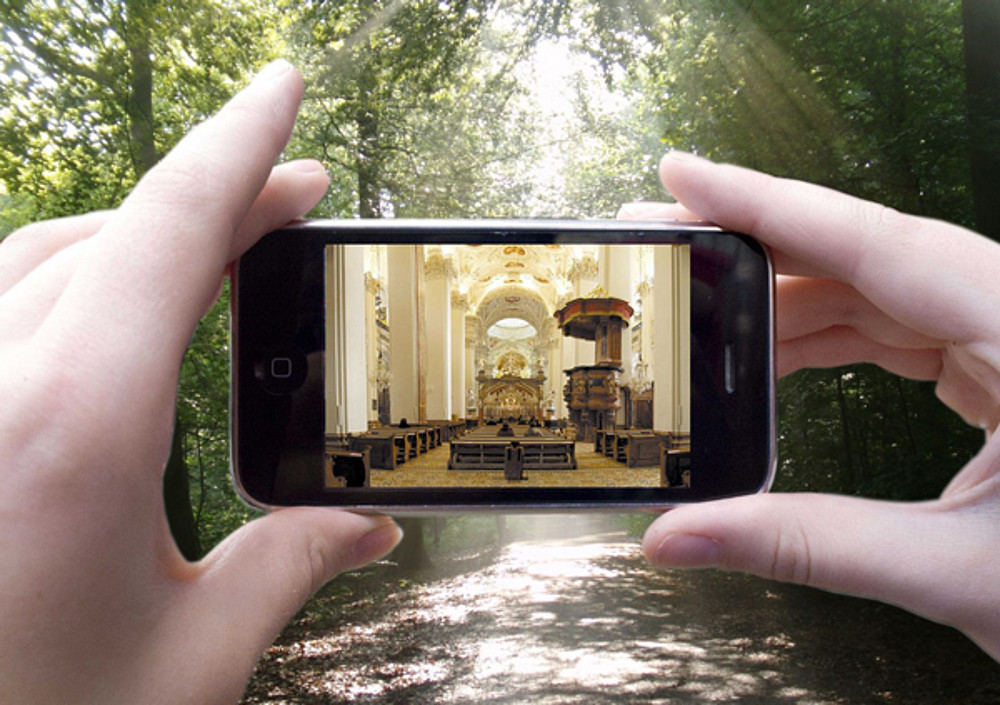
Pilgern 2.0: Das Smartphone hat auch den Wallfahrts-Tourismus erreicht. WissenschafterInnen der Uni Graz untersuchen dieses Phänomen. Foto: Pilgrimage Europe SI-

Pilgern 2.0: Das Smartphone hat auch den Wallfahrts-Tourismus erreicht. WissenschafterInnen der Uni Graz untersuchen dieses Phänomen. Foto: Pilgrimage Europe SI-AT

ForscherInnen der Uni Graz zeigen neue Wallfahrt-Trends auf

Neue Motive des Wallfahrens haben sich in den letzten Jahrzehnten etabliert: Anstelle von Buße und der Heilung von Krankheiten sind Selbstfindung und Entschleunigung die Schlagworte. Traditionelle Pilgerwege verlieren zusehends ihre Wirkung, neue Formen werden gesucht und konstruiert. „Pilgern ist nicht mehr nur auf Fußwegen möglich. Im Laufe der Jahrzehnte haben sich Wallfahrten per Motorrad, Auto, Bus, Zug, Fahrrad, Flugzeug oder gar Pferd gebildet“, sagt Ao.Univ.-Prof. Dr. Helmut Eberhart vom Institut für Volkskunde und Kulturanthropologie an der Universität Graz. Im Rahmen des EU-Projektes „PILGRIMAGE EUROPE SI-AT“ untersuchte der Forscher gemeinsam mit einer Gruppe von Studierenden steirische Pilgerwege auf deren touristische Herausforderungen. Die Ergebnisse der Forschungsarbeit im Rahmen des universitären Schwerpunkts Kultur- und Deutungsgeschichte Europas flossen auch in eine eigene App „Kirche unterwegs“ ein.

Wallfahrts-Boom
Organisierte Wallfahrten erlebten in den vergangenen zehn Jahren einen regelrechten Boom. Um möglichst viele Menschen zu erreichen, werden auch traditionelle Routen wiederbelebt und neue werden geschaffen. „Der Wallfahrtsort, das eigentliche Ziel einer Pilgerreise, steht nicht mehr im Vordergrund, sondern der Weg dorthin mit all seinen Begleiterscheinungen ist von Interesse“, weiß Eberhart. Und so haben TouristikerInnen längst erkannt, das Angebot an spirituellen Reisen auszuweiten. Bei der derzeit laufenden Neukonzeption von Pilgerwegen nach Mariazell war es der Wunsch vieler Gemeinden, dass die Routen auch ihr Gebiet passieren, um möglichst Anteil an diesem Boom zu haben. Die Gemeinden würden jedenfalls von den PilgerInnen profitieren, betont der Volkskundler. 

Wissen für App
Im Jahr 2012 trat die katholische Kirche Steiermark an Eberhart mit einem Auftrag heran: Er sollte Sakraldenkmäler, wie etwa Bildstöcke und Kirchen, entlang zweier neugeschaffener Pilgerwege von Slowenien nach Mariazell erfassen sowie Legenden und Geschichten rund um die Stätten recherchieren. Das Wissen, welches die ForscherInnen im Rahmen des Projektes gewonnen haben, wurde dann in die App „Kirche unterwegs“ eingearbeitet und begleitet die Reisenden auf ihrem Weg zur Begegnung mit Gott und sich selbst.


Helmut Eberhart im Beitrag "Rendezvous mit Gott" im Webradio der Grazer Universitäten

created by Konstantinos Tzivanopoulos

Related news

The future of Styria as a knowledge region is at risk

It is reported that 500 million euros are to be cut from Styrian universities. University vice-chancellors fear that this will sacrifice the development and competitiveness of the region as a centre for science, culture and business in favour of short-term cost-cutting targets.

A good winter for honeybees: mortality rate in Austria below ten per cent

20 May is World Bee Day. Local beekeepers can celebrate it with confidence this year, as their colonies have come through the winter relatively well.

Whistles against division: Rivka Saltiel experienced both unrest and solidarity in the US

Rivka Saltiel, a geographer from the University of Graz, has been working as a visiting professor in Minneapolis for the past five months and has witnessed first-hand the state of emergency and the deadly raids carried out by the immigration agency ICE. She reports on the collective solidarity of the population, the resistance to the President’s attempts to divide the community, and the power of informal social networks that ensure day-to-day provision and safety. These practices of solidarity are also relevant for Europe.

Record of reported species: Styria wins the global City Nature Challenge

Observers in Styria recorded 5,158 different animals, plants and fungi as part of the international City Nature Challenge between 24 and 27 April 2026. This saw the region take first place in the "species" category. Ostrava in the Czech Republic made the most observations, with just under 140,000, whilst the San Francisco Bay Area had the highest number of participants, namely 3,019.

Begin of page section:
Additional information:

University of Graz
Universitaetsplatz 3
8010 Graz
Austria
  • Contact
  • Web Editors
  • Moodle
  • UNIGRAZonline
  • Imprint
  • Data Protection Declaration
  • Accessibility Declaration
Weatherstation
Uni Graz

End of this page section. Go to overview of page sections

End of this page section. Go to overview of page sections

Begin of page section:

End of this page section. Go to overview of page sections