



Begin of page section:
Page sections:

  • Go to contents (Accesskey 1)
  • Go to position marker (Accesskey 2)
  • Go to main navigation (Accesskey 3)
  • Go to sub navigation (Accesskey 4)
  • Go to additional information (Accesskey 5)
  • Go to page settings (user/language) (Accesskey 8)
  • Go to search (Accesskey 9)

End of this page section. Go to overview of page sections

Begin of page section:
Page settings:

English en
Deutsch de
Search
Login

End of this page section. Go to overview of page sections

Begin of page section:
Search:

Search for details about Uni Graz
Close

End of this page section. Go to overview of page sections


Search

Begin of page section:
Main navigation:

Page navigation:

  • University

    University
    • About the University
    • Organisation
    • Faculties
    • Library
    • Working at University of Graz
    • Campus
    Developing solutions for the world of tomorrow - that is our mission. Our students and our researchers take on the great challenges of society and carry the knowledge out.
  • Research Profile

    Research Profile
    • Our Expertise
    • Research Questions
    • Research Portal
    • Promoting Research
    • Research Transfer
    • Ethics in Research
    • Commission for Scientific Integrity
    Scientific excellence and the courage to break new ground. Research at the University of Graz creates the foundations for making the future worth living.
  • Studies

    Studies
    • Prospective Students
    • Students
  • Community

    Community
    • International
    • Location
    • Research and Business
    • Alumni
    The University of Graz is a hub for international research and brings together scientists and business experts. Moreover, it fosters the exchange and cooperation in study and teaching.
  • Spotlight
Topics
  • Sustainable University
  • Researchers answer
  • Work for us
Close menu

End of this page section. Go to overview of page sections

Begin of page section:
You are here:

University of Graz News Sieg im Bundesfinale

End of this page section. Go to overview of page sections

Friday, 22 June 2018

Sieg im Bundesfinale

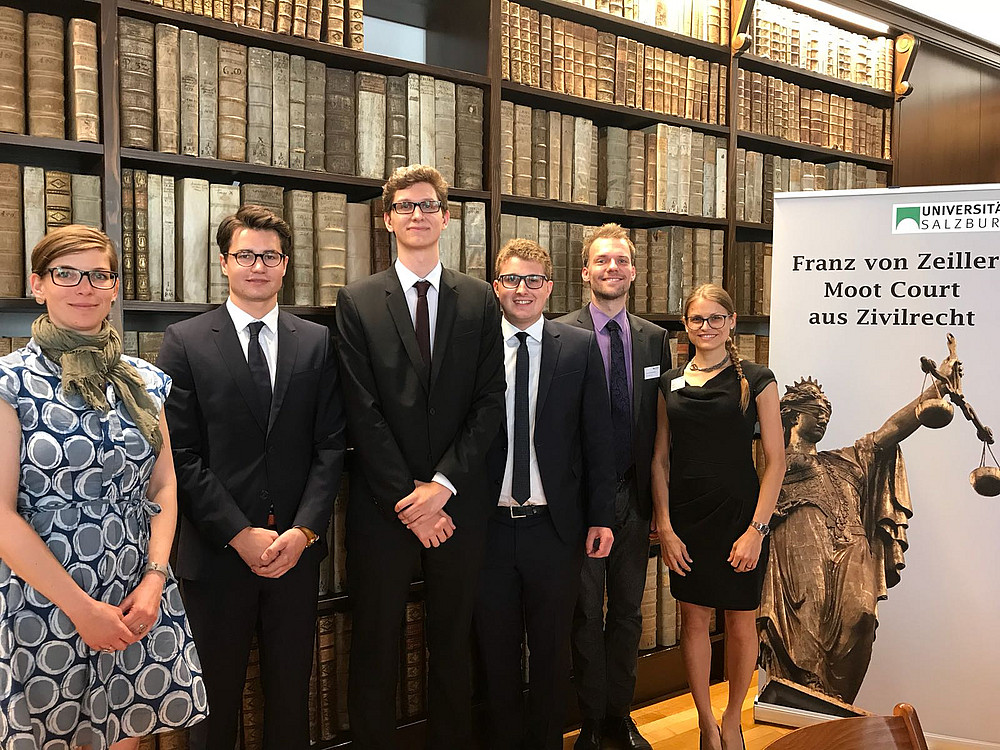
Das erfolgreiche Grazer Team mit seinen Betreuern (v.l.n.r.) : Ingrid Tscherner (LG für Zivilrechtssachen Graz), Philipp Friedl, Nikolas Raunigg, Martin Sonvilla, Philipp Anzenberger (Institut für Zivilverfahrensrecht), Marie-Therese Fritzer (Institut für Zivilrecht); Foto: privat

Das erfolgreiche Grazer Team mit seinen Betreuern (v.l.n.r.) : Ingrid Tscherner (LG für Zivilrechtssachen Graz), Philipp Friedl, Nikolas Raunigg, Martin Sonvilla, Philipp Anzenberger (Institut für Zivilverfahrensrecht), Marie-Therese Fritzer (Institut für Zivilrecht); Foto: privat

Studierendenteam der REWI-Fakultät gewinnt "Franz von Zeiller-Moot Court aus Zivilrecht"

Über den Tellerrand hinausblicken, ist eine weit verbreitete Devise. Die Universität Graz bietet ihren Studierenden die Möglichkeit im Rahmen ihres Studiums ihr Wissen zu erweitern und Erfahrungen zu sammeln. An der Rechtswissenschaftlichen Fakultät sieht das in etwa so aus: Nachwuchs-JuristInnen treten in einem simulierten Prozess gegeneinander an. Dazu wurde im Vorjahr ein eigener Übungsraum - Moot-Court-Raum - an der Universität Graz eröffnet. 

Am Institut für Zivilverfahrensrecht bilden immer wieder Studierende der Rechtswissenschaften eigene Teams und treten in nationalen Bewerben an. Am 15. Juni 2018 fand in Salzburg bereits zum 15. Mal das Bundesfinale des „Franz von Zeiller-Moot Court aus Zivilrecht“ statt. Dabei konnte sich das Grazer Studierendenteam bestehend aus Philipp Friedl, Nikolas Raunigg und Martin Sonvilla mit einer überragenden Leistung gegen das stark besetzte Teilnehmerfeld (vertreten waren Teams der Universitäten Wien, Linz, Salzburg und Innsbruck) durchsetzen und erlangten den ersten Platz.Betreut wurden die Studierenden dabei von Lehrveranstaltungsleiter Philipp Anzenberger, Marie-Therese Fritzer, Ingrid Tscherner (Landesgericht für Zivilrechtssachen Graz) und der Kanzlei Scherbaum-Seebacher.

Der Moot Court ist einer der größten und wichtigsten Wettbewerbe für Studierende der Rechtswissenschaften. Setting des Bundesfinales ist ein Zivilprozess dritter Instanz (also vor dem Obersten Gerichtshof), wo die Teams in die Rolle von AnwältInnen schlüpfen und eine der Prozessparteien vertreten. Die Fälle sind dabei aus dem Leben gegriffen: Ihnen liegen im Wesentlichen reale Berufungsurteile zugrunde, die von den Studierendenteams vor dem RichterInnensenat bekämpft (oder verteidigt) werden.  

created by Philipp Anzenberger & Philipp Friedl & Konstantinos Tzivanopoulos

Related news

Career Booster: How the Research Careers Campus supports researchers

They are innovative, creative and productive – researchers who have not yet been appointed to a professorship make a massive contribution to a university’s research output. To provide them with even better support on their career path, the University of Graz has established the Research Careers Campus. The official launch took place on 22 April 2026 with a ‘festival’.

Greenery on the rise: over 500 new flowers, perennials and shrubs on campus

Bright blooms and fresh greenery make our hearts beat faster in spring. But it is not just us humans who delight in this colourful growth. For many animals, this splendour provides, above all, food and habitat. There has recently been an increase in this on the University of Graz campus. More than 500 native flowers, perennials and shrubs have been planted on strips of fallow land around Universitätsplatz 2.

Building biological bridges: Chemist discovers an ecological tool for the pharmaceutical industry

Building a relationship on a solid foundation is also important in chemistry. To produce medicines, disinfectants or plant protection products, stable bonds between carbon atoms must be formed. Conventional chemical methods rely on environmentally harmful reagents and solvents to carry out the desired reaction. This process also produces unusable by-products. Chemist Lilla Gal has discovered an enzyme that enables the same process to take place efficiently and sustainably. The results of her research were recently published in the prestigious journal Angewandte Chemie.

Higher Education Strategy 2040: Austria’s universities on course for the future

Austria has 77 higher education institutions, which is above the EU average – but does this really make sense? The new Higher Education Strategy 2040 focuses on cooperation rather than mergers. As one of the six largest universities in Austria, the University of Graz plays a central role in this.

Begin of page section:
Additional information:

University of Graz
Universitaetsplatz 3
8010 Graz
Austria
  • Contact
  • Web Editors
  • Moodle
  • UNIGRAZonline
  • Imprint
  • Data Protection Declaration
  • Accessibility Declaration
Weatherstation
Uni Graz

End of this page section. Go to overview of page sections

End of this page section. Go to overview of page sections

Begin of page section:

End of this page section. Go to overview of page sections


