Begin of page section:
Page sections:

  • Go to contents (Accesskey 1)
  • Go to position marker (Accesskey 2)
  • Go to main navigation (Accesskey 3)
  • Go to sub navigation (Accesskey 4)
  • Go to additional information (Accesskey 5)
  • Go to page settings (user/language) (Accesskey 8)
  • Go to search (Accesskey 9)

End of this page section. Go to overview of page sections

Begin of page section:
Page settings:

English en
Deutsch de
Search
Login

End of this page section. Go to overview of page sections

Begin of page section:
Search:

Search for details about Uni Graz
Close

End of this page section. Go to overview of page sections


Search

Begin of page section:
Main navigation:

Page navigation:

  • University

    University
    • About the University
    • Organisation
    • Faculties
    • Library
    • Working at University of Graz
    • Campus
    Developing solutions for the world of tomorrow - that is our mission. Our students and our researchers take on the great challenges of society and carry the knowledge out.
  • Research Profile

    Research Profile
    • Our Expertise
    • Research Questions
    • Research Portal
    • Promoting Research
    • Research Transfer
    • Ethics in Research
    • Commission for Scientific Integrity
    Scientific excellence and the courage to break new ground. Research at the University of Graz creates the foundations for making the future worth living.
  • Studies

    Studies
    • Prospective Students
    • Students
    • Registration for Study Programme (Winter semester 2026/27)
  • Community

    Community
    • International
    • Location
    • Research and Business
    • Alumni
    The University of Graz is a hub for international research and brings together scientists and business experts. Moreover, it fosters the exchange and cooperation in study and teaching.
Topics
  • Sustainable University
  • Researchers answer
  • Work for us
Close menu

End of this page section. Go to overview of page sections

Begin of page section:
You are here:

University of Graz News 7 Universitäten

End of this page section. Go to overview of page sections

Wednesday, 26 June 2019

7 Universitäten

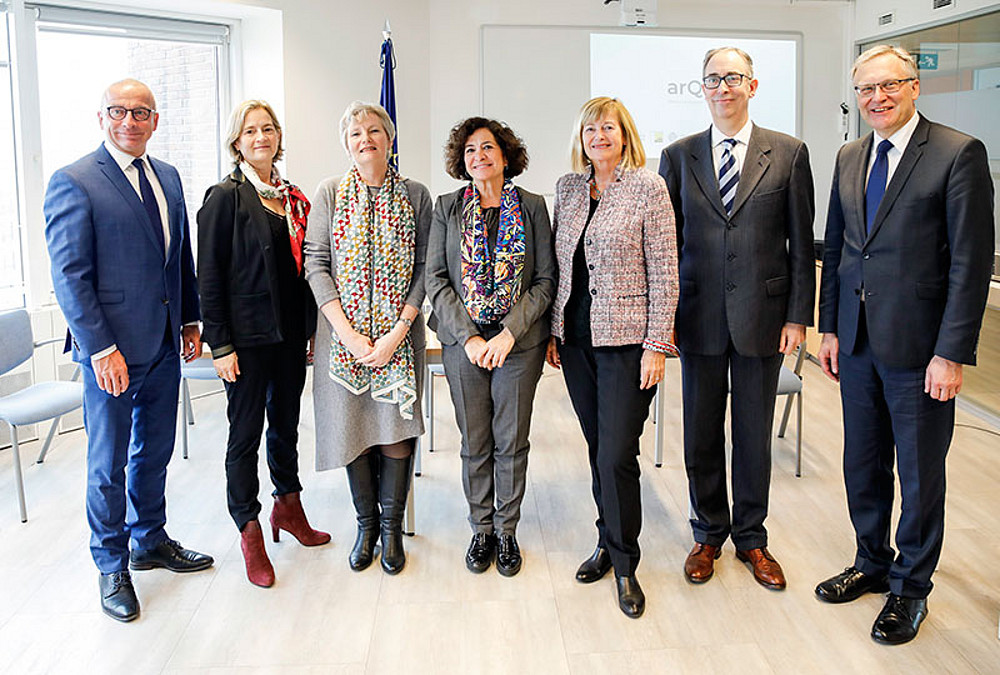
RektorInnen, VizerektorInnen und VertreterInnen des Konsortiums (v.l.): Svend Poller (Leipzig), Michèle Cottier (Lyon), Dorothy Kelly (Granada), María Pilar Aranda Ramírez (Granada), Christa Neuper (Graz), Alessandro Paccagnella (Padua), Arturas Žukauskas (Vilnius). Foto: © EFE/Elio Germani. ©© EFE/Elio Germani 2018

RektorInnen, VizerektorInnen und VertreterInnen des Konsortiums (v.l.): Svend Poller (Leipzig), Michèle Cottier (Lyon), Dorothy Kelly (Granada), María Pilar Aranda Ramírez (Granada), Christa Neuper (Graz), Alessandro Paccagnella (Padua), Arturas Žukauskas (Vilnius). Foto: © EFE/Elio Germani.

... schaffen neuen europäischen Hochschulraum: EU fördert Arqus-Allianz mit fünf Millionen Euro

Die Universität Graz hat zusammen mit sechs europäischen Universitäten Ende des Vorjahres die Allianz Arqus ins Leben gerufen, um einen gemeinsamen Hochschulraum ohne Schranken, mit intensiverer wissenschaftlicher Zusammenarbeit und verstärktem globalen Engagement zu schaffen. Die Initiative feiert heute, 26. Juni 2019, einen großen Erfolg: Die Europäische Kommission fördert Arqus als eines von 17 Allianzen bei insgesamt 54 Einreichungen mit einer maximalen Summe von fünf Millionen Euro. Insgesamt beträgt die Förderungssumme der EU 85 Millionen Euro für die 17 Allianzen. Zwei österreichische Universitäten, die Universität Graz und die BOKU Wien, sind Mitglieder in bewilligten Allianzen dieser Pilotphase.

In Zukunft werden die Universitäten Granada (Spanien), Bergen (Norwegen), Graz (Österreich), Leipzig (Deutschland), Lyon (Frankreich), Padua (Italien) und Vilnius (Litauen) also noch enger und umfassender zusammenarbeiten als bisher. Einen besonderen Schwerpunkt werden die Universitäten künftig auf innovatives Lehren und Lernen, Mehrsprachigkeit und starkes regionales Engagement legen.

Rektorin Christa Neuper freut sich über die Förderung der Arqus-Allianz: „Die Universität Graz sieht es als ihre Aufgabe, sich mit zentralen gesellschaftlichen Themen wissenschaftlich auseinanderzusetzen, Lösungswege aufzuzeigen und die Entwicklung ihrer Studierenden zu kritisch denkenden Persönlichkeiten zu fördern. Die Finanzierung der Arqus-Allianz eröffnet den Partner-Universitäten nun die Möglichkeit, schrankenlose Mobilität und internationale Forschungskooperationen auf höchstem Niveau umzusetzen sowie die Qualität in Lehre und Management anhand von Best-Practice-Beispielen kontinuierlich weiterzuentwickeln.“

Mehr zur Arqus-Allianz:
Die sieben Gründungsmitglieder – die Universitäten Granada, Bergen, Graz, Leipzig, Lyon, Padua und Vilnius – vereinen knapp 310.000 Studierende und 40.000 MitarbeiterInnen. Jede dieser Hochschulen ist nicht nur führend an europäischen Projekten und Internationalisierungsprozessen beteiligt, sondern spielt auch eine wichtige Rolle bei der regionalen Entwicklung an ihren jeweiligen Standorten. Der Name der Allianz leitet sich vom polysemischen lateinischen Begriff arcus/arquus für Bogen ab und veranschaulicht die starken Fundamente, die das Konsortium legen möchte, um Brücken in eine gemeinsame Zukunft zu bauen.

 

created by Gerhild Leljak

Related news

Complying with the norm: Why Do Standards Shape Our Lives, Elisabeth Staudegger?

Standards determine whether a sheet of paper fits in a printer or whether a charging plug can power multiple devices. These standards shape our everyday lives. But who actually sets these standards? Where are the weaknesses, and how could science help to improve them? Elisabeth Staudegger, Head of the ‘Law and IT’ Department at the Institute for Legal Foundations at the University of Graz, host the Academic Standards Day on 16 June. Here she relays how sciences can contribute to the topic of standardisation and reveals her personal favourite standard.

More body awareness than a culture war

In Italy, sex education lessons will in future only be permitted with parental consent, and will be banned entirely in nurseries and primary schools. At the same time, Pride Month highlights why knowledge about the body, relationships, boundaries and diversity is important for young people. A study by the University of Graz shows how important knowledge about the body, contraception, relationship skills and protection against violence is

Will Austria win the World Cup? Mathematician reveals calculation method

Michael Fischer uses the football tournament as a practical example for highschool lessons.

Survival strategies: How plants respond to drought

According to Geosphere Austria, this spring was the driest in Austria since records began around 170 years ago. The low rainfall put particular pressure on the agricultural sector. And climate change is set to make the situation even worse in the coming decades. We asked Johannes Liesche, a professor at the Department of Biology at the University of Graz, how plants react to water shortages and how they survive periods of drought.

Begin of page section:
Additional information:

University of Graz
Universitaetsplatz 3
8010 Graz
Austria
  • Contact
  • Web Editors
  • Moodle
  • UNIGRAZonline
  • Imprint
  • Data Protection Declaration
  • Accessibility Declaration
Weatherstation
Uni Graz

End of this page section. Go to overview of page sections

End of this page section. Go to overview of page sections

Begin of page section:

End of this page section. Go to overview of page sections