Begin of page section:
Page sections:

  • Go to contents (Accesskey 1)
  • Go to position marker (Accesskey 2)
  • Go to main navigation (Accesskey 3)
  • Go to sub navigation (Accesskey 4)
  • Go to additional information (Accesskey 5)
  • Go to page settings (user/language) (Accesskey 8)
  • Go to search (Accesskey 9)

End of this page section. Go to overview of page sections

Begin of page section:
Page settings:

English en
Deutsch de
Search
Login

End of this page section. Go to overview of page sections

Begin of page section:
Search:

Search for details about Uni Graz
Close

End of this page section. Go to overview of page sections


Search

Begin of page section:
Main navigation:

Page navigation:

  • University

    University
    • About the University
    • Organisation
    • Faculties
    • Library
    • Working at University of Graz
    • Campus
    Developing solutions for the world of tomorrow - that is our mission. Our students and our researchers take on the great challenges of society and carry the knowledge out.
  • Research Profile

    Research Profile
    • Our Expertise
    • Research Questions
    • Research Portal
    • Promoting Research
    • Research Transfer
    • Ethics in Research
    Scientific excellence and the courage to break new ground. Research at the University of Graz creates the foundations for making the future worth living.
  • Studies

    Studies
    • Prospective Students
    • Students
  • Community

    Community
    • International
    • Location
    • Research and Business
    • Alumni
    The University of Graz is a hub for international research and brings together scientists and business experts. Moreover, it fosters the exchange and cooperation in study and teaching.
  • Spotlight
Topics
  • Sustainable University
  • Researchers answer
  • Work for us
Close menu

End of this page section. Go to overview of page sections

Begin of page section:
You are here:

University of Graz News Short but powerful: PhD students present their research in the 3 Minute Thesis Competition

End of this page section. Go to overview of page sections

Friday, 22 March 2024

Short but powerful: PhD students present their research in the 3 Minute Thesis Competition

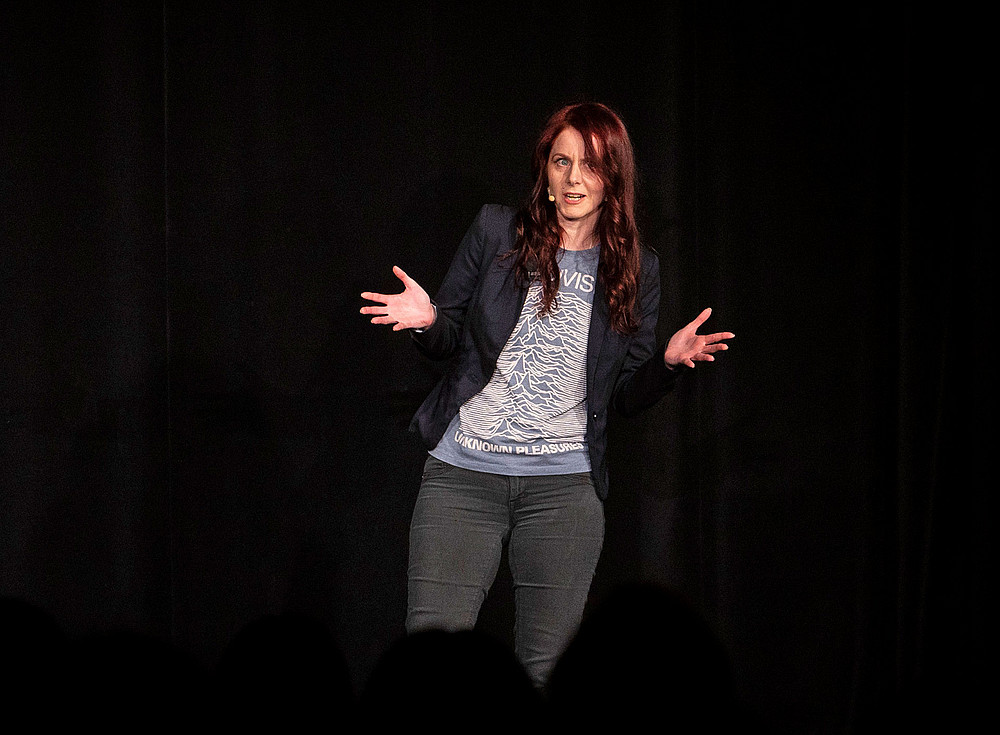
Silvia Lasnik, hands open, speaking, in front of a black background ©Uni Graz/Angele

Silvia Lasnik won the 3MT Graz 2024, according to the jury decision. Photo: Uni Graz/Angele

Brevity is the soul of wit - a saying that was confirmed at the Three Minute Thesis Competition (3MT) on 15 March 2024. Eleven doctoral students from the University of Graz took part in the event organised by the Doctoral Academy as part of an international competition. The task: to present their own research in English in three minutes in an understandable and exciting way for an audience from outside the field. Allowed: a single PowerPoint slide and a lot of creativity. All participants demonstrated this on stage at the Literaturhaus Graz.

Why is "native speakerism" a dangerous dragon?
Who is the best person to teach a foreign language? Someone who learnt it as the first language? "Not necessarily," says English specialist Silvia Lasnik. "We have to slay the dragon of native speakerism." She impressed the jury with the vivid picture she painted in her presentation. They chose her as the winner of the 3MT Graz 2024. "Pedagogical and didactic skills are just as important as language skills," emphasises Lasnik. In her doctoral thesis, supervised by Hermine Penz, she is investigating how the dragon paralyses teachers. "If they are afraid to speak in a foreign language because they don't think they know it well enough, then this has a negative effect on their teaching," says the doctoral student. "Especially with English, which is used worldwide as a bridge language, communicative competence should come first, before grammar and accent." This needs to be taught as early as the teacher training programme. Because future teachers should be able to emphasise speaking over reading and writing when designing their own lessons.

How do protein communication errors cause cancer?
In her doctoral thesis at the Institute of Pharmaceutical Sciences, Sarah Masser is uncovering mechanisms of cancer growth. With a captivating presentation on stage, she wowed her viewers and listeners, who rewarded her with the 3MT People's Choice Award 2024. "Abnormal protein-protein interactions (PPIs) and post-translational modifications (PTMs) play a role in the development of malignant tumours. They can activate cancer genes or deactivate tumor suppressing genes. Malfunctions in cell metabolism can also be a consequence," says Masser. As a member of Ulrich Stelzl's research group in Pharmaceutical Chemistry, Masser is investigating the communication of two enzyme groups that switch signalling pathways of cell metabolism on and off. She is thus contributing to a better understanding of the molecular mechanisms of cancer. "New findings should make it possible to treat different types of cancer in a more targeted manner. This would lead to more effective and less toxic therapies," the doctoral student explains.

The 3MT Competition is organised annually by the Coimbra Group, an association of particularly renowned and traditional European universities. An international jury will now select three winners from the regional competitions for the final in Turku/Finland on 6 June 2024. The University of Graz is keeping its fingers crossed for Silvia Lasnik.

More information on 3MT

created by Gudrun Pichler

Related news

Diversity buddies at the University of Graz: Support on equal terms

The University of Graz is strengthening its commitment to equal opportunities with its new Diversity Buddies. University members can find easily accessible contact persons here for questions relating to equality and diversity. All employees can get involved and take action.

When parents find it difficult to have a say

In her dissertation, translation scholar Marie Tschurtschenthaler examines how communication between compulsory schools and parents whose first language is not German works – and what role professional language mediation plays in this. Initial insights show that it is not just about language, but also about resources, responsibilities and the institutional framework.

AI in schools: Maria Bertel drafts legal guidelines for teachers

The legal expert and her team analysed the legal situation regarding the use of artificial intelligence in education as part of an EU project and answered open questions from practice.

Cosmetics in the environment: University of Graz proves danger to ants

Titanium dioxide, which is found in cosmetics, for example, is increasingly entering the environment in the form of nanoparticles. This could also put insects at risk. If ants ingest the substance in combination with the pesticide glyphosate, it disturbs the development of their offspring. Scientists at the University of Graz are drawing attention to the negative consequences of this toxic cocktail.

Begin of page section:
Additional information:

University of Graz
Universitaetsplatz 3
8010 Graz
Austria
  • Contact
  • Web Editors
  • Moodle
  • UNIGRAZonline
  • Imprint
  • Data Protection Declaration
  • Accessibility Declaration
Weatherstation
Uni Graz

End of this page section. Go to overview of page sections

End of this page section. Go to overview of page sections

Begin of page section:

End of this page section. Go to overview of page sections