Begin of page section:
Page sections:

  • Go to contents (Accesskey 1)
  • Go to position marker (Accesskey 2)
  • Go to main navigation (Accesskey 3)
  • Go to sub navigation (Accesskey 4)
  • Go to additional information (Accesskey 5)
  • Go to page settings (user/language) (Accesskey 8)
  • Go to search (Accesskey 9)

End of this page section. Go to overview of page sections

Begin of page section:
Page settings:

English en
Deutsch de
Search
Login

End of this page section. Go to overview of page sections

Begin of page section:
Search:

Search for details about Uni Graz
Close

End of this page section. Go to overview of page sections


Search

Begin of page section:
Main navigation:

Page navigation:

  • University

    University
    • About the University
    • Organisation
    • Faculties
    • Library
    • Working at University of Graz
    • Campus
    Developing solutions for the world of tomorrow - that is our mission. Our students and our researchers take on the great challenges of society and carry the knowledge out.
  • Research Profile

    Research Profile
    • Our Expertise
    • Research Questions
    • Research Portal
    • Promoting Research
    • Research Transfer
    • Ethics in Research
    Scientific excellence and the courage to break new ground. Research at the University of Graz creates the foundations for making the future worth living.
  • Studies

    Studies
    • Prospective Students
    • Students
  • Community

    Community
    • International
    • Location
    • Research and Business
    • Alumni
    The University of Graz is a hub for international research and brings together scientists and business experts. Moreover, it fosters the exchange and cooperation in study and teaching.
  • Spotlight
Topics
  • Our digital Advent calendar
  • Sustainable University
  • Researchers answer
  • Work for us
Close menu

End of this page section. Go to overview of page sections

Begin of page section:
You are here:

University of Graz News Setback: Austria's greenhouse gas emissions rise in 2025

End of this page section. Go to overview of page sections

Friday, 19 December 2025

Setback: Austria's greenhouse gas emissions rise in 2025

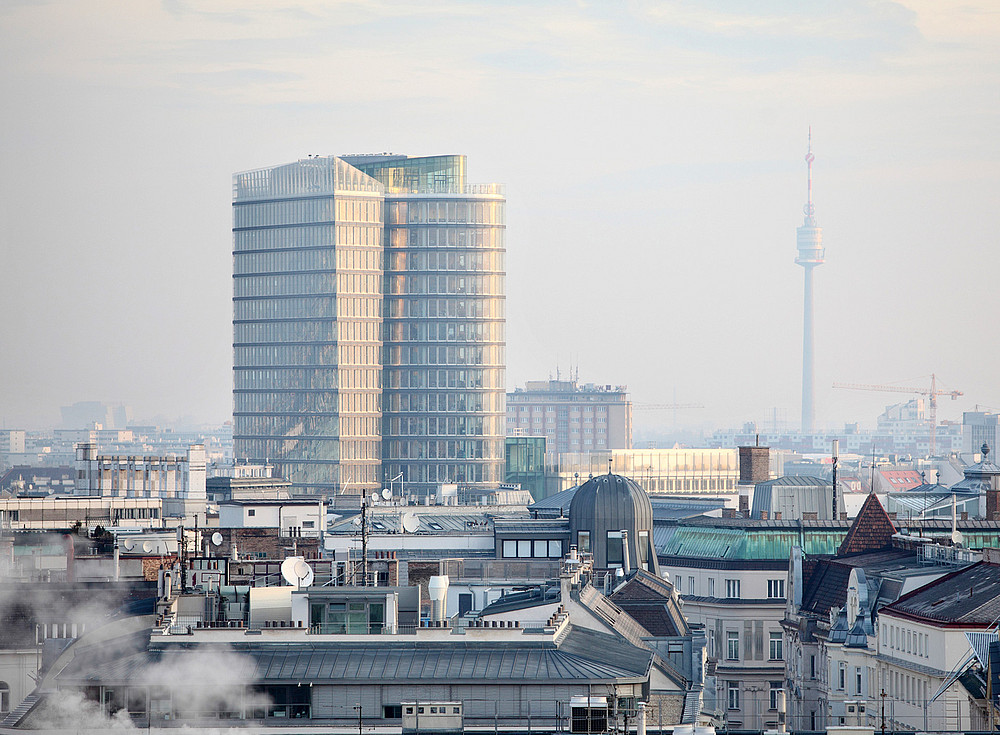
View from above of Vienna with the UNIQA Tower and the Danube Tower, haze in the air, some smoke in the foreground ©Losevsky Pavel - stock.adobe.com

According to calculations by researchers at the University of Graz, Austria's greenhouse gas emissions in 2025 will be around 2.5 per cent higher than in the previous year. Photo: Pavel Losevsky - stock.adobe.com

Climate protection is currently facing an uphill battle. The United Nations have recently been unable to agree on a roadmap for phasing out fossil fuels, even though global warming continues to accelerate. Also Austria still does not have a national climate law with a clear target path for reducing emissions. This is evidently taking its toll: Austria’s greenhouse gas emissions rose again in 2025 for the first time in years, by around two and a half percent, according to calculations by researchers at the University of Graz. In addition to overly cautious climate action measures, this is due to somewhat colder winter months compared to 2024, which are driving up natural gas consumption.


Climate researchers Gottfried Kirchengast and Stefan Schleicher from the Wegener Center at the University of Graz have produced a prediction of Austrian greenhouse gas emissions in 2025 based on data available up to October 2025, including data for natural gas and petroleum products, among others. “According to our results the emissions, measured in million tons of CO2 equivalent, will be around 2.5 percent higher this year than last year. This corresponds to an increase of 1.7 million tons and essentially negates the reduction achieved in 2024 compared to 2023,” reports Kirchengast. The estimated uncertainty of the prediction is plus/minus two percent.

“The main reasons for the increase are the slowing pace in the expansion of renewable energies and in the reduction of transport emissions, as well as cooler winter months leading to more heating degree days, which further increase natural gas consumption,” explains the researcher, adding: “Particularly worrying is the increase of Austria’s share in international aviation emissions, which we computed as a complementary result. They rose to over six million tons of CO₂ equivalent in 2025. This amount now corresponds to one third of the emissions of the entire Austrian transport sector on the ground.”

The current increase marks the end of a hopeful trend: emissions had been falling steadily since 2021. “Climate action in Austria has somewhat stalled, even though research clearly shows that this delay will result in billions in costs and extensive damage. This is a real wake-up call for the government," says Kirchengast, who sees an urgent need for more effective climate policies.

Details on the forecast for greenhouse gas emissions in Austria in 2025 (German only)


Temperature rise can only be slowed by drastic emission reductions
Global warming is already very close to the 1.5-degree limit set by the Paris Climate Agreement. “Our prediction to this end, based on data up to November 2025, shows a long-term global surface air temperature increase of 1.48 °C by 2025,” says Kirchengast, who computed this forecast jointly with his doctoral student Moritz Pichler at the Wegener Center. The main cause of the rapid warming is the continuing high level of emissions. “Only a drastic reduction in greenhouse gas emissions can slow down this threatening development. At the same time, this opens up great opportunities for a more sustainable economy,” says the researcher, emphasizing the need for a profound reorientation. “We need ambitious climate action management at all levels. This ranges from clear framework goals set by policymakers and corresponding guidelines and incentives for companies to a climate-friendly lifestyle in our own personal sphere,” says Kirchengast.

Web portal on greenhouse gas emissions and climate change
Gottfried Kirchengast’s team continuously updates the publicly accessible web portal “Graz Climate Change Indicators – ClimateTracer” with the latest information on the development of greenhouse gas emissions, global warming and other important indicators of climate change. It offers reliable information for Austria, Europe and the entire world since 1960, as well as future scenarios up to 2050 based on the Paris climate goals.

All of this research is part of the Field of Excellence Climate Change Graz at the University of Graz.

Further links to the ClimateTracer web portal
Data on Austria's greenhouse gas emissions
Data on global warming

created by Gudrun Pichler

Related news

Profound: Geoscientist Marko Bermanec deciphers processes of the Earth's plates

What happens deep down is very important to us above ground. Especially when hidden chemical processes between tectonic plates have serious consequences. Earth scientist Marko Bermanec investigates these processes in depth.

Kink in the curve: Eleonore Faber researches the "fuzzy" parts of algebra

How can the movements of robotic arms be described using maths? And what does a computer need to understand in order to function? The magic word to answer these questions is algebra. Eleonore Faber has been a professor of this branch of mathematics at the University of Graz for two years. She is particularly interested in complex phenomena that cannot be fully understood using conventional rules or laws - where algebra becomes "fuzzy".

Jurist Jürgen Pirker erhält den Wissenschaftspreises der Margaretha Lupac-Stiftung

Wie kann der Staat nationale Minderheiten schützen? Wie kann er darauf achten, dass Mitglieder einer bestimmten ethnischen oder religiösen Gruppe nicht gezwungen werden, ihre persönlichen Freiheiten aufgrund dieser Zugehörigkeit aufzugeben? Und wie ging Österreich in den vergangenen 180 Jahren mit dieser Frage um?

Preserving knowledge: Book sponsorship success story cracks the 100,000 euro mark

The special collections of Graz University Library comprise around 300,000 valuable objects from 25 centuries: Papyri, manuscripts, incunabula, maps and printed books. The sensational find from 2023 is also kept here: the Graz Mummy Book, the world's oldest known book fragment in codex form.

Begin of page section:
Additional information:

University of Graz
Universitaetsplatz 3
8010 Graz
Austria
  • Contact
  • Web Editors
  • Moodle
  • UNIGRAZonline
  • Imprint
  • Data Protection Declaration
  • Accessibility Declaration
Weatherstation
Uni Graz

End of this page section. Go to overview of page sections

End of this page section. Go to overview of page sections

Begin of page section:

End of this page section. Go to overview of page sections