



Begin of page section:
Page sections:

  • Go to contents (Accesskey 1)
  • Go to position marker (Accesskey 2)
  • Go to main navigation (Accesskey 3)
  • Go to sub navigation (Accesskey 4)
  • Go to additional information (Accesskey 5)
  • Go to page settings (user/language) (Accesskey 8)
  • Go to search (Accesskey 9)

End of this page section. Go to overview of page sections

Begin of page section:
Page settings:

English en
Deutsch de
Search
Login

End of this page section. Go to overview of page sections

Begin of page section:
Search:

Search for details about Uni Graz
Close

End of this page section. Go to overview of page sections


Search

Begin of page section:
Main navigation:

Page navigation:

  • University

    University
    • About the University
    • Organisation
    • Faculties
    • Library
    • Working at University of Graz
    • Campus
    Developing solutions for the world of tomorrow - that is our mission. Our students and our researchers take on the great challenges of society and carry the knowledge out.
  • Research Profile

    Research Profile
    • Our Expertise
    • Research Questions
    • Research Portal
    • Promoting Research
    • Research Transfer
    • Ethics in Research
    • Commission for Scientific Integrity
    Scientific excellence and the courage to break new ground. Research at the University of Graz creates the foundations for making the future worth living.
  • Studies

    Studies
    • Prospective Students
    • Students
  • Community

    Community
    • International
    • Location
    • Research and Business
    • Alumni
    The University of Graz is a hub for international research and brings together scientists and business experts. Moreover, it fosters the exchange and cooperation in study and teaching.
  • Spotlight
Topics
  • Sustainable University
  • Researchers answer
  • Work for us
Close menu

End of this page section. Go to overview of page sections

Begin of page section:
You are here:

University of Graz News Sensitive and strong: physicists at the University of Graz create basis for new sensors

End of this page section. Go to overview of page sections

Wednesday, 19 March 2025

Sensitive and strong: physicists at the University of Graz create basis for new sensors

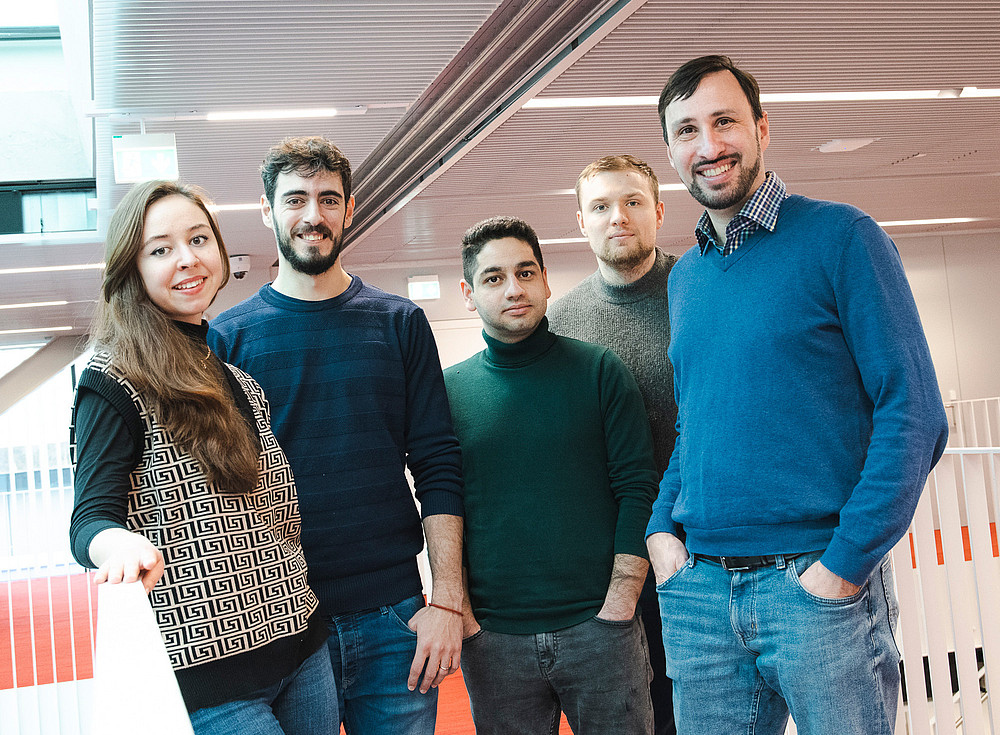
Diana Shakirova, Adrià Conós Valero, Masoud Hamidi, Sergei Gladyshev and Thomas Weiss, standing in der university library ©Uni Graz/Tzivanopoulos

The team of Thomas Weiss (r.): Diana Shakirova, Adrià Conós Valero, Masoud Hamidi and Sergei Gladyshev (from left). Photo: University of Graz/Tzivanopoulos

Sensors play a crucial role in all areas of modern technology. The more precisely they respond to the smallest changes, the higher the quality and performance of an application – whether in devices for facial recognition at the airport or for detection of viruses. Researchers in the field of nanooptics at the University of Graz have now found a solution for further optimising sensors. The current study was published in the renowned scientific journal Physical Review Letters.


Thomas Weiss and his team at the Department of Physics at the University of Graz are investigating electromagnetic resonances in nanostructures, thinner than a human hair. They design these nanostructures to exhibit resonantly enhanced optical signals, for instance, when exciting the system with a laser near their resonance frequencies. This resonant amplification can be used in a variety of applications.

"In the case of optical sensors, light is trapped in the nanostructures for a short period of time before it is emitted by the electromagnetic resonances. In doing so, it provides information about the environment of the structures. This makes it possible to detect molecules, gases or liquids, for example in biomedicine or chemistry," explains Thomas Weiss.

Combined advantages
In their current work, the researchers describe the conditions under which a structure can be designed to support a novel type of resonance. "This is both highly sensitive to the environment and easy to detect because it decays only slowly. A combination of advantages that was previously not possible. We call this new class of resonances an 'EP-BIC'," says Adrià Canós Valero, first author of the study.

The physicists from Graz merged two already known classes of resonances – so-called exceptional points (EPs) and bound states in the continuum (BICs) – each having a serious disadvantage: EPs are particularly sensitive to small changes, which makes their signal extremely sensitive to the environment, but they decay very quickly. This makes it difficult to detect their signal. BICs have the opposite problem. They decay slowly and are therefore easy to detect but are not as sensitive to small environmental changes as EPs. Therefore, they cannot be used to efficiently detect small amounts of substances, such as molecules.

"In our work, we have found a solution to this problem," says Canós Valero. "The structure we describe supports a resonance that is both an EP and a BIC and combines the advantages of both." The physicists expect that their research results will have a strong impact on the development of advanced sensors.

Publication
Exceptional Bound States in the Continuum
Physical Review Letters 134, 103802 – Published 14 March, 2025
DOI: https://doi.org/10.1103/PhysRevLett.134.103802

 

⇒ If you want to know how the world works and enjoy experimenting and analytical thinking, you can study Physics at the University of Graz.

empty picture
empty picture
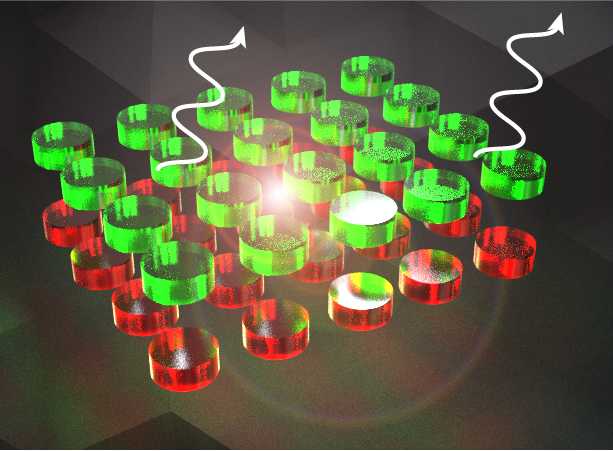
Schematic of a bilayer metasurface to realize EP-BICs ©Adrià Canós Valero / University of Graz
©Adrià Canós Valero / University of Graz
Schematic of a bilayer metasurface to realize EP-BICs. Optical metasurfaces are flat arrangements of dielectric or metallic nanostructures, which allow tailoring the light propagation in a layer of subwavelength thickness. Figure: Adrià Canós Valero / University of Graz
created by Gudrun Pichler

Related news

Around the world in eight stops: the Long Night of Research at the University of Graz

On 24 April from 5 pm, you can take a short trip around the globe at the University of Graz, discovering pecularities of foreign countries or new local features in the entrance hall of the University Library. The itinerary takes you through introduced animal species, political attitudes and the omnipotence of algorithms. There will also be a programme in the historic reading hall, as well as at the UniGraz@Museum and the University Archive.

Studying at the University of Graz: How to enrol

Ready for a new chapter in your life with the start of your studies at the University of Graz in the winter semester 2026/27? Here you will find information on deadlines, admission procedures, registration, and everything else you need to successfully start your studies in the fall.

Interpreting data: Why studies sometimes get it wrong

Hilmar Brohmer and Ziva Korda from the Institute of Psychology, together with 500 international colleagues, have re-evaluated a hundred scientific publications and have often come to different conclusions.

Crystal-clear: AI method revolutionises solar observation

The Sun makes life on Earth possible. However, its magnetic fields can also cause massive disruption. This makes it all the more important to gain a better understanding of the processes taking place on our nearest star. A research team from the University of Graz and the High Altitude Observatory in Boulder (USA) has succeeded in doing just that. The astrophysicists have developed an AI-supported method that makes even the smallest structures on the Sun visible. The scientists are convinced that this will bring about a lasting change in solar observation and that the new method can be used for the planned European Solar Telescope.

Begin of page section:
Additional information:

University of Graz
Universitaetsplatz 3
8010 Graz
Austria
  • Contact
  • Web Editors
  • Moodle
  • UNIGRAZonline
  • Imprint
  • Data Protection Declaration
  • Accessibility Declaration
Weatherstation
Uni Graz

End of this page section. Go to overview of page sections

End of this page section. Go to overview of page sections

Begin of page section:

End of this page section. Go to overview of page sections