Begin of page section:
Page sections:

  • Go to contents (Accesskey 1)
  • Go to position marker (Accesskey 2)
  • Go to main navigation (Accesskey 3)
  • Go to sub navigation (Accesskey 4)
  • Go to additional information (Accesskey 5)
  • Go to page settings (user/language) (Accesskey 8)
  • Go to search (Accesskey 9)

End of this page section. Go to overview of page sections

Begin of page section:
Page settings:

English en
Deutsch de
Search
Login

End of this page section. Go to overview of page sections

Begin of page section:
Search:

Search for details about Uni Graz
Close

End of this page section. Go to overview of page sections


Search

Begin of page section:
Main navigation:

Page navigation:

  • University

    University
    • About the University
    • Organisation
    • Faculties
    • Library
    • Working at University of Graz
    • Campus
    Developing solutions for the world of tomorrow - that is our mission. Our students and our researchers take on the great challenges of society and carry the knowledge out.
  • Research Profile

    Research Profile
    • Our Expertise
    • Research Questions
    • Research Portal
    • Promoting Research
    • Research Transfer
    • Ethics in Research
    • Commission for Scientific Integrity
    Scientific excellence and the courage to break new ground. Research at the University of Graz creates the foundations for making the future worth living.
  • Studies

    Studies
    • Prospective Students
    • Students
    • Welcome Weeks for First Year Students
  • Community

    Community
    • International
    • Location
    • Research and Business
    • Alumni
    The University of Graz is a hub for international research and brings together scientists and business experts. Moreover, it fosters the exchange and cooperation in study and teaching.
Topics
  • Sustainable University
  • Researchers answer
  • Work for us
Close menu

End of this page section. Go to overview of page sections

Begin of page section:
You are here:

University of Graz News Seit 1865

End of this page section. Go to overview of page sections

Friday, 12 June 2015

Seit 1865

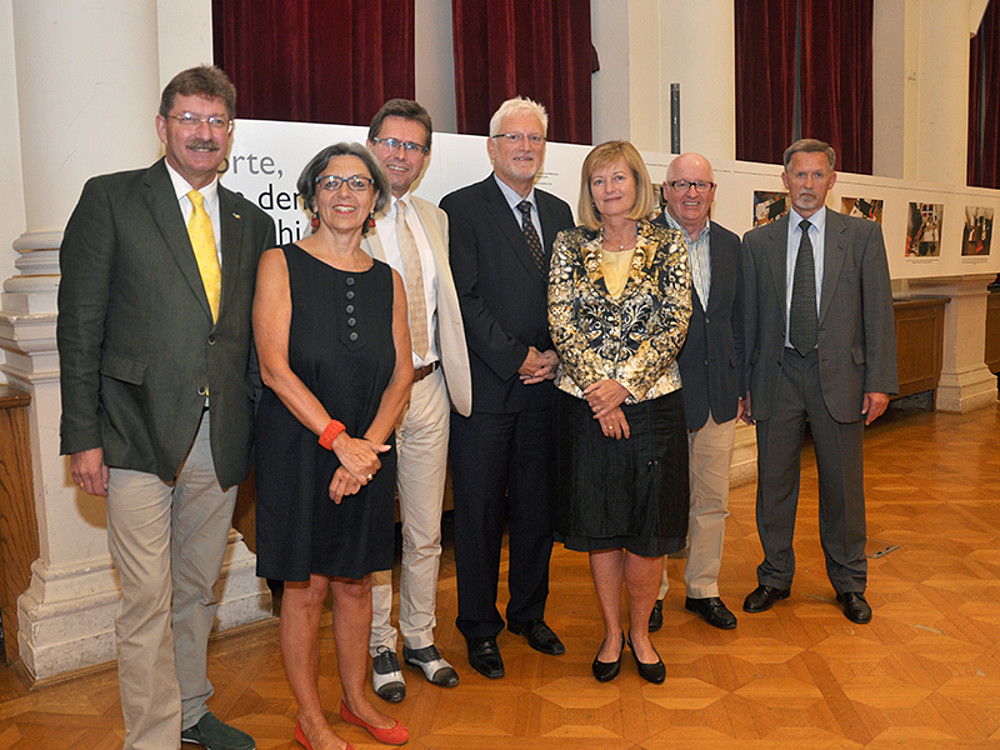
Forschungs-Vizerektor Peter Scherrer, Rektorin Elisabeth Freismuth, Studien-Vizerektor Martin Polaschek, Günther Burkert, stellvertretender Sektionschef im Wissenschaftsministerium, Rektorin Christa Neuper, Historiker Stefan Karner u. Harald Heppner (v.l

Festakt in der Aula: Forschungs-Vizerektor Peter Scherrer, Rektorin Elisabeth Freismuth, Studien-Vizerektor Martin Polaschek, Günther Burkert, stellvertretender Sektionschef im Wissenschaftsministerium, Rektorin Christa Neuper, Historiker Stefan Karner und Historiker Harald Heppner (v.l.) Foto: Uni Graz/Schweiger

Vizerektor Martin Polaschek, GEWI-Studiendekan Helmut Eberhart, stellv. Sektionschef Günther Burkert, Karl Peitler vom Universalmuseum Joanneum, Birgit Strimitzer-Riedler, Leiterin Wissenschaft und Gesundheit, Gernot Obersteiner vom Landesarchiv (v.l.)

GratulantInnen: Vizerektor Martin Polaschek, GEWI-Studiendekan Helmut Eberhart, stellv. Sektionschef Günther Burkert, Karl Peitler vom Universalmuseum Joanneum, Birgit Strimitzer-Riedler, Leiterin Wissenschaft und Gesundheit, Gernot Obersteiner vom Landesarchiv (v.l.)

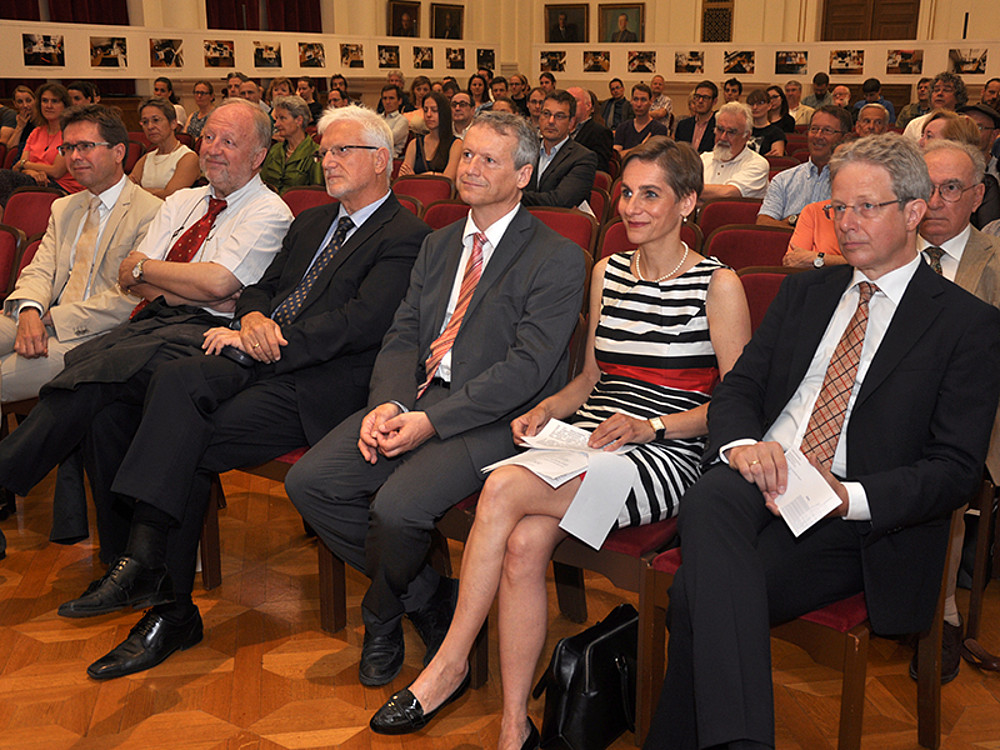
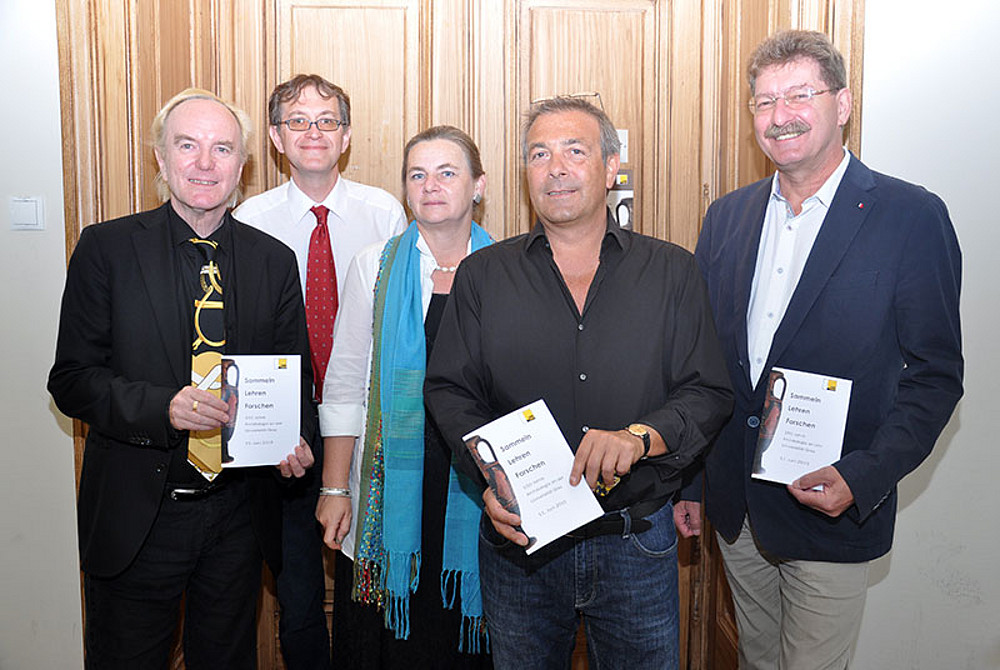
Archäologie-Symposium: Die Vortragenden Karl Krierer und Hubert Szemethy von der Universität Wien, Elisabeth Trinkl, GEWI-Vizedekan Arne Ziegler und Forschungsvizerektor Peter Scherrer (v.l.). Foto: Uni Graz/Kastrun

Archäologie-Symposium: Die Vortragenden Karl Krierer und Hubert Szemethy von der Universität Wien, Elisabeth Trinkl, GEWI-Vizedekan Arne Ziegler und Forschungsvizerektor Peter Scherrer (v.l.). Foto: Uni Graz/Kastrun

Geschichte und Archäologie feierten ihr 150-Jahr-Jubiläum

Die vielen Gesichter von Geschichte betrachtete nicht nur eine fast gleichnamige Sonder-Ausstellung im Uni-Museum im vergangenen Frühjahr. Die unterschiedlichen Facetten der historischen Fächer, die vor genau 150 Jahren das Licht der „Campus-Welt“ der Uni Graz erblickten, standen auch beim Festakt zum Jubiläum am 12. Juni 2015 in der Aula der Karl-Franzens-Universität im Mittelpunkt.

Rektorin Christa Neuper blickte in Zukunft des Wissenschaftszweiges, die etwa im Entwicklungsplan bis 2018 seinen Niederschlag findet. „Die Geschichte ist heuer mit vielen Aktivitäten hinausgegangen, das ist für die Sichtbarkeit in der Gesellschaft von hoher Bedeutung“, betonte Neuper. Nach vor schaute auch Helmut Eberhart, Studiendekan der Geisteswissenschaftlichen Fakultät, der appellierte: „Wir müssen in der Ausbildung stärker auf die Fähigkeiten für die Beschäftigung am Arbeitsmarkt achten.“  

Neben vielen Angehörigen der beiden Institute gratulierten prominente AbsolventInnen zum 150. Geburtstag: darunter Kunstuni-Rektorin Elisabeth Freismuth, Günther Burkert, stellvertretender Sektionschef im Wissenschaftsministerium, sowie Birgit Strimitzer-Riedler, Leiterin der Abteilung Wissenschaft und Gesundheit des Landes Steiermark, Gernot Obersteiner vom Landesarchiv, Karl Peitler vom Universalmuseum Joanneum sowie die StudierendenvertreterInnen Alexander Baumann und Astrid Schmölzer.

Eine Zeitreise ins 19. Jahrhundert unternahmen zwei Experten in ihren Vorträgen: Alois Kernbauer, Leiter des Universitätsarchives, ließ die Gründungszeit der Disziplin Geschichte Revue passieren. Und Erwin Pochmarski zeichnete die Anfänge der Archäologie nach.

Sammeln, Lehren und Forschen – unter diesem Motto feierte das Institut für Archäologie der Uni Graz am Tag zuvor, dem 11. Juni 2015, seinen 150. Geburtstag mit einem Symposium: Nach den Eröffnungsworten von Vizerektor Peter Scherrer und GEWI-Vizedekan Arne Ziegler beleuchteten renommierte ExpertInnen – darunter Karl Krierer und Hubert Szemethy von der Universität Wien – zunächst die Ausgangssituation der Wissenschaftsdisziplin in der Steiermark rund um das Jahr 1865, in dem das damalige „archäologische Cabinet“ an der Universität Graz gegründet wurde. Am Nachmittag wurde der aktuelle Stellenwert archäologischer Sammlungen im digitalen Zeitalter thematisiert. Danach belegten Kurzvorträge und Posterpräsentationen der Abschlussarbeiten von zehn Studierenden, dass die Archäologie um exzellenten akademischen Nachwuchs nicht verlegen ist.


created by Gerhild Kastrun & Andreas Schweiger

Related news

Jurassic Sounds: Biologist reconstructs insect songs from 165 million years ago

It was apparently not just the roars of the dinosaurs that made up the soundscape of the animal world during the Jurassic period. Crickets and grasshoppers communicated through a variety of songs and high-pitched sounds, as Thorin Jonsson from the Institute of Biology at the University of Graz discovered together with colleagues from the universities of Lincoln, Bristol (UK), Beijing (China) and Tempe (USA). The findings on what are so far the oldest traces of sound on Earth have just been published in the journal PNAS.

EU funding boosts international exchange between universities

The University of Graz is further expanding its international study opportunities through the European university alliance Arqus and is taking the lead in two key projects. In future, students will benefit from even more joint degree programmes and from simplified recognition of academic achievements through the Joint European Degree Label.

Rescue and risks: Researchers have surveyed public perceptions of AI

The use of artificial intelligence has had to be made transparent since 2 August 2026. The EU’s AI Act, which has been in force since then, also sets out how risky an application is and which security measures apply as a result. However, the assessment of risks by the legislation differs in some cases significantly from the perceptions of the Austrian public. This is the finding of a representative study carried out by data scientist Stefan Thalmann from the University of Graz and his team.

The Healing Sea: Researchers discover new approaches to treating chronic inflammation in sponges

Chronic inflammation plays a key role in many diseases, ranging from metabolic disorders and cardiovascular diseases to tissue damage following injuries or infections. “Normally, the body is able to resolve inflammation on its own. If this process becomes unbalanced, immune cells remain permanently active and continue to drive negative changes in the tissue,” explains Andreas Koeberle, a pharmacist at the University of Graz.

Begin of page section:
Additional information:

University of Graz
Universitaetsplatz 3
8010 Graz
Austria
  • Contact
  • Web Editors
  • Moodle
  • UNIGRAZonline
  • Imprint
  • Data Protection Declaration
  • Accessibility Declaration
Weatherstation
Uni Graz

End of this page section. Go to overview of page sections

End of this page section. Go to overview of page sections

Begin of page section:

End of this page section. Go to overview of page sections