



Begin of page section:
Page sections:

  • Go to contents (Accesskey 1)
  • Go to position marker (Accesskey 2)
  • Go to main navigation (Accesskey 3)
  • Go to sub navigation (Accesskey 4)
  • Go to additional information (Accesskey 5)
  • Go to page settings (user/language) (Accesskey 8)
  • Go to search (Accesskey 9)

End of this page section. Go to overview of page sections

Begin of page section:
Page settings:

English en
Deutsch de
Search
Login

End of this page section. Go to overview of page sections

Begin of page section:
Search:

Search for details about Uni Graz
Close

End of this page section. Go to overview of page sections


Search

Begin of page section:
Main navigation:

Page navigation:

  • University

    University
    • About the University
    • Organisation
    • Faculties
    • Library
    • Working at University of Graz
    • Campus
    Developing solutions for the world of tomorrow - that is our mission. Our students and our researchers take on the great challenges of society and carry the knowledge out.
  • Research Profile

    Research Profile
    • Our Expertise
    • Research Questions
    • Research Portal
    • Promoting Research
    • Research Transfer
    • Ethics in Research
    • Commission for Scientific Integrity
    Scientific excellence and the courage to break new ground. Research at the University of Graz creates the foundations for making the future worth living.
  • Studies

    Studies
    • Prospective Students
    • Students
  • Community

    Community
    • International
    • Location
    • Research and Business
    • Alumni
    The University of Graz is a hub for international research and brings together scientists and business experts. Moreover, it fosters the exchange and cooperation in study and teaching.
Topics
  • Sustainable University
  • Researchers answer
  • Work for us
Close menu

End of this page section. Go to overview of page sections

Begin of page section:
You are here:

University of Graz News Second period

End of this page section. Go to overview of page sections

Thursday, 28 July 2022

Second period

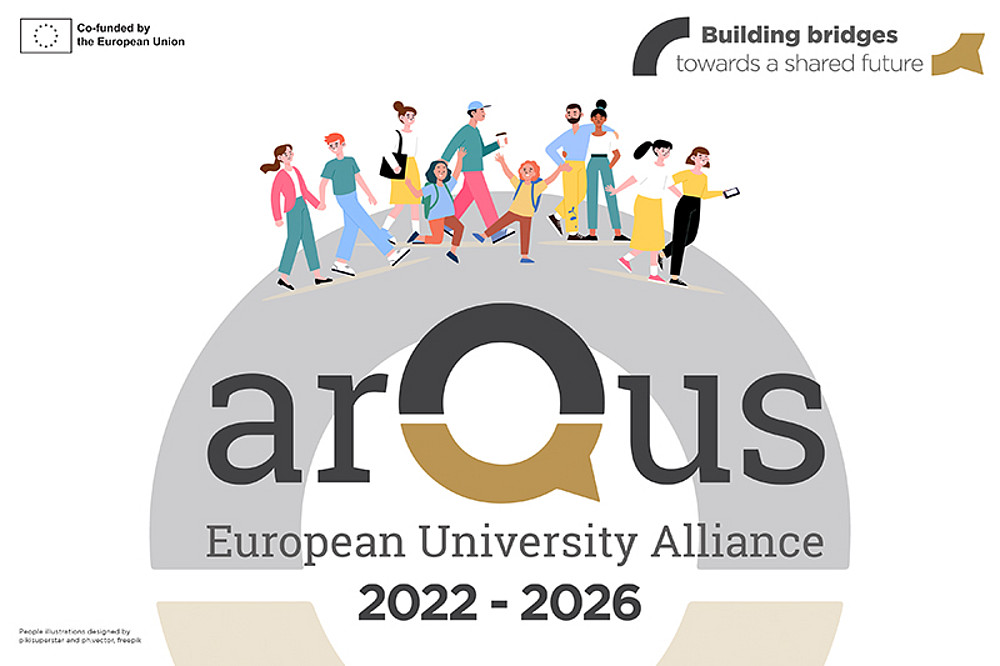
Uni Graz enters the next four years with the higher education alliance Arqus and a 14.4 million grant from the EU

With a record budget of 272 million euros, the European Commission is funding 16 so-called "European universities" for another four years. These are alliances of several universities spread across the entire continent. Among them is the University of Graz, which is one member of the Arqus alliance, which currently has nine. 

The goal of Arqus: To connect researchers, staff and students, improve the experience of early-stage researchers, run more collaborative programs, provide innovative teaching and be deeply involved in local communities. An important feature of the new funding phase is the establishment of a Talent and Innovation Fund for excellent students, with a special focus on those from vulnerable backgrounds and those affected by the war in Ukraine. 

Many unis, many goals 
As of September 2022, Arqus consists of the universities of Granada (Spain), Graz (Austria), Leipzig (Germany), Lyon (France), Minho (Portugal), Padua (Italy), Vilnius (Lithuania) and Wrocław (Poland). Their vision for 2032 is that of a forward-looking, open, integrated and research-led European University. The first three years have laid the foundation for close collaboration. Among the bonuses for Arqus members are such things as free mobility between partner universities, joint educational and staff development opportunities, and shared use of resources. 

Over the next four years, Arqus plans to work more intensively on the pressing issues of our time: Climate Change and Sustainable Development; Artificial Intelligence and Digital Transformation; and European Identity and Cultural Heritage. In the "Living Lab," researchers, teachers and students will work together to develop ideas for solutions to these issues. Students in particular play an important role in Arqus: the "Student Agora" provides the framework by which they design projects to help shape the world of tomorrow. To fulfill these tasks, Arqus will develop, among other things, a shared, virtual learning and teaching platform. 

More about the European Universities Initiative
European Universities are alliances of higher education institutions from across Europe working together in education, research and innovation for the benefit of students, teachers, researchers and society. The now 44 European Universities comprise 340 higher education institutions in capital cities and remote regions of 31 countries. In the course of the current funding call, four new alliances also see the light of day. 

More information about Arqus on the website and in the mission statement 2022-2032 

created by Gerhild Leljak

Related news

Complying with the norm: Why Do Standards Shape Our Lives, Elisabeth Staudegger?

Standards determine whether a sheet of paper fits in a printer or whether a charging plug can power multiple devices. These standards shape our everyday lives. But who actually sets these standards? Where are the weaknesses, and how could science help to improve them? Elisabeth Staudegger, Head of the ‘Law and IT’ Department at the Institute for Legal Foundations at the University of Graz, host the Academic Standards Day on 16 June. Here she relays how sciences can contribute to the topic of standardisation and reveals her personal favourite standard.

More body awareness than a culture war

In Italy, sex education lessons will in future only be permitted with parental consent, and will be banned entirely in nurseries and primary schools. At the same time, Pride Month highlights why knowledge about the body, relationships, boundaries and diversity is important for young people. A study by the University of Graz shows how important knowledge about the body, contraception, relationship skills and protection against violence is

Will Austria win the World Cup? Mathematician reveals calculation method

Michael Fischer uses the football tournament as a practical example for highschool lessons.

Survival strategies: How plants respond to drought

According to Geosphere Austria, this spring was the driest in Austria since records began around 170 years ago. The low rainfall put particular pressure on the agricultural sector. And climate change is set to make the situation even worse in the coming decades. We asked Johannes Liesche, a professor at the Department of Biology at the University of Graz, how plants react to water shortages and how they survive periods of drought.

Begin of page section:
Additional information:

University of Graz
Universitaetsplatz 3
8010 Graz
Austria
  • Contact
  • Web Editors
  • Moodle
  • UNIGRAZonline
  • Imprint
  • Data Protection Declaration
  • Accessibility Declaration
Weatherstation
Uni Graz

End of this page section. Go to overview of page sections

End of this page section. Go to overview of page sections

Begin of page section:

End of this page section. Go to overview of page sections