



Begin of page section:
Page sections:

  • Go to contents (Accesskey 1)
  • Go to position marker (Accesskey 2)
  • Go to main navigation (Accesskey 3)
  • Go to sub navigation (Accesskey 4)
  • Go to additional information (Accesskey 5)
  • Go to page settings (user/language) (Accesskey 8)
  • Go to search (Accesskey 9)

End of this page section. Go to overview of page sections

Begin of page section:
Page settings:

English en
Deutsch de
Search
Login

End of this page section. Go to overview of page sections

Begin of page section:
Search:

Search for details about Uni Graz
Close

End of this page section. Go to overview of page sections


Search

Begin of page section:
Main navigation:

Page navigation:

  • University

    University
    • About the University
    • Organisation
    • Faculties
    • Library
    • Working at University of Graz
    • Campus
    Developing solutions for the world of tomorrow - that is our mission. Our students and our researchers take on the great challenges of society and carry the knowledge out.
  • Research Profile

    Research Profile
    • Our Expertise
    • Research Questions
    • Research Portal
    • Promoting Research
    • Research Transfer
    • Ethics in Research
    • Commission for Scientific Integrity
    Scientific excellence and the courage to break new ground. Research at the University of Graz creates the foundations for making the future worth living.
  • Studies

    Studies
    • Prospective Students
    • Students
    • Registration for Study Programme (Winter semester 2026/27)
  • Community

    Community
    • International
    • Location
    • Research and Business
    • Alumni
    The University of Graz is a hub for international research and brings together scientists and business experts. Moreover, it fosters the exchange and cooperation in study and teaching.
Topics
  • Sustainable University
  • Researchers answer
  • Work for us
Close menu

End of this page section. Go to overview of page sections

Begin of page section:
You are here:

University of Graz News Schutz-Schalter

End of this page section. Go to overview of page sections

Wednesday, 22 March 2017

Schutz-Schalter

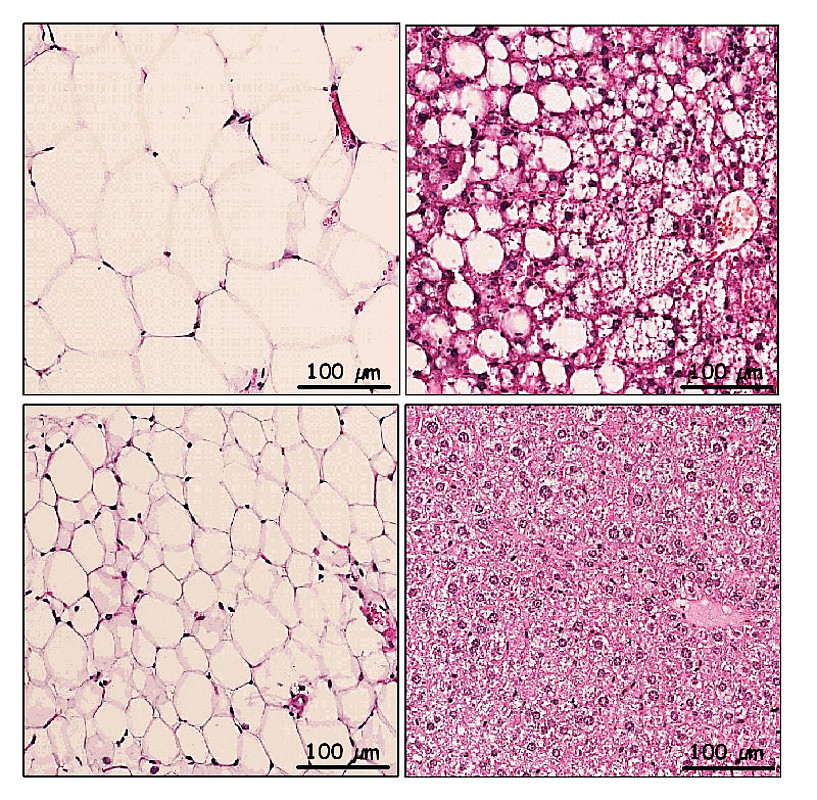
Die Behandlung mit Atglistatin reduziert Fettmasse und verhindert nicht-alkoholische Fettleber trotz fettreicher Ernährung. Foto: Sohsuke Yamada

Die Behandlung mit Atglistatin reduziert Fettmasse und verhindert nicht-alkoholische Fettleber trotz fettreicher Ernährung. Auf dem Bild dargestellt sind Gewebeschnitte von Leber (links) und Fettgewebe (rechts). Zu sehen sind Fetteinlagerungen (weiße Flächen) die durch Atglistatingabe (unten) deutlich reduziert werden. Foto: Sohsuke Yamada

Grazer ForscherInnen entwickeln Wirkstoff zur Behandlung von Fettleibigkeit und deren Folgeerkrankungen

Laut der Weltgesundheitsorganisation WHO sind rund 1,9 Milliarden Menschen weltweit übergewichtig. 75 Prozent von ihnen leiden unter einer nicht-alkoholischen Fettleber, 400 Millionen haben Typ-II-Diabetes. Neben den psychosozialen Auswirkungen von Fettleibigkeit führen vor allem deren Folgeerkrankungen zu einer starken Einschränkung der Lebensqualität und -dauer. WissenschafterInnen der Karl-Franzens-Universität Graz und der TU Graz haben nun einen Wirkstoff entwickelt, der Fettleibigkeit reduziert und Typ-II-Diabetes sowie nicht-alkoholische Fettleber verhindern kann. Die Forschungsergebnisse der Arbeitsgruppen von Univ.-Prof. Dr. Rudolf Zechner, Assoz.-Prof. Dr. Robert Zimmermann, beide Uni Graz, und Univ.-Prof. Dr. Rolf Breinbauer von der TU Graz wurden im renommierten Fachmagazin Nature Communications veröffentlicht.


Einer der Hauptgründe für die Entstehung von stoffwechselbedingten Erkrankungen, die mit Adipositas in Verbindung gebracht werden, ist ein erhöhter Fettsäurespiegel im Blut. Diese Lipide werden durch die Aktivität eines Enzyms namens Adipose Triglyceride Lipase, kurz ATGL, aus dem gespeicherten Fett des Fettgewebes freigesetzt. „Bei Übergewicht verhindern übermäßig ins Blut freigesetzte Fettsäuren die Aufnahme von Glucose in den Muskel und ins Fettgewebe. Es entsteht eine sogenannte Insulinresistenz, einer Vorstufe von Typ-II-Diabetes“, erklärt Priv. Doz. Dr. Martina Schweiger, Erst- und korrespondierende Autorin der Publikation. Außerdem kommt es zum erhöhten Einstrom von Fettsäuren in Gewebe, dessen primäre Funktion nicht die Speicherung von Lipiden darstellt – etwa in die Leber. Durch die Anhäufung von Triglyzeriden in diesem Organ wird seine Funktion gestört, die Konsequenz ist eine nicht-alkoholische Fettleber.


„Da die ATGL die Menge an freigesetzten Fettsäuren ins Blut bestimmt, haben wir uns vorgenommen, dieses Enzym zu inhibieren, um die metabolischen Folgen von Übergewicht zu behandeln“, so Schweiger. Bereits 2013 gelang es den Arbeitsgruppen von Zimmermann und Breinbauer, ein Molekül mit dem Namen Atglistatin zu synthetisieren, das die Aktivität der ATGL unterbindet. In ihrer neuen Studie charakterisierten die ForscherInnen jetzt die Wirkung dieses Hemmstoffes Atglistatin im Tiermodell. „Durch das Ausschalten der ATGL konnten wir die Insulinresistenz und die Entstehung der nicht-alkoholischen Fettleber vollständig verhindern. Außerdem kam es zu einer Gewichtsreduktion trotz fettreicher Nahrung“, schildert Schweiger. Entscheidend war die Erkenntnis, dass ATGL nicht komplett unterbunden werden darf. „Hemmt man ATGL vollständig, führt das zwar ebenso zu einer Verbesserung der Adipositas und der Insulinresistenz, jedoch kommt es zu einer Verfettung des Herzens, die tödlich enden kann“, unterstreicht die Forscherin. Eine vorübergehende Hemmung hat jedoch keinerlei schädliche Nebenwirkungen. „Durch Aufnahme des Wirkstoffes Atglistatin ist das Enzym für sechs Stunden abgestellt. Nach dieser Zeit baut der Körper den Hemmstoff auf natürlichem Weg ab. Danach nimmt ATGL seine Arbeit wieder auf“, erklärt Schweiger.


Die Publikation ist ein weiteres Beispiel für die erfolgreiche Kooperation der Karl-Franzens-Universität Graz und der TU Graz in den Naturwissenschaften, NAWI Graz.
 
Publikation:

M. Schweiger, M. Romauch, R. Schreiber, G. Grabner, S.Hütter, P. Kotzbeck, P. Benedikt, T. Eichmann, S.Yamada, O.Knittelfelder, C.Diwoky, C.Doler, N. Mayer, W. De Cecco, R. Breinbauer, R. Zimmermann, & R. Zechner : Pharmacological Inhibition of Adipose Triglyceride Lipase Corrects High-Fat Diet-induced Insulin Resistance and Hepatosteatosis in Mice. DOI: 10.1038/NCOMMS14859


created by Gerhild Kastrun

Related news

Baby health: University of Graz is seeking study participants to investigate early risk factors

Why does the body composition of babies vary so much? Some children gain a significant amount of fat mass within a few weeks, whilst others show hardly any change over the same period. “At the same time, initial observations suggest that fat distribution in all babies may follow a similar pattern, regardless of their total body fat,” explains Marco Höfler from the Institute of Movement Sciences, Sport and Health at the University of Graz. He is coordinating the research project ‘Small Bodies – Big Questions’, for which participants are currently still being sought: pregnant women and babies up to four weeks old.

In hot water: New Report reveals record losses in glaciers, permafrost and snow cover

Climate change is driving up temperatures not only in summer. Winters are also getting warmer – with dramatic consequences for glaciers, permafrost, snow cover and the freezing of lakes. The recently published cryosphere report provides specific figures for Austria. “Our monitoring shows a clear trend with record losses of ice and snow,” says project leader Wolfgang Schöner from the University of Graz.

Theologian at the University of Graz: What the excommunication of the Society of St Pius X

Following the schism involving the Society of St Pius X, there is a need for discussion. Bernd Hillebrand from the University of Graz explains why the Vatican took this step, what role anti-democratic tendencies play, and why the Society’s sacraments are no longer recognised as valid under canon law for Catholics with immediate effect.

“HeinrichBiCool”: University of Graz demonstrates the effects of green facades and roofs

The University of Graz has launched a pioneering project at the University Centre for Theology. Its name, “HeinrichBiCool”, says it all: a comprehensive system of green facades and roof will cool the building at Heinrichstraße 80 during the summer. At the same time, this will create a new habitat for plants and animals, helping to increase biodiversity. The accompanying monitoring programme will provide detailed data on the impact of the measures on indoor climate, energy consumption and biodiversity. The findings will lay a scientifically sound foundation for further projects aimed at making cities sustainable, climate-resilient and liveable. The partners in this project, funded by the Austrian Research Promotion Agency (FFG), are AEE INTEC – Institute for Sustainable Technologies, Technisches Büro Siegfried Stark, the landscape architecture and urban planning firm “studio boden”, and Ökoteam Graz.

Begin of page section:
Additional information:

University of Graz
Universitaetsplatz 3
8010 Graz
Austria
  • Contact
  • Web Editors
  • Moodle
  • UNIGRAZonline
  • Imprint
  • Data Protection Declaration
  • Accessibility Declaration
Weatherstation
Uni Graz

End of this page section. Go to overview of page sections

End of this page section. Go to overview of page sections

Begin of page section:

End of this page section. Go to overview of page sections

