Begin of page section:
Page sections:

  • Go to contents (Accesskey 1)
  • Go to position marker (Accesskey 2)
  • Go to main navigation (Accesskey 3)
  • Go to sub navigation (Accesskey 4)
  • Go to additional information (Accesskey 5)
  • Go to page settings (user/language) (Accesskey 8)
  • Go to search (Accesskey 9)

End of this page section. Go to overview of page sections

Begin of page section:
Page settings:

English en
Deutsch de
Search
Login

End of this page section. Go to overview of page sections

Begin of page section:
Search:

Search for details about Uni Graz
Close

End of this page section. Go to overview of page sections


Search

Begin of page section:
Main navigation:

Page navigation:

  • University

    University
    • About the University
    • Organisation
    • Faculties
    • Library
    • Working at University of Graz
    • Campus
    Developing solutions for the world of tomorrow - that is our mission. Our students and our researchers take on the great challenges of society and carry the knowledge out.
  • Research Profile

    Research Profile
    • Our Expertise
    • Research Questions
    • Research Portal
    • Promoting Research
    • Research Transfer
    • Ethics in Research
    • Commission for Scientific Integrity
    Scientific excellence and the courage to break new ground. Research at the University of Graz creates the foundations for making the future worth living.
  • Studies

    Studies
    • Prospective Students
    • Students
    • Registration for Study Programme (Winter semester 2026/27)
    • Study Days 22-26 June 2026
  • Community

    Community
    • International
    • Location
    • Research and Business
    • Alumni
    The University of Graz is a hub for international research and brings together scientists and business experts. Moreover, it fosters the exchange and cooperation in study and teaching.
Topics
  • Sustainable University
  • Researchers answer
  • Work for us
Close menu

End of this page section. Go to overview of page sections

Begin of page section:
You are here:

University of Graz News 50. Band

End of this page section. Go to overview of page sections

Thursday, 14 January 2021

50. Band

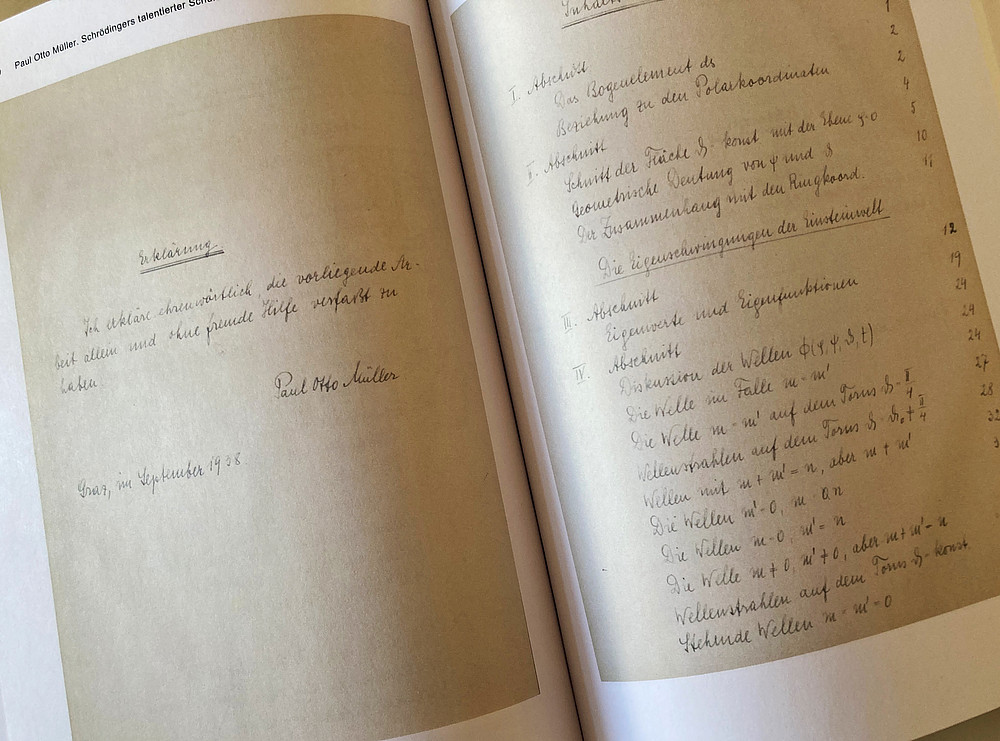
Blick ins Buch: die handschriftlich verfasste Dissertation von Paul Otto Müller Foto: Uni Graz/Schweiger

Blick ins Buch: die handschriftlich verfasste Dissertation von Paul Otto Müller Foto: Uni Graz/Schweiger

Schrödingers Schüler: Neues Buch zeichnet den Weg vom talentierten Studenten zum NS-Physiker nach

Es war jene ruhmreiche Ära, als Nobelpreisträger an der Universität Graz forschten und lehrten. Und eine weniger glanzvolle, als das NS-Regime bald WissenschafterInnen und Studierende vom Campus jagte. Dieser Zeit widmet sich ein neues Buch über einen hochtalentierten Studenten und überzeugten Nationalsozialisten. Mit dem Physiker Paul Otto Müller (1915–1942) beschäftigt sich der mittlerweile 50. Band der Reihe „Publikationen aus dem Archiv der Universität Graz“ – herausgegeben von Alois Kernbauer und Manfred Popp, unter Mitarbeit von Frank Ulrich Müller und Hermann Nicolai.

Paul Otto Müller schrieb ab 1938 seine Dissertation an der Universität Graz bei Erwin Schrödinger, dem überaus angesehenen Nobelpreisträger von 1933. „Müller setzte sich mit einer Frage der Allgemeinen Relativitätstheorie auseinander, was zu dieser Zeit ungewöhnlich war“, schildert Alois Kernbauer, Leiter des Universitätsarchivs der Universität Graz. Zugleich förderte Paul Otto Müller die nationalsozialistische SS. „Doch für Schrödinger spielte die Weltanschauung keine Rolle“, betont der Historiker. „Schrödinger sah in Müller vor allem das gewaltige wissenschaftliche Talent. Er war sicher sein begabtester Schüler.“ Dass die Arbeit nach wie vor von hoher Aktualität ist, bestätigt Hermann Nicolai, Direktor am Max-Planck-Institut für Gravitationsphysik in Potsdam. Die Autoren haben sich daher auch entschlossen, die handschriftlich verfasste Dissertation in der Publikation abzudrucken.

Nach Schrödingers Entlassung 1939 stand Müller, so Kernbauer, auf verlorenem Posten, die theoretische Physik verlor in Graz massiv an Bedeutung. Der frischgebackene Doktor wechselte ans Kaiser-Wilhelm-Institut in Berlin, wo er am Uranprojekt mitarbeitete. Eine Gruppe von etwa 100 WissenschafterInnen sollte im Auftrag der Nationalsozialisten eine Atombombe herstellen. Auch Paul Otto Müller leistete Beiträge. „Müllers Ergebnis bedeutete“, schreibt Kernbauer, „dass die Voraussetzungen für eine Uran-Bombe die wirtschaftlich-technischen Möglichkeiten in Deutschland bei weitem übersteigen würden. Müller trug damit dazu bei, eine deutsche Atombombenentwicklung während des 2. Weltkrieges zu vermeiden.“ Die wissenschaftliche Debatte über die Rolle des Physikers, die rege international geführt wird, erhält damit wohl weiteren Input.

>> Über die Publikationen aus dem Archiv der Universität Graz mehr erfahren
created by Andreas Schweiger

Related news

Staying fit during the holidays: summer sports on the University of Graz campus

The Kleeblattlauf is not the end of the fitness term. Following last year’s successful launch, the University of Graz is once again offering summer sports on campus this year. From 30 June to 16 July 2026, there will be a free exercise programme in the open air. On the shady Südwiese (between the main building and Universitätsplatz 2), anyone interested can get in shape in the afternoons with body workouts, fascia training and yoga.

Getting even hotter: Researchers predict global warming of 1.7 degrees by 2027

While Europe is currently sweltering in the heat, global temperatures are also rising towards concerning record levels. In 2026, Earth’s surface air temperature is expected to reach 1.62 degrees, and in 2027 even 1.71 degrees Celsius above pre-industrial levels. The long-term temperature rise – an average over a 20-year period – is predicted to exceed the 1.5-degree threshold of the Paris Agreement as of 2026 already. For the first time, researchers at the University of Graz have been able to make such a forecast so far in advance. The intensifying El Niño climate event favors forecast skill and thereby facilitates a reliable computation.

Forest fire at Rosenhain: Volunteer fire brigade carried out an evacuation drill at the Jesuit refectory

Thick smoke in the stairwell, flames at the edge of the forest, people missing in the Jesuit refectory at the University of Graz: at Rosenhain, the Graz Volunteer Fire Brigade carried out a drill simulating a scenario that is becoming increasingly realistic given the heat and drought

Full effort in the heat: the Sports Centre was in full swing at the Kleeblattlauf

On 19 June 2026, 2,000 runners and hundreds of supporters made their way to the Rosenhain for a sporting end-of-term event.

Begin of page section:
Additional information:

University of Graz
Universitaetsplatz 3
8010 Graz
Austria
  • Contact
  • Web Editors
  • Moodle
  • UNIGRAZonline
  • Imprint
  • Data Protection Declaration
  • Accessibility Declaration
Weatherstation
Uni Graz

End of this page section. Go to overview of page sections

End of this page section. Go to overview of page sections

Begin of page section:

End of this page section. Go to overview of page sections