



Begin of page section:
Page sections:

  • Go to contents (Accesskey 1)
  • Go to position marker (Accesskey 2)
  • Go to main navigation (Accesskey 3)
  • Go to sub navigation (Accesskey 4)
  • Go to additional information (Accesskey 5)
  • Go to page settings (user/language) (Accesskey 8)
  • Go to search (Accesskey 9)

End of this page section. Go to overview of page sections

Begin of page section:
Page settings:

English en
Deutsch de
Search
Login

End of this page section. Go to overview of page sections

Begin of page section:
Search:

Search for details about Uni Graz
Close

End of this page section. Go to overview of page sections


Search

Begin of page section:
Main navigation:

Page navigation:

  • University

    University
    • About the University
    • Organisation
    • Faculties
    • Library
    • Working at University of Graz
    • Campus
    Developing solutions for the world of tomorrow - that is our mission. Our students and our researchers take on the great challenges of society and carry the knowledge out.
  • Research Profile

    Research Profile
    • Our Expertise
    • Research Questions
    • Research Portal
    • Promoting Research
    • Research Transfer
    • Ethics in Research
    • Commission for Scientific Integrity
    Scientific excellence and the courage to break new ground. Research at the University of Graz creates the foundations for making the future worth living.
  • Studies

    Studies
    • Prospective Students
    • Students
  • Community

    Community
    • International
    • Location
    • Research and Business
    • Alumni
    The University of Graz is a hub for international research and brings together scientists and business experts. Moreover, it fosters the exchange and cooperation in study and teaching.
  • Spotlight
Topics
  • Sustainable University
  • Researchers answer
  • Work for us
Close menu

End of this page section. Go to overview of page sections

Begin of page section:
You are here:

University of Graz News Schnittstelle BioTechMed

End of this page section. Go to overview of page sections

Thursday, 12 December 2013

Schnittstelle BioTechMed
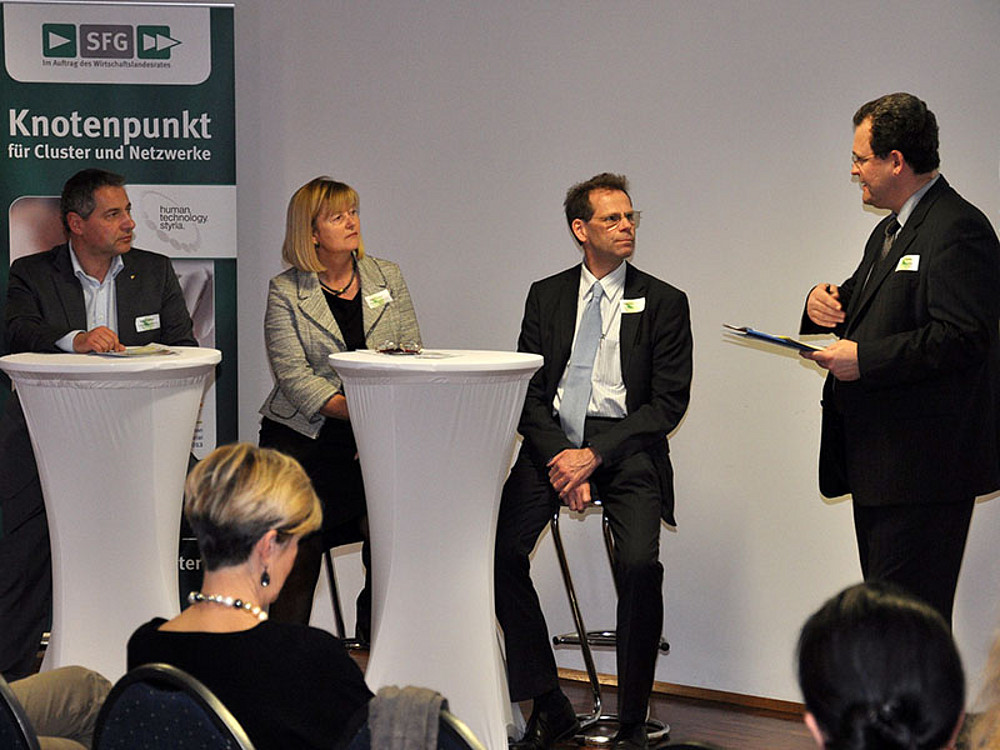
Bei der „Executive Lounge“ diskutierten: Markus Steppan (BioTechMed-Koordinator Uni Graz), Rektorin Christa Neuper, Sven Stegemann (Director Pharmaceutical Business Development, Capsugel) und Moderator Wolfgang Filz. Foto:HTS
Bei der „Executive Lounge“ diskutierten: Markus Steppan (BioTechMed-Koordinator Uni Graz), Rektorin Christa Neuper, Sven Stegemann (Director Pharmaceutical Business Development, Capsugel) und Moderator Wolfgang Filz. Foto:HTS

Der Humantechnologie-Cluster Styria diskutierte die Forschungskooperation der drei Grazer Universitäten

Vernetzung am Standort: Uni Graz, TU Graz und Med Uni Graz präsentierten bei der Dezember-„Executive Lounge“ des Humantechnologie-Clusters am 10. Dezember 2013 interessierten möglichen KooperationspartnerInnen aus der Wirtschaft die gemeinsame Forschungsplattform BioTechMed.
Mit der Forschungsplattform BioTechMed bündeln die drei großen steirischen Universitäten ihre Aktivitäten in den Life Sciences und Humantechnologien, machen sie international sichtbarer und wollen auch Schnittstellen für die Wirtschaft öffnen.

Die Clusterverantwortliche Andrea Wutte und Moderator Wolfgang Filz konnten Wirtschaftslandesrat Christian Buchmann begrüßen. Buchmann bot auch für die Zukunft „die volle Unterstützung der Politik“ für die BioTechMed-Aktivitäten an.
Sven Stegemann, Director Pharmaceutical Development bei Capsugel, referierte über „Chancen für Innovationen durch Convergence aus Sicht der Big Pharma“. Professoren des renommierten MIT bezeichneten in einer viel beachteten Studie die „Konvergenz von Life Sciences, Naturwissenschaften und Engineering“ als „Dritte Biomedizinische Revolution“. Eine regionale Antwort auf diesen internationalen Trend ist die Forschungsplattform BioTechMed.

Die Rektorin der Karl-Franzens-Universität, Christa Neuper, bezeichnete BioTechMed mit den Forschungsschwerpunkten „Molekulare Biomedizin“, „Neurowissenschaften“, „Pharmazeutische und Medizinische Technologie“ sowie „Quantitative Biomedizin und Modellierung“ als „das wichtigste strategische Projekt der drei Grazer Universitäten“. Neuper betonte auch, dass es vor allem „um Spitzenforschung“ gehe. In der Praxis solle BioTechMed „wie ein Shared Space funktionieren“: Ohne starre Regeln im Detail können alle Beteiligten, orientiert am gemeinsamen Ziel, produktiv miteinander arbeiten.

Für den BioTechMed-Koordinator der Uni Graz, Markus Steppan, wird mit der 2011 gestarteten Forschungsplattform „kein regionales Süppchen gekocht, es gibt vielmehr einen internationalen wissenschaftlichen Fachbeirat“, der die Qualität der Forschungsprojekte sicherstellen hilft. Steppan präsentierte die Vernetzungsformate „Lab Visits“, „Postdoc-Pool“ und „Future Space“ – damit werde das „Out-of-the-box-Denken“ gezielt gefördert.
Rudolf Stollberger, BioTechMed-Koordinator der TU Graz, präsentierte anhand praktischer Beispiele „neue Forschungshorizonte durch interdisziplinäre Methodenintegration“. Praktische Beispiele von Konvergenz und Kooperation aus klinisch-medizinischer Sicht stellte schließlich der BioTechMed-Koordinator der Med Uni Graz, Harald Mangge, vor.

In der anschließenden Diskussion regte unter anderen Universitätsrätin Waltraud Schinko-Neuroth an, dass BioTechMed auch Schnittstellen zu den Förderstellen des Landes und zu den Clustergesellschaften schaffen solle, um etwa Gründungen und andere unternehmerische Anwendungen möglich zu machen. Ihre Unterstützung und Interesse an inhaltlichen Kooperationen meldeten die Vertreterinnen und Vertreter des BioNanoNet, des Science Park Graz und der FH Joanneum an. Man war sich auch darüber einig, schon in frühen Stadien des Studiums die Kommunikationskompetenzen der künftigen WissenschafterInnen zu stärken.

created by Humantechnologie-Cluster & Schweiger

Related news

Higher Education Strategy 2040: Austria’s universities on course for the future

Austria has 77 higher education institutions, which is above the EU average – but does this really make sense? The new Higher Education Strategy 2040 focuses on cooperation rather than mergers. As one of the six largest universities in Austria, the University of Graz plays a central role in this.

Climate research in Greenland: Old data provides new insights

The polar explorer and University of Graz professor Alfred Wegener left behind a unique collection of climate data from Greenland. A research team from the University of Graz is now analysing this 100-year-old treasure trove of data and comparing it with current measurements.

Diversity in nature and science: How we talk about plants and each other

Ginkgo, kiwi, hemp: they exist as male and female plants. Anyone who paid attention in biology class will confirm this. But is this categorisation, established by Carl von Linné almost 300 years ago, still valid today? An interdisciplinary team at the University of Graz is questioning these attributions and using this as a starting point to provide food for thought for gender-sensitive interaction between students, scientific and teaching staff.

Around the world in eight stops: the Long Night of Research at the University of Graz

On 24 April from 5 pm, you can take a short trip around the globe at the University of Graz, discovering pecularities of foreign countries or new local features in the entrance hall of the University Library. The itinerary takes you through introduced animal species, political attitudes and the omnipotence of algorithms. There will also be a programme in the historic reading hall, as well as at the UniGraz@Museum and the University Archive.

Begin of page section:
Additional information:

University of Graz
Universitaetsplatz 3
8010 Graz
Austria
  • Contact
  • Web Editors
  • Moodle
  • UNIGRAZonline
  • Imprint
  • Data Protection Declaration
  • Accessibility Declaration
Weatherstation
Uni Graz

End of this page section. Go to overview of page sections

End of this page section. Go to overview of page sections

Begin of page section:

End of this page section. Go to overview of page sections

