



Begin of page section:
Page sections:

  • Go to contents (Accesskey 1)
  • Go to position marker (Accesskey 2)
  • Go to main navigation (Accesskey 3)
  • Go to sub navigation (Accesskey 4)
  • Go to additional information (Accesskey 5)
  • Go to page settings (user/language) (Accesskey 8)
  • Go to search (Accesskey 9)

End of this page section. Go to overview of page sections

Begin of page section:
Page settings:

English en
Deutsch de
Search
Login

End of this page section. Go to overview of page sections

Begin of page section:
Search:

Search for details about Uni Graz
Close

End of this page section. Go to overview of page sections


Search

Begin of page section:
Main navigation:

Page navigation:

  • University

    University
    • About the University
    • Organisation
    • Faculties
    • Library
    • Working at University of Graz
    • Campus
    Developing solutions for the world of tomorrow - that is our mission. Our students and our researchers take on the great challenges of society and carry the knowledge out.
  • Research Profile

    Research Profile
    • Our Expertise
    • Research Questions
    • Research Portal
    • Promoting Research
    • Research Transfer
    • Ethics in Research
    • Commission for Scientific Integrity
    Scientific excellence and the courage to break new ground. Research at the University of Graz creates the foundations for making the future worth living.
  • Studies

    Studies
    • Prospective Students
    • Students
    • Registration for Study Programme (Winter semester 2026/27)
    • Welcome Weeks for First Year Students
  • Community

    Community
    • International
    • Location
    • Research and Business
    • Alumni
    The University of Graz is a hub for international research and brings together scientists and business experts. Moreover, it fosters the exchange and cooperation in study and teaching.
Topics
  • Sustainable University
  • Researchers answer
  • Work for us
Close menu

End of this page section. Go to overview of page sections

Begin of page section:
You are here:

University of Graz News Rund um die Uhr

End of this page section. Go to overview of page sections

Friday, 17 January 2020

Rund um die Uhr

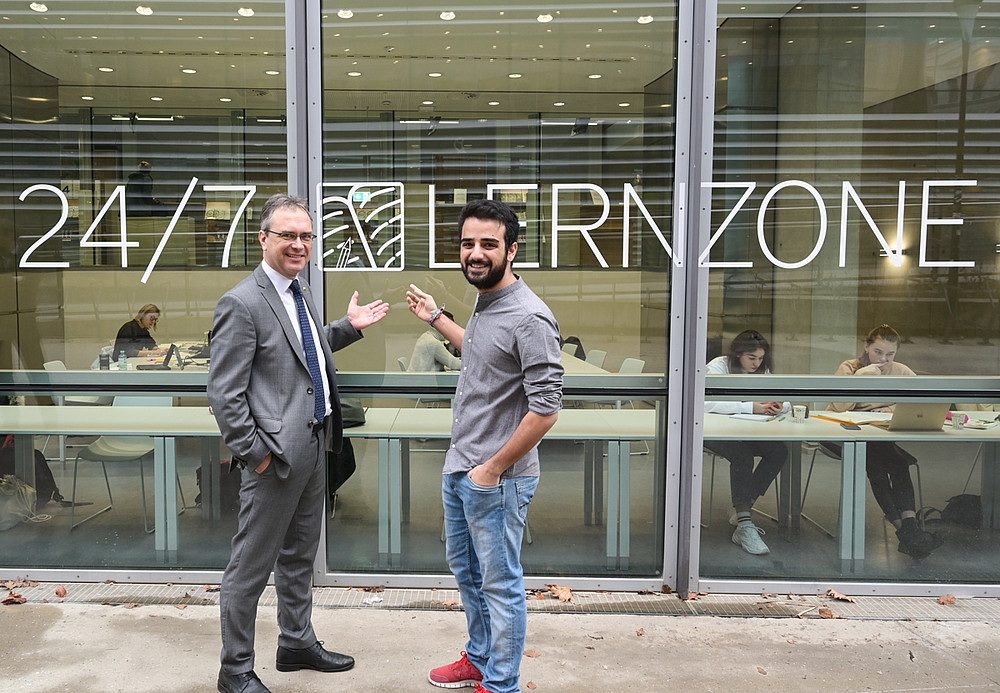
Peter Riedler (links) übergab den 365-Tage-Lernraum offiziell an den Vorsitzenden der ÖH Uni Graz, Armin Amiryousofi . Foto: Uni Graz/Tzivanopopoulos

Peter Riedler (links) übergab den 365-Tage-Lernraum offiziell an den Vorsitzenden der ÖH Uni Graz, Armin Amiryousofi . Foto: Uni Graz/Tzivanopoulos

Die Universität Graz eröffnet ihren ersten 24/7 Lernbereich. Und: ab sofort sind auch die Gruppenarbeitsräume in der Bibliothek buchbar

24 Stunden am Tag, sieben Tage die Woche, 52 Wochen im Jahr an der Universität Graz lernen? Das ist ab sofort im 24/7 – sprich „twenty-four-seven“ – Lernbereich möglich. Seit Anfang der Woche ist der Raum im Erdgeschoss des Domenig Baus für Studierende der Universität Graz rund um die Uhr geöffnet. Insgesamt stehen – zusätzlich zu den 450 Lese- und Lernplätzen in der Bibliothek – nun nochmals 60 Lernplätze zur Verfügung. Der Zugang ist von außen, über einen Eingang gegenüber dem RESOWI-Gebäude möglich.

„Ich freue mich, dass wir im Rahmen des Umbaus der Universitätsbibliothek nun auch die Möglichkeiten für einen 24/7-Bereich für unsere Studierenden geschaffen haben“, betont Infrastruktur-Vizerektor Peter Riedler. „Damit können wir die Rahmenbedingungen zur Prüfungsvorbereitung weiter verbessern.“ Gemeinsam mit Ralph Zettl, zuständig für Raum und Ressourcen an der Uni Graz, übergab Riedler den Lernbereich an das Vorsitzenden-Team der ÖH Uni Graz und somit an die Studierenden.

Zugang über UniGrazCard
Der 24/7-Bereich ist während der Gebäudeöffnungszeiten der Bibliothek – Montag bis Freitag von sechs bis 22 Uhr und samstags von acht bis 22 Uhr – zugänglich. Außerhalb der Zeiten sowie sonn- und feiertags haben alle an der Universität Graz aktiv gemeldeten Studierenden mit der UniGrazCard Zutritt zum Lernbereich. Die Karte muss nicht aktiviert werden; beim ersten Besuch außerhalb der Zeiten muss sie nur länger vor das Lesegerät gehalten werden. Die Tür öffnet dann automatisch.

Gruppenräume in der UB: Über E-Mail buchbar
Neu sind auch die sechs Gruppenarbeitsräume im dritten und vierten Stock der Universitätsbibliothek. Die mit einem 75 Zoll-Bildschirm ausgestatteten Arbeitsräume können von Studierenden über den Webmail-Kalender selbstständig gebucht werden.

Die uniIT hat dazu eine umfassende Anleitung zum Buchungsprozess erstellt https://it.uni-graz.at/de/anleitungen/detail/article/gruppenraeume-der-ub-buchen/
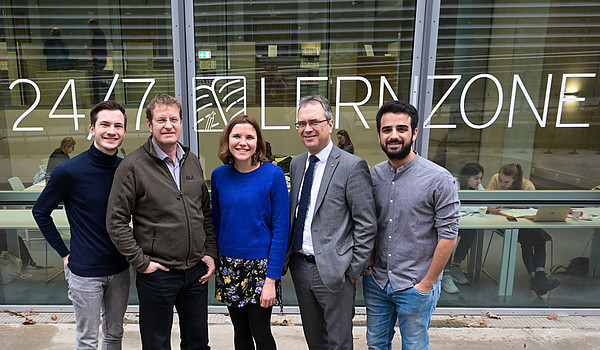
 

Der 24/7-Lernbereich im Domenig-Bau wurde offiziell eröffnet und steht ab sofort allen Studierenden der Universität Graz rund um die Uhr zur Verfügung. Jan Stering, Ralph Zettl, Viktoria Wimmer, Peter Riedler und Armin Amiryousofi (v.l.). Foto: Uni Graz/Tzivanopoulos
created by Konstantin Tzivanopoulos

Related news

How formulas are making medicine more personalised

When Federica Caforio talks about the heart, it doesn’t sound like an operating theatre, but rather like equations, parameters and simulations. Yet this is precisely where the medical promise of her research lies: one day, clinical data will be used to create a digital twin of the heart – a virtual model that will enable a better understanding of diseases and allow for more personalised treatment plans. She will be presenting her research at the ‘ECMTB 2026’ mathematics conference.

University Spin-Off Company “Innovation Hub Graz” works to make Spin-Offs investor ready

The Medical University of Graz, University of Graz and TU Graz are once again joining forces to establish a joint Innovation Hub Graz (iHub Graz). At this transfer centre, selected, particularly promising university spin-offs are specifically prepared to be investor ready.

Adhesive force: Researchers demonstrate how cells determine their function

How does a single cell develop into an organism with skin, muscles, intestines, a heart and other specialised tissues? Two studies published in leading journals have identified a mechanism that links genes, chemical signals and the physical properties of tissues. Scientists from London, Heidelberg and Graz were involved in the research.

Vitamin E is the key: a pharmacist has discovered a substance that ‘switches off’ inflammation

Alzheimer’s, obesity or atherosclerosis: many lifestyle-related diseases are driven by or accompanied by inflammation. “Treatments usually aim to halt the progression of inflammation. However, for a long-term cure, it must be completely resolved,” explains Andreas Koeberle, a pharmacist at the University of Graz. Normally, the body carries out this work itself. However, if this process does not function properly, chronic inflammation can develop, which can contribute to conditions such as cardiovascular disease or cancer.

Begin of page section:
Additional information:

University of Graz
Universitaetsplatz 3
8010 Graz
Austria
  • Contact
  • Web Editors
  • Moodle
  • UNIGRAZonline
  • Imprint
  • Data Protection Declaration
  • Accessibility Declaration
Weatherstation
Uni Graz

End of this page section. Go to overview of page sections

End of this page section. Go to overview of page sections

Begin of page section:

End of this page section. Go to overview of page sections


