Begin of page section:
Page sections:

  • Go to contents (Accesskey 1)
  • Go to position marker (Accesskey 2)
  • Go to main navigation (Accesskey 3)
  • Go to sub navigation (Accesskey 4)
  • Go to additional information (Accesskey 5)
  • Go to page settings (user/language) (Accesskey 8)
  • Go to search (Accesskey 9)

End of this page section. Go to overview of page sections

Begin of page section:
Page settings:

English en
Deutsch de
Search
Login

End of this page section. Go to overview of page sections

Begin of page section:
Search:

Search for details about Uni Graz
Close

End of this page section. Go to overview of page sections


Search

Begin of page section:
Main navigation:

Page navigation:

  • University

    University
    • About the University
    • Organisation
    • Faculties
    • Library
    • Working at University of Graz
    • Campus
    Developing solutions for the world of tomorrow - that is our mission. Our students and our researchers take on the great challenges of society and carry the knowledge out.
  • Research Profile

    Research Profile
    • Our Expertise
    • Research Questions
    • Research Portal
    • Promoting Research
    • Research Transfer
    • Ethics in Research
    • Commission for Scientific Integrity
    Scientific excellence and the courage to break new ground. Research at the University of Graz creates the foundations for making the future worth living.
  • Studies

    Studies
    • Prospective Students
    • Students
  • Community

    Community
    • International
    • Location
    • Research and Business
    • Alumni
    The University of Graz is a hub for international research and brings together scientists and business experts. Moreover, it fosters the exchange and cooperation in study and teaching.
  • Spotlight
Topics
  • Sustainable University
  • Researchers answer
  • Work for us
Close menu

End of this page section. Go to overview of page sections

Begin of page section:
You are here:

University of Graz News Roter Teppich

End of this page section. Go to overview of page sections

Tuesday, 17 September 2013

Roter Teppich
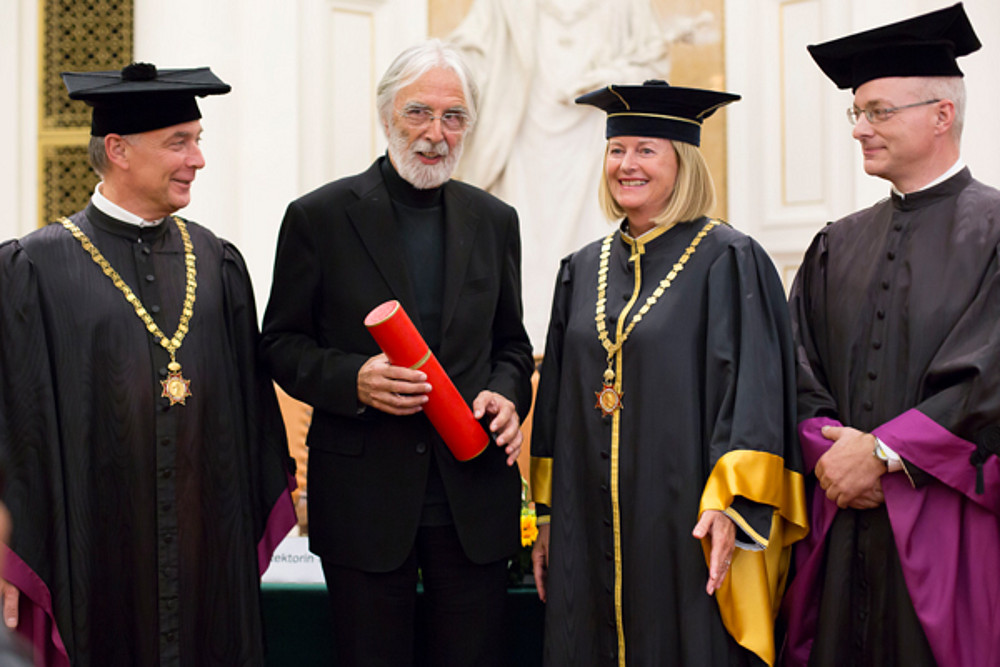
Ehrenpromotion an der Uni Graz: Dekan Hans-Ferdinand Angel, Ehrendoktor Michael Haneke, Rektorin Christa Neuper und Vizedekan Christian Wessely (v.l.) Fotos: Marija Kanizaj
Ehrenpromotion an der Uni Graz: Dekan Hans-Ferdinand Angel, Ehrendoktor Michael Haneke, Rektorin Christa Neuper und Vizedekan Christian Wessely (v.l.) Fotos: Marija Kanizaj

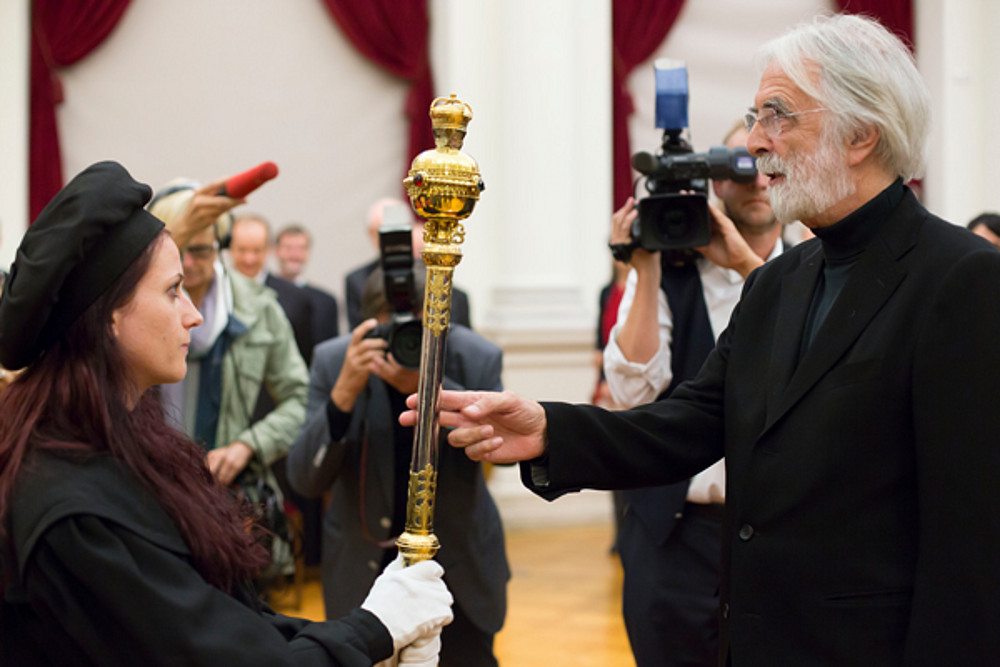
Feierlicher Schwur des Oscar-gekrönten Regisseurs
Feierlicher Schwur des Oscar-gekrönten Regisseurs

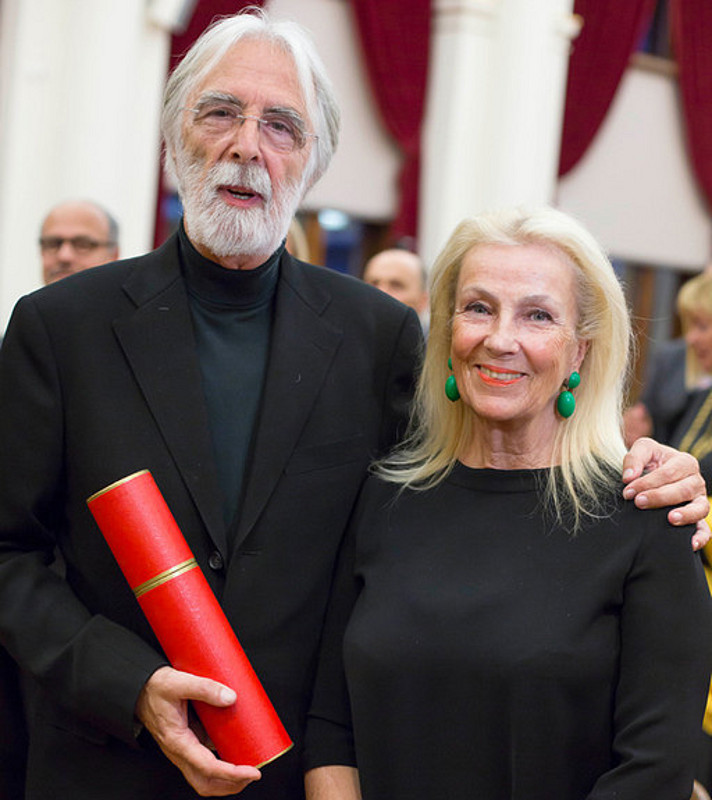
Frischgebackener Ehrendoktor mit Ehefrau Susanne Haneke
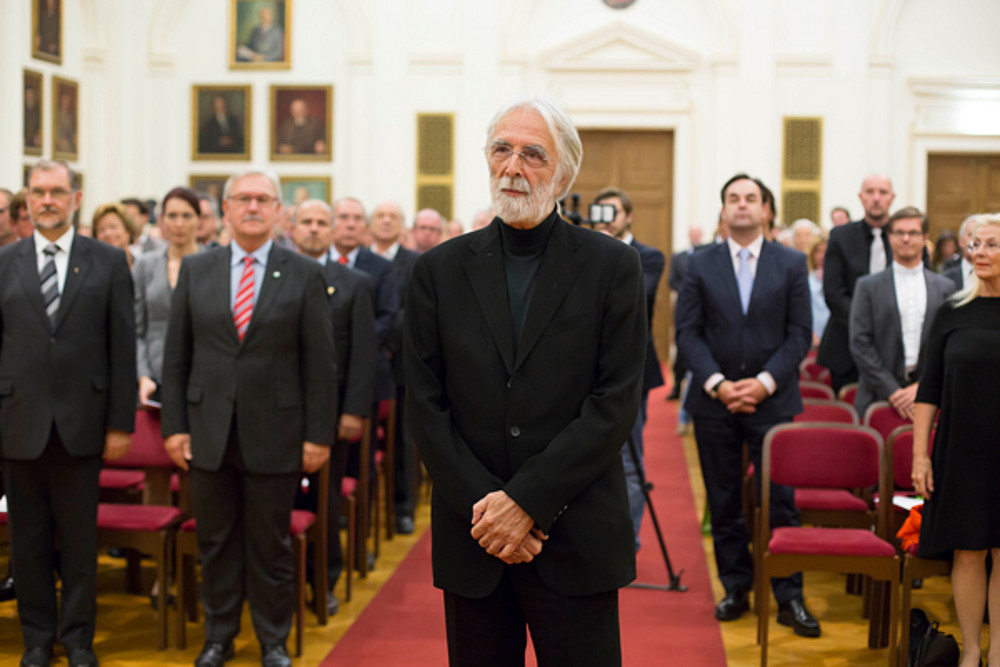
Frischgebackener Ehrendoktor mit Ehefrau Susanne Haneke

Haneke: „Es ist eine große Ehre, die mich außerordentlich freut."

Haneke: „Es ist eine große Ehre, die mich außerordentlich freut."

Michael Haneke zum Ehrendoktor der Theologie ernannt: Uni Graz würdigt wissenschaftliches Wirken des Regisseurs

Den Oscar, den Golden Globe und die goldene Palme hat er für sein filmisches Schaffen erhalten. Am 17. September 2013 wurde Erfolgsregisseur Michael Haneke mit dem Ehrendoktorat der Theologie der Karl-Franzens-Universität Graz ausgezeichnet.

Die Universität Graz würdigt mit der akademischen Anerkennung insbesondere das gesellschaftliche und wissenschaftliche Wirken des international höchst anerkannten Österreichers. Rektorin Christa Neuper verwies im Rahmen des Festaktes in der Aula der Uni Graz auf die Leistungen Michael Hanekes: „Seine Filme sind sowohl Forschungsgegenstand als auch Impuls für WissenschafterInnen der Universität.“ Daher hat der Senat auf Antrag der Katholisch-Theologischen Fakultät die Ehrung beschlossen.

Michael Haneke greift mit seinen Werken, wie „Das weiße Band“ (2009) und „Amour“ (2012), Fragestellungen auf, die sowohl soziologisch, philosophisch als auch zutiefst ethisch und theologisch relevant sind. Hans-Ferdinand Angel, Dekan der Katholisch-Theologischen Fakultät, führte aus: „Der Regisseur legt den Finger auf wunde Punkte unseres gesellschaftlichen Zusammenlebens, thematisiert auf immer neue Weise die Verfasstheit des Individuums sowie seine Hinwendung auf ein Anderes und stellt dies kritisch zur Diskussion.“

Gerhard Larcher, Professor für Fundamentaltheologie und Leiter des Forschungsschwerpunktes „Film und Medien“, arbeitet seit mehr als 20 Jahren mit dem Künstler zusammen. „Michael Haneke hat sich um die Wissenschaft sehr verdient gemacht, indem er wieder Gelegenheiten zu Filmsichtungen von noch nicht veröffentlichtem Material ermöglicht und Unterlagen wie Originaldrehbücher und Storyboards für Analysen zur Verfügung gestellt hat“, schilderte Larcher in seiner Laudatio – gemeinsam mit Franz Grabner, Leiter der ORF Kultur-Dokumentarfilmredaktion, sowie Christian Wessely, Vizedekan der Katholisch-Theologischen Fakultät, vorgetragen. „Dieser Kooperation verdanken das Institut sowie die Forschungsgruppe ,Film und Theologie‘ einen beträchtlichen Teil ihres wissenschaftlichen Outputs.“

„Es ist eine große Ehre, die mich außerordentlich freut“, dankte Michael Haneke der Katholisch-Theologischen Fakultät. Der Regisseur hob die kontinuierlichen und bereichernden Gespräche mit den WissenschafterInnen hervor: „Woher kommen wir? Wohin gehen wir? Das sind zentrale Fragen, die sowohl Theologen als auch Künstler beschäftigen.“


created by Andreas Schweiger

Related news

Higher Education Strategy 2040: Austria’s universities on course for the future

Austria has 77 higher education institutions, which is above the EU average – but does this really make sense? The new Higher Education Strategy 2040 focuses on cooperation rather than mergers. As one of the six largest universities in Austria, the University of Graz plays a central role in this.

Climate research in Greenland: Old data provides new insights

The polar explorer and University of Graz professor Alfred Wegener left behind a unique collection of climate data from Greenland. A research team from the University of Graz is now analysing this 100-year-old treasure trove of data and comparing it with current measurements.

Diversity in nature and science: How we talk about plants and each other

Ginkgo, kiwi, hemp: they exist as male and female plants. Anyone who paid attention in biology class will confirm this. But is this categorisation, established by Carl von Linné almost 300 years ago, still valid today? An interdisciplinary team at the University of Graz is questioning these attributions and using this as a starting point to provide food for thought for gender-sensitive interaction between students, scientific and teaching staff.

Around the world in eight stops: the Long Night of Research at the University of Graz

On 24 April from 5 pm, you can take a short trip around the globe at the University of Graz, discovering pecularities of foreign countries or new local features in the entrance hall of the University Library. The itinerary takes you through introduced animal species, political attitudes and the omnipotence of algorithms. There will also be a programme in the historic reading hall, as well as at the UniGraz@Museum and the University Archive.

Begin of page section:
Additional information:

University of Graz
Universitaetsplatz 3
8010 Graz
Austria
  • Contact
  • Web Editors
  • Moodle
  • UNIGRAZonline
  • Imprint
  • Data Protection Declaration
  • Accessibility Declaration
Weatherstation
Uni Graz

End of this page section. Go to overview of page sections

End of this page section. Go to overview of page sections

Begin of page section:

End of this page section. Go to overview of page sections