Begin of page section:
Page sections:

  • Go to contents (Accesskey 1)
  • Go to position marker (Accesskey 2)
  • Go to main navigation (Accesskey 3)
  • Go to sub navigation (Accesskey 4)
  • Go to additional information (Accesskey 5)
  • Go to page settings (user/language) (Accesskey 8)
  • Go to search (Accesskey 9)

End of this page section. Go to overview of page sections

Begin of page section:
Page settings:

English en
Deutsch de
Search
Login

End of this page section. Go to overview of page sections

Begin of page section:
Search:

Search for details about Uni Graz
Close

End of this page section. Go to overview of page sections


Search

Begin of page section:
Main navigation:

Page navigation:

  • University

    University
    • About the University
    • Organisation
    • Faculties
    • Library
    • Working at University of Graz
    • Campus
    Developing solutions for the world of tomorrow - that is our mission. Our students and our researchers take on the great challenges of society and carry the knowledge out.
  • Research Profile

    Research Profile
    • Our Expertise
    • Research Questions
    • Research Portal
    • Promoting Research
    • Research Transfer
    • Ethics in Research
    Scientific excellence and the courage to break new ground. Research at the University of Graz creates the foundations for making the future worth living.
  • Studies

    Studies
    • Prospective Students
    • Students
  • Community

    Community
    • International
    • Location
    • Research and Business
    • Alumni
    The University of Graz is a hub for international research and brings together scientists and business experts. Moreover, it fosters the exchange and cooperation in study and teaching.
  • Spotlight
Topics
  • Sustainable University
  • Researchers answer
  • Work for us
Close menu

End of this page section. Go to overview of page sections

Begin of page section:
You are here:

University of Graz News Römische Reise

End of this page section. Go to overview of page sections

Wednesday, 09 December 2020

Römische Reise

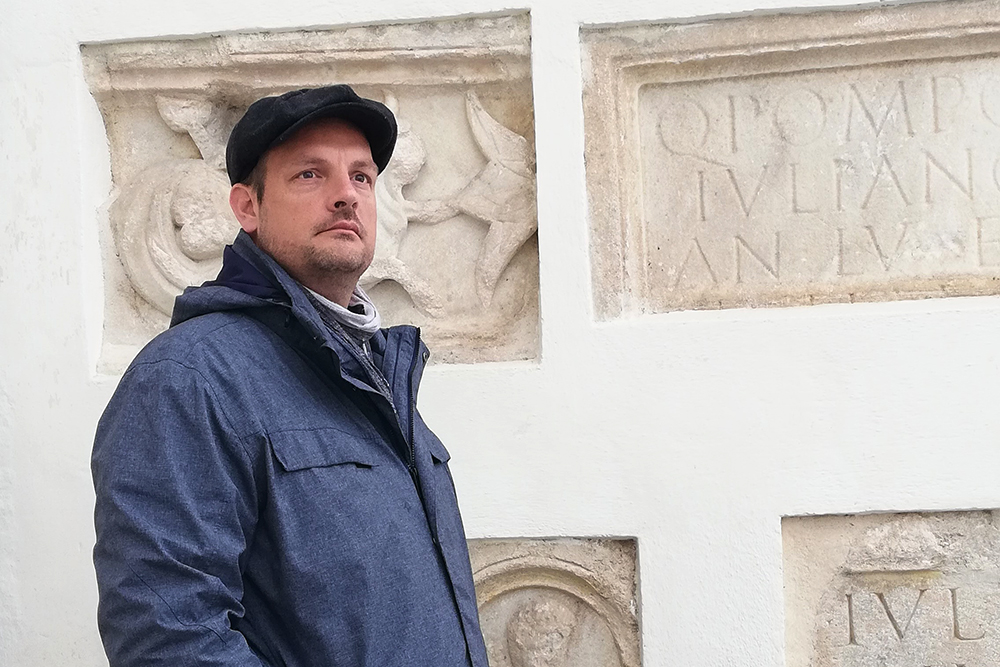
Ein ERC Grant-Projekt unter der Leitung von Leif Scheuermann folgt antiken Transportwegen zwischen Adria und Donau. Foto: Uni Graz/Scheuermann

Ein ERC Grant-Projekt unter der Leitung von Leif Scheuermann folgt antiken Transportwegen zwischen Adria und Donau. Foto: Uni Graz/Scheuermann

Mit dem Eselkarren auf dem Datenhighway: zwei Millionen-EU-Projekt an der Universität Graz folgt antiken Transportwegen zwischen Adria und Donau

Autobahnen, die uns schnell ans Mittelmeer bringen, sind keine Erfindung der Gegenwart. Bereits die RömerInnen verfügten über ein ausgeklügeltes Verkehrsnetz zwischen Adria und Donau. Diese vor allem für den Handel wichtigen Wege wird Leif Scheuermann, Wissenschafter am Zentrum für Informationsmodellierung der Universität Graz, digital wiederauferstehen lassen. Mithilfe einer der anerkanntesten und höchsten Forschungsförderungen der EU, einem ERC Grant in der Höhe von knapp zwei Millionen Euro.

Das Projekt STRADA wird uns ins erste Jahrhundert nach Christus zurückkatapultieren. Eine umfassende Darstellung soll die römischen Routen auf Land und Wasser exakt nachzeichnen. Wie schnell kam man in der Antike von Aquileia an der Adria ans heutige Enns an der Donau, auf Straßen und Flüssen, zu unterschiedlichen Jahreszeiten und bei jeder Witterung? Diese Fragen will Projektleiter und frisch gebackener ERC Grant-Träger Leif Scheuermann beantworten.

Wetter, Wägen, Wirtschaft
Der Historiker und sein Team werden dazu nicht nur die Verbindungen mit einem computergestützten Simulationssystem rekonstruieren, sondern wollen auch die einstigen Verhältnisse buchstäblich hautnah erlebbar machen. Menschen und Tiere, wie Maulesel und Pferde des österreichischen Bundesheeres, werden das Tragen der Lasten nachstellen. Originalgetreue Nachbauten von Schiffen und Karren – in Kooperation mit dem Archäologischen Park und Archäologiemuseum des Landschaftsverband Rheinland in Xanten (D) und der Universität Trier (D) – sollen das wirklichkeitsnahe Bild vervollständigen. Alle Daten werden schließlich miteinander verknüpft und auf einer webbasierten Plattform digital zusammenfließen.

Scheuermann: „Wir wollen wissen: Wie sind die Menschen früher mit Änderungen umgegangen und welche Auswirkungen hatte das auf die Ökonomie?“ Denn klar ist, so der Forscher, Transportzeiten spielen für den wirtschaftlichen Erfolg eine entscheidende Rolle. Damals wie heute. Ist es gegenwärtig die Corona-Pandemie, so beeinflusste möglicherweise im dritten Jahrhundert ein zunehmend kühleres Klima den Handel. Mit massiven Folgen, wie der Historiker vermutet: „Die vielen Luxusprodukte, für die die Römer bekannt sind, kamen nicht an die Donau, und das in den Alpen produzierte Fleisch erreichte nicht die Großstädte am Mittelmeer.“

STRADA (Simulation of Transport between the Adriatic Sea and the Danube) wird von der Europäischen Kommission in den kommenden fünf Jahren mit insgesamt 1,9 Millionen Euro gefördert.
Das Projekt ist an der Universität Graz im Profilbildenden Bereich „Dimensionen der Europäisierung“ verankert.

created by Andreas Schweiger

Related news

Cosmetics in the environment: University of Graz proves danger to ants

Titanium dioxide, which is found in cosmetics, for example, is increasingly entering the environment in the form of nanoparticles. This could also put insects at risk. If ants ingest the substance in combination with the pesticide glyphosate, it disturbs the development of their offspring. Scientists at the University of Graz are drawing attention to the negative consequences of this toxic cocktail.

How are tech companies changing democracy? Uni Graz designs exhibition for schools

Filtered information, conspiracy theories, fake news – certain groups and corporations are using social media and algorithms to try to influence public opinion in their favour. Their goal: to weaken fundamental rights and diversity of opinion and seize power. In a new exhibition, researchers at the University of Graz are working with pupils to explore the impact of social media and AI on democracy. In accompanying workshops, the scientists want to encourage young people to develop their own ideas for a socially and ecologically viable future and to actively help shape it. The exhibition, designed as a travelling exhibition for schools, will open on 9 March 2026 at the Dreihackengasse Gymnasium in Graz.

Step by step: What motivates Mireille van Poppel as a scientist and vice-rector

Improving people's health and eliminating inequalities: Mireille van Poppel pursues these goals both as a public health researcher and as vice-rector for Internationalisation and Equality. In both roles, she pays particular attention to individual needs.

Master's degree in psychotherapy in Graz: registration opens in March

Graz is becoming a hotspot for psychotherapy: from 2026, the University of Graz and the Medical University of Graz will jointly offer the new master's programme. Registration for the admission procedure for the 140 study places will start in March.

Begin of page section:
Additional information:

University of Graz
Universitaetsplatz 3
8010 Graz
Austria
  • Contact
  • Web Editors
  • Moodle
  • UNIGRAZonline
  • Imprint
  • Data Protection Declaration
  • Accessibility Declaration
Weatherstation
Uni Graz

End of this page section. Go to overview of page sections

End of this page section. Go to overview of page sections

Begin of page section:

End of this page section. Go to overview of page sections