Begin of page section:
Page sections:

  • Go to contents (Accesskey 1)
  • Go to position marker (Accesskey 2)
  • Go to main navigation (Accesskey 3)
  • Go to sub navigation (Accesskey 4)
  • Go to additional information (Accesskey 5)
  • Go to page settings (user/language) (Accesskey 8)
  • Go to search (Accesskey 9)

End of this page section. Go to overview of page sections

Begin of page section:
Page settings:

English en
Deutsch de
Search
Login

End of this page section. Go to overview of page sections

Begin of page section:
Search:

Search for details about Uni Graz
Close

End of this page section. Go to overview of page sections


Search

Begin of page section:
Main navigation:

Page navigation:

  • University

    University
    • About the University
    • Organisation
    • Faculties
    • Library
    • Working at University of Graz
    • Campus
    Developing solutions for the world of tomorrow - that is our mission. Our students and our researchers take on the great challenges of society and carry the knowledge out.
  • Research Profile

    Research Profile
    • Our Expertise
    • Research Questions
    • Research Portal
    • Promoting Research
    • Research Transfer
    • Ethics in Research
    Scientific excellence and the courage to break new ground. Research at the University of Graz creates the foundations for making the future worth living.
  • Studies

    Studies
    • Prospective Students
    • Students
  • Community

    Community
    • International
    • Location
    • Research and Business
    • Alumni
    The University of Graz is a hub for international research and brings together scientists and business experts. Moreover, it fosters the exchange and cooperation in study and teaching.
  • Spotlight
Topics
  • Our digital Advent calendar
  • Sustainable University
  • Researchers answer
  • Work for us
Close menu

End of this page section. Go to overview of page sections

Begin of page section:
You are here:

University of Graz News Rituals in the judiciary: between tradition and modernity

End of this page section. Go to overview of page sections

Wednesday, 19 February 2025

Rituals in the judiciary: between tradition and modernity

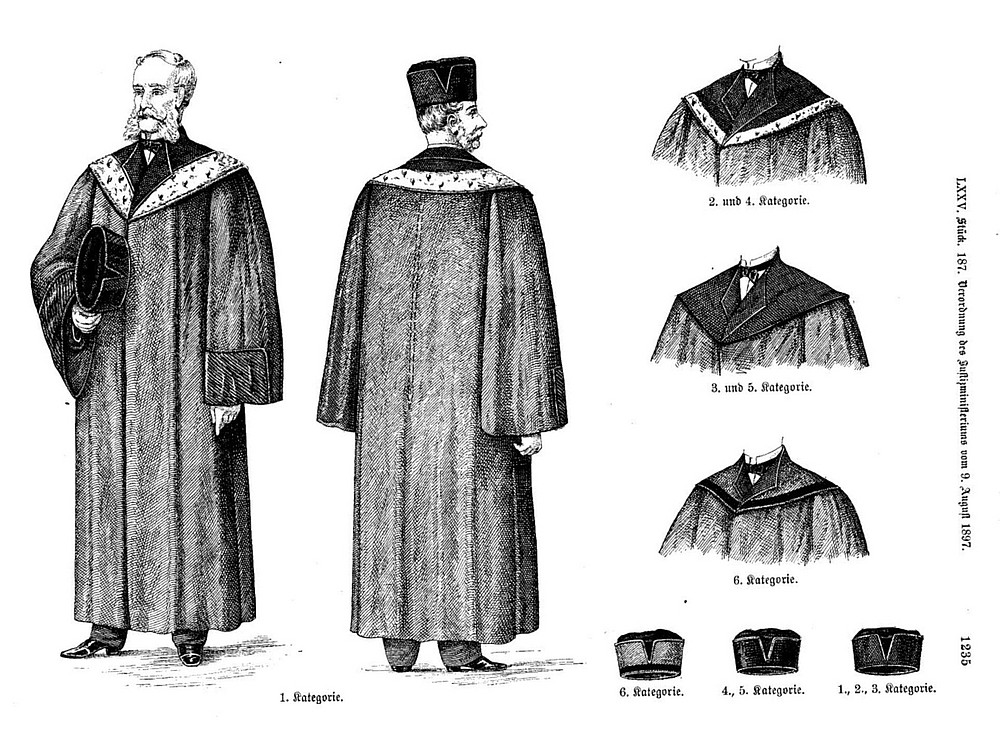
Historical copperplate engraving of robes for judges, black and white illustration, line drawing, flat design, front view and side views of a man wearing a robe with a cape over his shoulders and a cap on his head, in different poses, character sheet for book cover design in print style

The gown as a robe in court has a tradition going back centuries. Photo: Uni Graz/Kocher

From medieval court proceedings to the modern-day role of the lawyer, to today's social partnership: rituals in the legal and political spheres strengthen trust in state institutions and promote democracy. Some very old customs are still relevant today and influence our daily lives.

Gowns, gavel and solemn oaths – these are part of the rituals that have played an important role in the justice system for centuries. ‘To this day, there is the practice of cordoning off the court, that is, the inner area during a hearing,’ explains Gernot Kocher, emeritus professor of legal history. This was already common practice in the Middle Ages, although there were no courtrooms. ‘Back then, they simply used hazel branches to cordon it off.’

The robe also has a long history, says Kocher: ‘Originally it was the traditional clothing of priests and later of academics.’ After the reforms of Emperor Joseph I and the takeover of the administration of justice by lawyers, they also wore this robe in court.

Until then, lay jurisdiction had been the norm for centuries. ‘Farmers from the surrounding area were obliged to serve in the courts,’ explains Kocher. Today, there are once again courts of lay assessors and lay jurors. ‘But that is a development of the 20th century,’ says the expert. This is a revival of an old tradition.

There are very old rituals that are almost forgotten today, according to the legal historian. ‘In the past, it was common practice in some regions of Austria for the region's farmers to walk the fields together once a year and check the boundaries.’ With the introduction of the land registry and the cadastre, this custom lost its importance.

For the experienced lawyer, rituals in the legal field have an important function. “They strengthen the population's trust in the judiciary and at the same time convey a respectful distance”.

Strengthening democracy

Trust in state institutions strengthens democracy, explains Matthias Lukan, a professor at the Department of Public Law and Political Science. That is also one of the purposes of rituals such as the swearing-in, he says. ‘It starts at the very top with the federal government, which swears to uphold the law and the constitution before the federal president.’

This process is repeated every year when conscripts are sworn in before the Federal President or provincial governors. ‘There are even rituals for more menial positions. For example, members of the wine-tasting commissions have to swear an oath of neutrality,’ explains Lukan.

A uniquely Austrian ritual is the negotiations that take place within the framework of the social partnership. This developed in Austria after the Second World War, also with the history of the dictatorship in the corporate state in mind. ‘Every autumn, the representatives of employees and employers meet. Then, with much fanfare, their negotiations for salary adjustments begin,’ explains Lukan. The result is a ritual that many Austrians appreciate: the annual salary adjustment. A tradition that is by no means common in other countries.

created by Roman Vilgut

Related news

Chemical Christmas show at the University of Graz: An explosive evening at the Schauspielh

At the beginning of December, the University of Graz transformed the theater into a laboratory: as part of “Chemical Life,” teacher training students staged a chemical Christmas show for Styrian school classes—complete with ethanol rockets, nitrogen snow, and glowing effects. An evening designed to inspire interest in studying chemistry.

Train by train: Koralm railway accelerates exchange between the Universities

Lectures at the University of Klagenfurt in the morning, seminars at the University of Graz in the afternoon: Austria's longest tunnel and a journey time of around 45 minutes make it easy. The Koralm railway increases the speed of networking between the two university locations. The collaboration builds on existing cooperation - for example in the areas of teacher training, Slavic studies and as employers, the universities are well coordinated.

On the trail of the Big Bang: University of Graz receives 1.5 million euros for doctoral programmes

The Austrian Science Fund FWF has selected the Doctoral Programme in Theoretical Particle Physics at the University of Graz for funding from the Doc.funds. Six young scientists will be funded for 3.5 years. They will gain fundamentally new insights into the origins of the world.

From trans women and knee prostheses: sports science prizes awarded

Walking better with a prosthesis, successfully getting rid of excess weight, training more effectively, more fairness for trans people in sport: these were the topics addressed by the students at the University of Graz who were awarded the sports science prizes for their Master's theses on 3 December 2025.

Begin of page section:
Additional information:

University of Graz
Universitaetsplatz 3
8010 Graz
Austria
  • Contact
  • Web Editors
  • Moodle
  • UNIGRAZonline
  • Imprint
  • Data Protection Declaration
  • Accessibility Declaration
Weatherstation
Uni Graz

End of this page section. Go to overview of page sections

End of this page section. Go to overview of page sections

Begin of page section:

End of this page section. Go to overview of page sections