Begin of page section:
Page sections:

  • Go to contents (Accesskey 1)
  • Go to position marker (Accesskey 2)
  • Go to main navigation (Accesskey 3)
  • Go to sub navigation (Accesskey 4)
  • Go to additional information (Accesskey 5)
  • Go to page settings (user/language) (Accesskey 8)
  • Go to search (Accesskey 9)

End of this page section. Go to overview of page sections

Begin of page section:
Page settings:

English en
Deutsch de
Search
Login

End of this page section. Go to overview of page sections

Begin of page section:
Search:

Search for details about Uni Graz
Close

End of this page section. Go to overview of page sections


Search

Begin of page section:
Main navigation:

Page navigation:

  • University

    University
    • About the University
    • Organisation
    • Faculties
    • Library
    • Working at University of Graz
    • Campus
    Developing solutions for the world of tomorrow - that is our mission. Our students and our researchers take on the great challenges of society and carry the knowledge out.
  • Research Profile

    Research Profile
    • Our Expertise
    • Research Questions
    • Research Portal
    • Promoting Research
    • Research Transfer
    • Ethics in Research
    • Commission for Scientific Integrity
    Scientific excellence and the courage to break new ground. Research at the University of Graz creates the foundations for making the future worth living.
  • Studies

    Studies
    • Prospective Students
    • Students
    • Registration for Study Programme (Winter semester 2026/27)
  • Community

    Community
    • International
    • Location
    • Research and Business
    • Alumni
    The University of Graz is a hub for international research and brings together scientists and business experts. Moreover, it fosters the exchange and cooperation in study and teaching.
Topics
  • Sustainable University
  • Researchers answer
  • Work for us
Close menu

End of this page section. Go to overview of page sections

Begin of page section:
You are here:

University of Graz News Ring getauscht

End of this page section. Go to overview of page sections

Wednesday, 25 May 2022

Ring getauscht

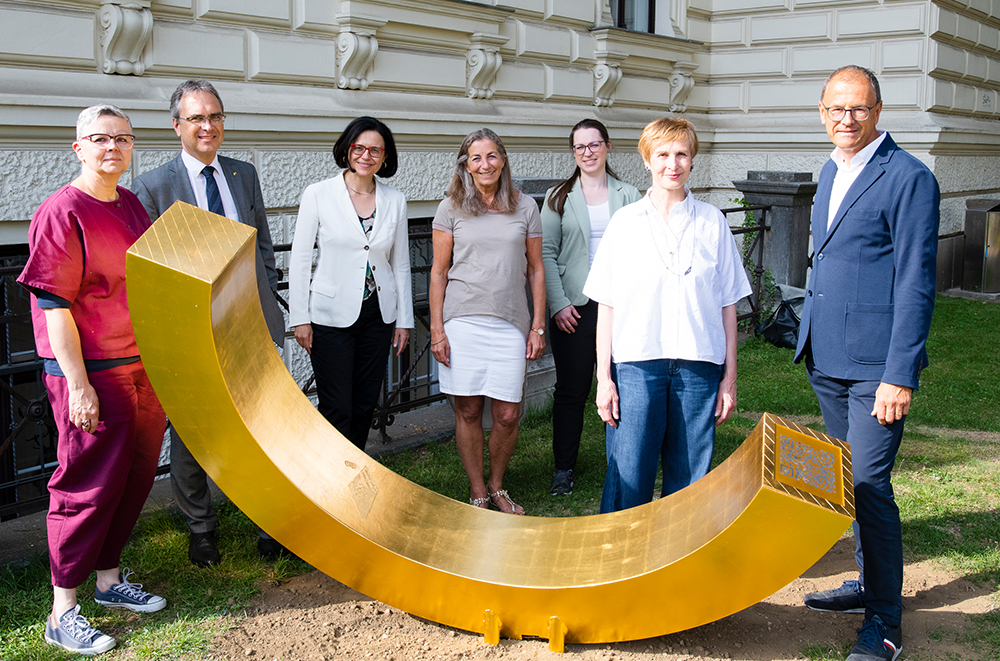
Erinnerung an eine Pionierin der Wissenschaft (v. l.): Renate Dworczak (Sonderbeauftragte für Gleichstellung hinsichtlich Gender und Diversität), Rektor Peter Riedler, Landtagsabgeordnete Sandra Holasek, Elisabeth Fiedler (Kunst im Außenraum), Gemeinderätin Manecke Maike, Künstlerin Barbara Edlinger und Universalmuseum-Direktor Wolfgang Muchitsch, Foto: Uni Graz/Tzivanopoulos ©Uni Graz/Tzivanopoulos

Erinnerung an eine Pionierin der Wissenschaft (v. l.): Renate Dworczak (Sonderbeauftragte für Gleichstellung hinsichtlich Gender und Diversität), Rektor Peter Riedler, Landtagsabgeordnete Sandra Holasek, Elisabeth Fiedler (Kunst im Außenraum), Gemeinderätin Manecke Maike, Künstlerin Barbara Edlinger und Universalmuseum-Direktor Wolfgang Muchitsch, Foto: Uni Graz/Tzivanopoulos

Denkmal für Medizinerin Oktavia Aigner-Rollett siedelte auf den Campus

Es ist heute nicht mehr vorstellbar, vor 117 Jahren war es aber eine Sensation: Dass eine Frau an der Universität Graz promovierte. Oktavia Aigner-Rollett war eine der ersten Medizinstudentinnen, die 1905 ihr Studium abschloss. An den Ort ihrer Promotion ist sie in Form eines Denkmals nun näher gerückt. Die vergoldete Ringskulptur aus Stahl steht vor dem Hauptgebäude der Uni Graz, wo das Kunstwerk nach der Restaurierung am 23. Mai 2022 feierlich wiederaufgestellt wurde. Zuvor stand die Installation, geschaffen von Barbara Edlinger, 25 Jahre lang im Bereich der Vorklinik in der Harrachgasse.
Der Innendurchmesser des halbierten Ringes entspricht übrigens der Körpergröße der Medizinerin. Die zweite Ringhälfte befindet sich beim Paulustor, wo einst das Allgemeine Krankenhaus, eine Wirkungsstätte von Aigner-Rollett, lag.

Künstlerin Barbara Edlinger verrät weitere Details des Denkmals: „Jede Ringskulptur ist in einer bestimmten Neigung zur Erdoberfläche aufgestellt, die dem Sonneneinfallswinkel zu ihrer Geburtsstunde und jenem zu ihrer Sterbestunde in Graz entspricht. Des Weiteren trägt die Ringskulptur – wie auch andere Schmuckstücke aus Edelmetall – eine ,Punzierung‘, die Aigner-Rolletts Geburts- und Sterbedatum beinhaltet.“
Im Zuge der Neuaufstellung wurden die Monitore an den Schnittstellen durch eingravierte QR-Codes ersetzt. Diese leiten Interessierte zu weiterführenden Angaben über Aigner-Rollett und sind gleichzeitig ein Interface für gegenwärtige frauenspezifische Anliegen.

>> Über Kunstwerke am Campus der Universität Graz mehr erfahren
created by Andreas Schweiger

Related news

Complying with the norm: Why Do Standards Shape Our Lives, Elisabeth Staudegger?

Standards determine whether a sheet of paper fits in a printer or whether a charging plug can power multiple devices. These standards shape our everyday lives. But who actually sets these standards? Where are the weaknesses, and how could science help to improve them? Elisabeth Staudegger, Head of the ‘Law and IT’ Department at the Institute for Legal Foundations at the University of Graz, host the Academic Standards Day on 16 June. Here she relays how sciences can contribute to the topic of standardisation and reveals her personal favourite standard.

More body awareness than a culture war

In Italy, sex education lessons will in future only be permitted with parental consent, and will be banned entirely in nurseries and primary schools. At the same time, Pride Month highlights why knowledge about the body, relationships, boundaries and diversity is important for young people. A study by the University of Graz shows how important knowledge about the body, contraception, relationship skills and protection against violence is

Will Austria win the World Cup? Mathematician reveals calculation method

Michael Fischer uses the football tournament as a practical example for highschool lessons.

Survival strategies: How plants respond to drought

According to Geosphere Austria, this spring was the driest in Austria since records began around 170 years ago. The low rainfall put particular pressure on the agricultural sector. And climate change is set to make the situation even worse in the coming decades. We asked Johannes Liesche, a professor at the Department of Biology at the University of Graz, how plants react to water shortages and how they survive periods of drought.

Begin of page section:
Additional information:

University of Graz
Universitaetsplatz 3
8010 Graz
Austria
  • Contact
  • Web Editors
  • Moodle
  • UNIGRAZonline
  • Imprint
  • Data Protection Declaration
  • Accessibility Declaration
Weatherstation
Uni Graz

End of this page section. Go to overview of page sections

End of this page section. Go to overview of page sections

Begin of page section:

End of this page section. Go to overview of page sections