Begin of page section:
Page sections:

  • Go to contents (Accesskey 1)
  • Go to position marker (Accesskey 2)
  • Go to main navigation (Accesskey 3)
  • Go to sub navigation (Accesskey 4)
  • Go to additional information (Accesskey 5)
  • Go to page settings (user/language) (Accesskey 8)
  • Go to search (Accesskey 9)

End of this page section. Go to overview of page sections

Begin of page section:
Page settings:

English en
Deutsch de
Search
Login

End of this page section. Go to overview of page sections

Begin of page section:
Search:

Search for details about Uni Graz
Close

End of this page section. Go to overview of page sections


Search

Begin of page section:
Main navigation:

Page navigation:

  • University

    University
    • About the University
    • Organisation
    • Faculties
    • Library
    • Working at University of Graz
    • Campus
    Developing solutions for the world of tomorrow - that is our mission. Our students and our researchers take on the great challenges of society and carry the knowledge out.
  • Research Profile

    Research Profile
    • Our Expertise
    • Research Questions
    • Research Portal
    • Promoting Research
    • Research Transfer
    • Ethics in Research
    Scientific excellence and the courage to break new ground. Research at the University of Graz creates the foundations for making the future worth living.
  • Studies

    Studies
    • Prospective Students
    • Students
  • Community

    Community
    • International
    • Location
    • Research and Business
    • Alumni
    The University of Graz is a hub for international research and brings together scientists and business experts. Moreover, it fosters the exchange and cooperation in study and teaching.
  • Spotlight
Topics
  • Our digital Advent calendar
  • Sustainable University
  • Researchers answer
  • Work for us
Close menu

End of this page section. Go to overview of page sections

Begin of page section:
You are here:

University of Graz News Richtungsweisend

End of this page section. Go to overview of page sections

Thursday, 17 February 2022

Richtungsweisend

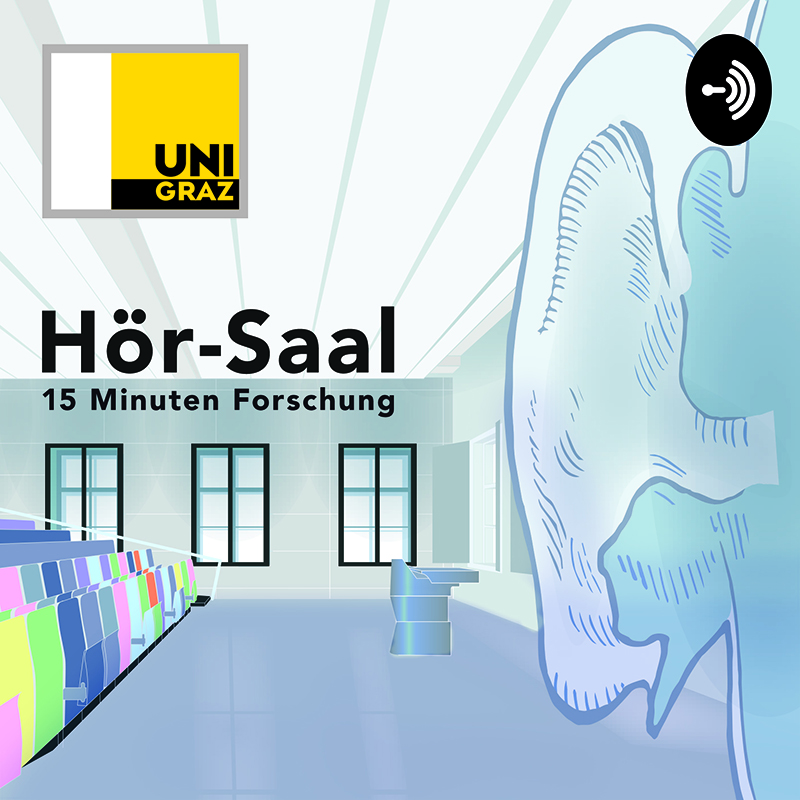
Den Wissenschaftspodcast "HörSaal: 15 Minuten Forschung" gibt es auf UniTube sowie verschiedenen Plattformen, etwa Spotify oder Apple Podcasts, zu hören bzw. zu abonnieren. Sujet: Uni Graz/Roman Klug.

Den Wissenschaftspodcast "HörSaal: 15 Minuten Forschung" gibt es auf UniTube sowie verschiedenen Plattformen, etwa Spotify oder Apple Podcasts, zu hören bzw. zu abonnieren. Sujet: Uni Graz/Roman Klug.

Wohin entwickelt sich das Sars-Cov2-Virus? Ökonom Patrick Mellacher erklärt im Podcast, wie er den Schweregrad künftiger Mutationen simuliert

Der Höhepunkt der Omikron-Welle sollte bald vorbei sein, Öffnungsschritte hat die Regierung für die nächsten zwei Wochen in Aussicht gestellt. Trotzdem wissen wir nicht genau, wie sich weitere Varianten des Sars-CoV2-Virus verhalten werden. Der Ökonom und Simulationsexperte Patrick Mellacher hat ein Modell entwickelt, mit dem man aber unter anderem den Schweregrad von Virusmutationen simulieren kann. Seine Prognose: Das Coronavirus wird aufgrund zunehmender Immunität im Durchschnitt weniger tödlich werden, aber hochansteckend bleiben. Mehr dazu hören Sie in der aktuellen Folge des Wissenschaftspodcasts „HörSaal: 15 Minuten Forschung.“

>> Zum Podcast auf UniTube, Apple Podcasts, Spotify und anchor.fm
 

Zur Person:
Patrick Mellacher forscht seit März 2020 am Schumpeter Centre der Universität Graz mit Hilfe von Simulationsmodellen und empirischen Analysen zu verschiedenen Aspekten der Covid-19 Krise. Sein ökonomisch-epidemiologisches Modell „COVID-Town“ wurde kürzlich mit dem Herbert Simon Young Scholar Prize 2021 ausgezeichnet und bildet die Basis für ein FWF-Projekt, in dem er seit Februar 2022 als PostDoc arbeitet. >> mehr erfahren


Weiterführende Infos:

>> Artikel "Endogenous viral mutations, evolutionary selection, and containment policy design" im Journal of Economic Interaction and Coordination (2022)

>> Direkter Link zu dem von Patrick Mellacher entwickelten Modell

>> Mehr zum FWF-Projekt „Agent-based Economic Epidemiology“

created by Gerhild Leljak

Related news

Chemical Christmas show at the University of Graz: An explosive evening at the Schauspielh

At the beginning of December, the University of Graz transformed the theater into a laboratory: as part of “Chemical Life,” teacher training students staged a chemical Christmas show for Styrian school classes—complete with ethanol rockets, nitrogen snow, and glowing effects. An evening designed to inspire interest in studying chemistry.

Train by train: Koralm railway accelerates exchange between the Universities

Lectures at the University of Klagenfurt in the morning, seminars at the University of Graz in the afternoon: Austria's longest tunnel and a journey time of around 45 minutes make it easy. The Koralm railway increases the speed of networking between the two university locations. The collaboration builds on existing cooperation - for example in the areas of teacher training, Slavic studies and as employers, the universities are well coordinated.

On the trail of the Big Bang: University of Graz receives 1.5 million euros for doctoral programmes

The Austrian Science Fund FWF has selected the Doctoral Programme in Theoretical Particle Physics at the University of Graz for funding from the Doc.funds. Six young scientists will be funded for 3.5 years. They will gain fundamentally new insights into the origins of the world.

From trans women and knee prostheses: sports science prizes awarded

Walking better with a prosthesis, successfully getting rid of excess weight, training more effectively, more fairness for trans people in sport: these were the topics addressed by the students at the University of Graz who were awarded the sports science prizes for their Master's theses on 3 December 2025.

Begin of page section:
Additional information:

University of Graz
Universitaetsplatz 3
8010 Graz
Austria
  • Contact
  • Web Editors
  • Moodle
  • UNIGRAZonline
  • Imprint
  • Data Protection Declaration
  • Accessibility Declaration
Weatherstation
Uni Graz

End of this page section. Go to overview of page sections

End of this page section. Go to overview of page sections

Begin of page section:

End of this page section. Go to overview of page sections