Begin of page section:
Page sections:

  • Go to contents (Accesskey 1)
  • Go to position marker (Accesskey 2)
  • Go to main navigation (Accesskey 3)
  • Go to sub navigation (Accesskey 4)
  • Go to additional information (Accesskey 5)
  • Go to page settings (user/language) (Accesskey 8)
  • Go to search (Accesskey 9)

End of this page section. Go to overview of page sections

Begin of page section:
Page settings:

English en
Deutsch de
Search
Login

End of this page section. Go to overview of page sections

Begin of page section:
Search:

Search for details about Uni Graz
Close

End of this page section. Go to overview of page sections


Search

Begin of page section:
Main navigation:

Page navigation:

  • University

    University
    • About the University
    • Organisation
    • Faculties
    • Library
    • Working at University of Graz
    • Campus
    Developing solutions for the world of tomorrow - that is our mission. Our students and our researchers take on the great challenges of society and carry the knowledge out.
  • Research Profile

    Research Profile
    • Our Expertise
    • Research Questions
    • Research Portal
    • Promoting Research
    • Research Transfer
    • Ethics in Research
    • Commission for Scientific Integrity
    Scientific excellence and the courage to break new ground. Research at the University of Graz creates the foundations for making the future worth living.
  • Studies

    Studies
    • Prospective Students
    • Students
    • Registration for Study Programme (Winter semester 2026/27)
  • Community

    Community
    • International
    • Location
    • Research and Business
    • Alumni
    The University of Graz is a hub for international research and brings together scientists and business experts. Moreover, it fosters the exchange and cooperation in study and teaching.
Topics
  • Sustainable University
  • Researchers answer
  • Work for us
Close menu

End of this page section. Go to overview of page sections

Begin of page section:
You are here:

University of Graz News Resistente Keime

End of this page section. Go to overview of page sections

Friday, 05 May 2017

Resistente Keime

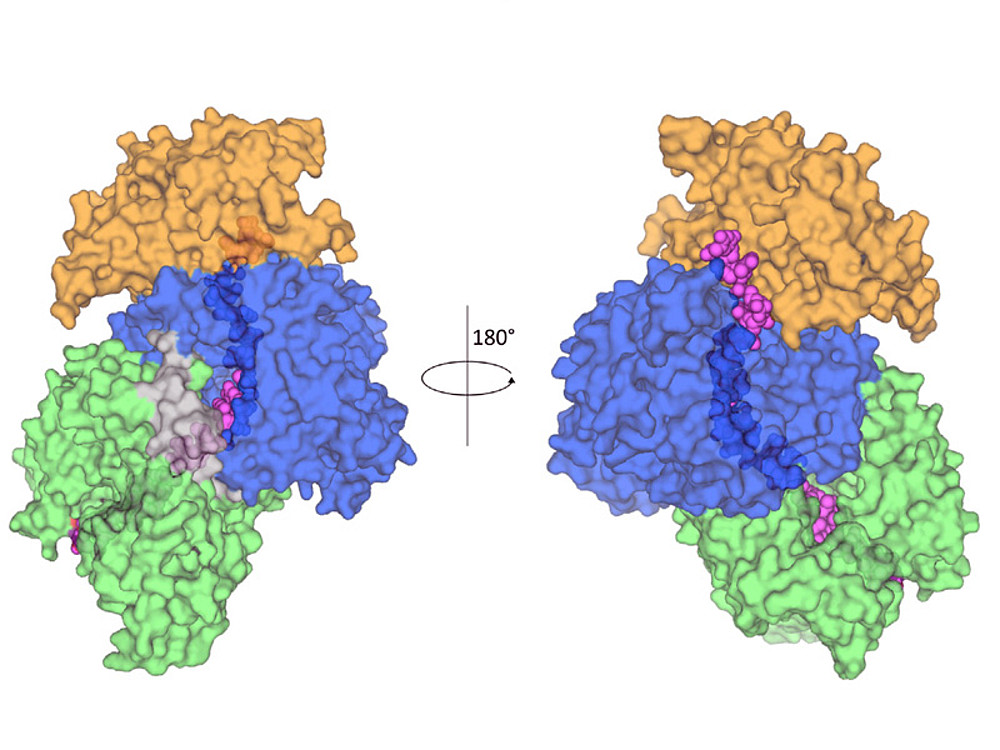
Das Enzym Relaxase mit seiner "Fracht", einem DNA-Stück (in Pink): Das Wissen um die Struktur soll helfen, Antibiotika-Resistenzen einzudämmen. Grafik: Ilangovan et al., Cell, CC BY (https://creativecommons.org/licenses/by/4.0/)
Das Enzym Relaxase mit seiner "Fracht", einem DNA-Stück (in Pink): Das Wissen um die Struktur soll helfen, Antibiotika-Resistenzen einzudämmen. Grafik: Ilangovan et al., Cell, CC BY (https://creativecommons.org/licenses/by/4.0/)

ForscherInnen aus Graz und London entschlüsseln Gen-Übertragung zwischen Bakterien

Die weltweit rasant wachsende Zahl an Bakterienstämmen, denen Antibiotika nichts mehr anhaben können, stellt Medizin und Forschung vor große Herausforderungen. Einer Lösung ist Ao.Univ.-Prof. Dr. Ellen Zechner vom Institut für Molekulare Biowissenschaften der Uni Graz einen großen Schritt näher gekommen. Sie hat mit ihrer Arbeitsgruppe und KooperationspartnerInnen in London die Struktur des Enzyms Relaxase entschlüsselt, das mithilft, DNA zwischen Bakterien auszutauschen. Durch diesen Vorgang können ganze Populationen von Krankheitserregern binnen kürzester Zeit gegen verschiedene Antibiotika resistent werden. Die neuesten Erkenntnisse zu Aufbau, Arbeitsweise und Eigenschaften des Enzyms wurden in der aktuellen Ausgabe des Fachmagazins Cell publiziert.

Dass Bakterien grundsätzlich Erbinformationen austauschen können, ist bereits seit den 1950er-Jahren bekannt. „Trotz intensiver Forschung ist es uns erst jetzt gelungen, die Struktur des dafür verantwortlichen Schlüsselenzyms zu bestimmen“, unterstreicht Zechner die Bedeutung der bahnbrechenden Entdeckung. Dadurch können erstmals entscheidende Vorgänge während der Weitergabe von DNA erklärt werden. Das liefert völlig neue Anhaltspunkte, um die Relaxase auszuschalten und damit die Verbreitung von Antibiotika-Resistenzen einzudämmen. „Unsere Erkenntnisse könnten dazu beitragen, neue Wirkstoffe zu entwickeln, die den Austausch von Genen zwischen Bakterien unterbinden. Bisherige Versuche waren unter anderem deswegen nur mäßig erfolgreich, weil wir kein detailliertes Bild des Enzyms hatten“, schildert die Molekularbiologin.

Die Relaxase wählt gezielt Erbinformationen aus, durchtrennt die beiden DNA-Stränge und transportiert einen davon durch einen Tunnel in das Nachbarbakterium. Der jeweils fehlende Strang wird in kürzester Zeit wieder nachgebildet. Die so übertragene Immunität gegen bestimmte Medikamente kann nun von beiden Bakterien wiederum weitergegeben werden. „Binnen Minuten werden große Mengen an DNA übertragen. Das erklärt, warum sich Antibiotikaresistenzen derart rasant ausbreiten“, schildert Zechner.

An der Erforschung des Enzyms war im Rahmen von BioTechMed-Graz auch Dr. Sandro Roier vom Institut für Molekulare Biowissenschaften der Uni Graz beteiligt. Zur Entschlüsselung der Struktur hat Prof. Gabriel Waksman vom University College London maßgeblich beigetragen.

Publikation:
Aravindan Ilangovan, Christopher W.M. Kay, Sandro Roier, Hassane El Mkami, Enrico Salvadori, Ellen L. Zechner, Giulia Zanetti, Gabriel Waksman: „Cryo-EM Structure of a Relaxase Reveals the Molecular Basis of DNA Unwinding during Bacterial Conjugation“, Cell (2017)

created by Dagmar Eklaude

Related news

In hot water: New Report reveals record losses in glaciers, permafrost and snow cover

Climate change is driving up temperatures not only in summer. Winters are also getting warmer – with dramatic consequences for glaciers, permafrost, snow cover and the freezing of lakes. The recently published cryosphere report provides specific figures for Austria. “Our monitoring shows a clear trend with record losses of ice and snow,” says project leader Wolfgang Schöner from the University of Graz.

Theologian at the University of Graz: What the excommunication of the Society of St Pius X

Following the schism involving the Society of St Pius X, there is a need for discussion. Bernd Hillebrand from the University of Graz explains why the Vatican took this step, what role anti-democratic tendencies play, and why the Society’s sacraments are no longer recognised as valid under canon law for Catholics with immediate effect.

“HeinrichBiCool”: University of Graz demonstrates the effects of green facades and roofs

The University of Graz has launched a pioneering project at the University Centre for Theology. Its name, “HeinrichBiCool”, says it all: a comprehensive system of green facades and roof will cool the building at Heinrichstraße 80 during the summer. At the same time, this will create a new habitat for plants and animals, helping to increase biodiversity. The accompanying monitoring programme will provide detailed data on the impact of the measures on indoor climate, energy consumption and biodiversity. The findings will lay a scientifically sound foundation for further projects aimed at making cities sustainable, climate-resilient and liveable. The partners in this project, funded by the Austrian Research Promotion Agency (FFG), are AEE INTEC – Institute for Sustainable Technologies, Technisches Büro Siegfried Stark, the landscape architecture and urban planning firm “studio boden”, and Ökoteam Graz.

When stress melts away in your mouth: nicotine pouches are widespread among Styrian students

Sociologists at the University of Graz, in collaboration with VIVID – the Centre for Addiction Prevention, have carried out a survey involving more than 600 participants. Around a quarter of them use these products. The ability to use them discreetly and flexibly is a key motivation.

Begin of page section:
Additional information:

University of Graz
Universitaetsplatz 3
8010 Graz
Austria
  • Contact
  • Web Editors
  • Moodle
  • UNIGRAZonline
  • Imprint
  • Data Protection Declaration
  • Accessibility Declaration
Weatherstation
Uni Graz

End of this page section. Go to overview of page sections

End of this page section. Go to overview of page sections

Begin of page section:

End of this page section. Go to overview of page sections