Begin of page section:
Page sections:

  • Go to contents (Accesskey 1)
  • Go to position marker (Accesskey 2)
  • Go to main navigation (Accesskey 3)
  • Go to sub navigation (Accesskey 4)
  • Go to additional information (Accesskey 5)
  • Go to page settings (user/language) (Accesskey 8)
  • Go to search (Accesskey 9)

End of this page section. Go to overview of page sections

Begin of page section:
Page settings:

English en
Deutsch de
Search
Login

End of this page section. Go to overview of page sections

Begin of page section:
Search:

Search for details about Uni Graz
Close

End of this page section. Go to overview of page sections


Search

Begin of page section:
Main navigation:

Page navigation:

  • University

    University
    • About the University
    • Organisation
    • Faculties
    • Library
    • Working at University of Graz
    • Campus
    Developing solutions for the world of tomorrow - that is our mission. Our students and our researchers take on the great challenges of society and carry the knowledge out.
  • Research Profile

    Research Profile
    • Our Expertise
    • Research Questions
    • Research Portal
    • Promoting Research
    • Research Transfer
    • Ethics in Research
    Scientific excellence and the courage to break new ground. Research at the University of Graz creates the foundations for making the future worth living.
  • Studies

    Studies
    • Prospective Students
    • Students
  • Community

    Community
    • International
    • Location
    • Research and Business
    • Alumni
    The University of Graz is a hub for international research and brings together scientists and business experts. Moreover, it fosters the exchange and cooperation in study and teaching.
  • Spotlight
Topics
  • Our digital Advent calendar
  • Sustainable University
  • Researchers answer
  • Work for us
Close menu

End of this page section. Go to overview of page sections

Begin of page section:
You are here:

University of Graz News Resistente Keime

End of this page section. Go to overview of page sections

Friday, 05 May 2017

Resistente Keime

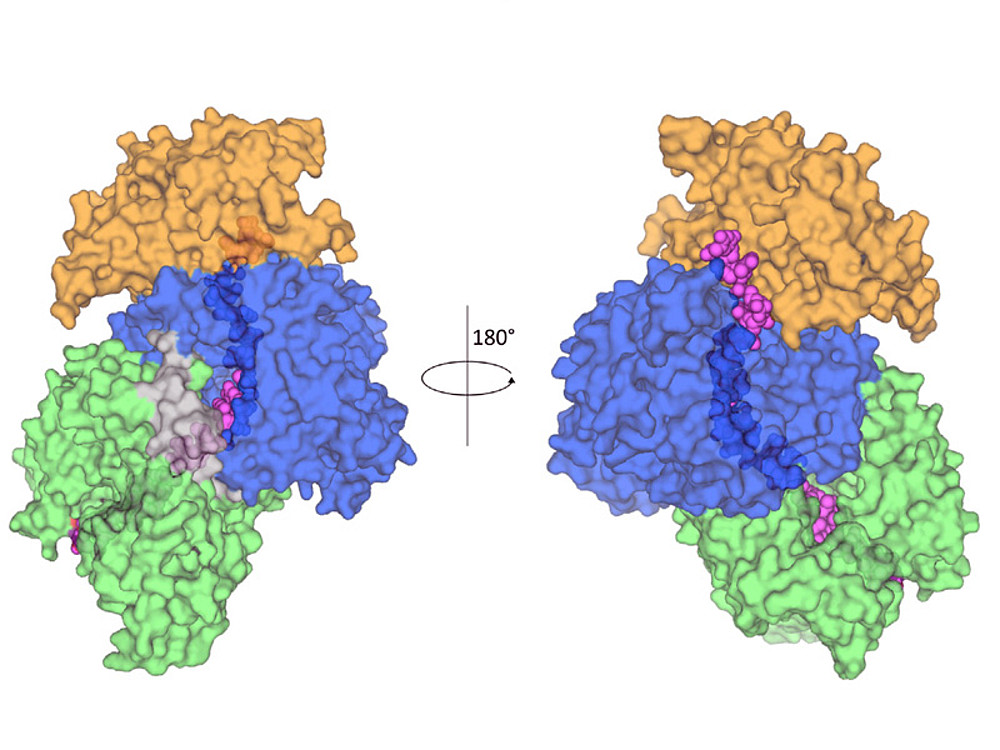
Das Enzym Relaxase mit seiner "Fracht", einem DNA-Stück (in Pink): Das Wissen um die Struktur soll helfen, Antibiotika-Resistenzen einzudämmen. Grafik: Ilangovan et al., Cell, CC BY (https://creativecommons.org/licenses/by/4.0/)

Das Enzym Relaxase mit seiner "Fracht", einem DNA-Stück (in Pink): Das Wissen um die Struktur soll helfen, Antibiotika-Resistenzen einzudämmen. Grafik: Ilangovan et al., Cell, CC BY (https://creativecommons.org/licenses/by/4.0/)

ForscherInnen aus Graz und London entschlüsseln Gen-Übertragung zwischen Bakterien

Die weltweit rasant wachsende Zahl an Bakterienstämmen, denen Antibiotika nichts mehr anhaben können, stellt Medizin und Forschung vor große Herausforderungen. Einer Lösung ist Ao.Univ.-Prof. Dr. Ellen Zechner vom Institut für Molekulare Biowissenschaften der Uni Graz einen großen Schritt näher gekommen. Sie hat mit ihrer Arbeitsgruppe und KooperationspartnerInnen in London die Struktur des Enzyms Relaxase entschlüsselt, das mithilft, DNA zwischen Bakterien auszutauschen. Durch diesen Vorgang können ganze Populationen von Krankheitserregern binnen kürzester Zeit gegen verschiedene Antibiotika resistent werden. Die neuesten Erkenntnisse zu Aufbau, Arbeitsweise und Eigenschaften des Enzyms wurden in der aktuellen Ausgabe des Fachmagazins Cell publiziert.

Dass Bakterien grundsätzlich Erbinformationen austauschen können, ist bereits seit den 1950er-Jahren bekannt. „Trotz intensiver Forschung ist es uns erst jetzt gelungen, die Struktur des dafür verantwortlichen Schlüsselenzyms zu bestimmen“, unterstreicht Zechner die Bedeutung der bahnbrechenden Entdeckung. Dadurch können erstmals entscheidende Vorgänge während der Weitergabe von DNA erklärt werden. Das liefert völlig neue Anhaltspunkte, um die Relaxase auszuschalten und damit die Verbreitung von Antibiotika-Resistenzen einzudämmen. „Unsere Erkenntnisse könnten dazu beitragen, neue Wirkstoffe zu entwickeln, die den Austausch von Genen zwischen Bakterien unterbinden. Bisherige Versuche waren unter anderem deswegen nur mäßig erfolgreich, weil wir kein detailliertes Bild des Enzyms hatten“, schildert die Molekularbiologin.

Die Relaxase wählt gezielt Erbinformationen aus, durchtrennt die beiden DNA-Stränge und transportiert einen davon durch einen Tunnel in das Nachbarbakterium. Der jeweils fehlende Strang wird in kürzester Zeit wieder nachgebildet. Die so übertragene Immunität gegen bestimmte Medikamente kann nun von beiden Bakterien wiederum weitergegeben werden. „Binnen Minuten werden große Mengen an DNA übertragen. Das erklärt, warum sich Antibiotikaresistenzen derart rasant ausbreiten“, schildert Zechner.

An der Erforschung des Enzyms war im Rahmen von BioTechMed-Graz auch Dr. Sandro Roier vom Institut für Molekulare Biowissenschaften der Uni Graz beteiligt. Zur Entschlüsselung der Struktur hat Prof. Gabriel Waksman vom University College London maßgeblich beigetragen.

Publikation:
Aravindan Ilangovan, Christopher W.M. Kay, Sandro Roier, Hassane El Mkami, Enrico Salvadori, Ellen L. Zechner, Giulia Zanetti, Gabriel Waksman: „Cryo-EM Structure of a Relaxase Reveals the Molecular Basis of DNA Unwinding during Bacterial Conjugation“, Cell (2017)

created by Dagmar Eklaude

Related news

Rector Peter Riedler: Starting the year with confidence

In 2026, we will continue to work consistently on positioning the University of Graz as a relevant player in Europe, while at the same time focusing on a modern, sustainable and climate-friendly university campus. When new digital applications are rolled out in January, we will not only create a stable and secure IT environment, but also modern working and studying conditions for future generations. Peter Rielder, Rector of the University of Graz

Uni Vibes 2026: the campus festival that transcends borders again

On 29 May 2026, it's that time again: the University of Graz celebrates, dances and vibrates. The campus will become a stage for art, science and music.

Setback: Austria's greenhouse gas emissions rise in 2025

Climate protection is currently facing an uphill battle. The United Nations have recently been unable to agree on a roadmap for phasing out fossil fuels, even though global warming continues to accelerate. Also Austria still does not have a national climate law with a clear target path for reducing emissions. This is evidently taking its toll: Austria’s greenhouse gas emissions rose again in 2025 for the first time in years, by around two and a half percent, according to calculations by researchers at the University of Graz. In addition to overly cautious climate action measures, this is due to somewhat colder winter months compared to 2024, which are driving up natural gas consumption.

Profound: Geoscientist Marko Bermanec deciphers processes of the Earth's plates

What happens deep down is very important to us above ground. Especially when hidden chemical processes between tectonic plates have serious consequences. Earth scientist Marko Bermanec investigates these processes in depth.

Begin of page section:
Additional information:

University of Graz
Universitaetsplatz 3
8010 Graz
Austria
  • Contact
  • Web Editors
  • Moodle
  • UNIGRAZonline
  • Imprint
  • Data Protection Declaration
  • Accessibility Declaration
Weatherstation
Uni Graz

End of this page section. Go to overview of page sections

End of this page section. Go to overview of page sections

Begin of page section:

End of this page section. Go to overview of page sections