Begin of page section:
Page sections:

  • Go to contents (Accesskey 1)
  • Go to position marker (Accesskey 2)
  • Go to main navigation (Accesskey 3)
  • Go to sub navigation (Accesskey 4)
  • Go to additional information (Accesskey 5)
  • Go to page settings (user/language) (Accesskey 8)
  • Go to search (Accesskey 9)

End of this page section. Go to overview of page sections

Begin of page section:
Page settings:

English en
Deutsch de
Search
Login

End of this page section. Go to overview of page sections

Begin of page section:
Search:

Search for details about Uni Graz
Close

End of this page section. Go to overview of page sections


Search

Begin of page section:
Main navigation:

Page navigation:

  • University

    University
    • About the University
    • Organisation
    • Faculties
    • Library
    • Working at University of Graz
    • Campus
    Developing solutions for the world of tomorrow - that is our mission. Our students and our researchers take on the great challenges of society and carry the knowledge out.
  • Research Profile

    Research Profile
    • Our Expertise
    • Research Questions
    • Research Portal
    • Promoting Research
    • Research Transfer
    • Ethics in Research
    Scientific excellence and the courage to break new ground. Research at the University of Graz creates the foundations for making the future worth living.
  • Studies

    Studies
    • Prospective Students
    • Students
  • Community

    Community
    • International
    • Location
    • Research and Business
    • Alumni
    The University of Graz is a hub for international research and brings together scientists and business experts. Moreover, it fosters the exchange and cooperation in study and teaching.
  • Spotlight
Topics
  • Our digital Advent calendar
  • Sustainable University
  • Researchers answer
  • Work for us
Close menu

End of this page section. Go to overview of page sections

Begin of page section:
You are here:

University of Graz News Researchers at the University of Graz show how matter can be created out of nowhere

End of this page section. Go to overview of page sections

Friday, 01 September 2023

Researchers at the University of Graz show how matter can be created out of nowhere

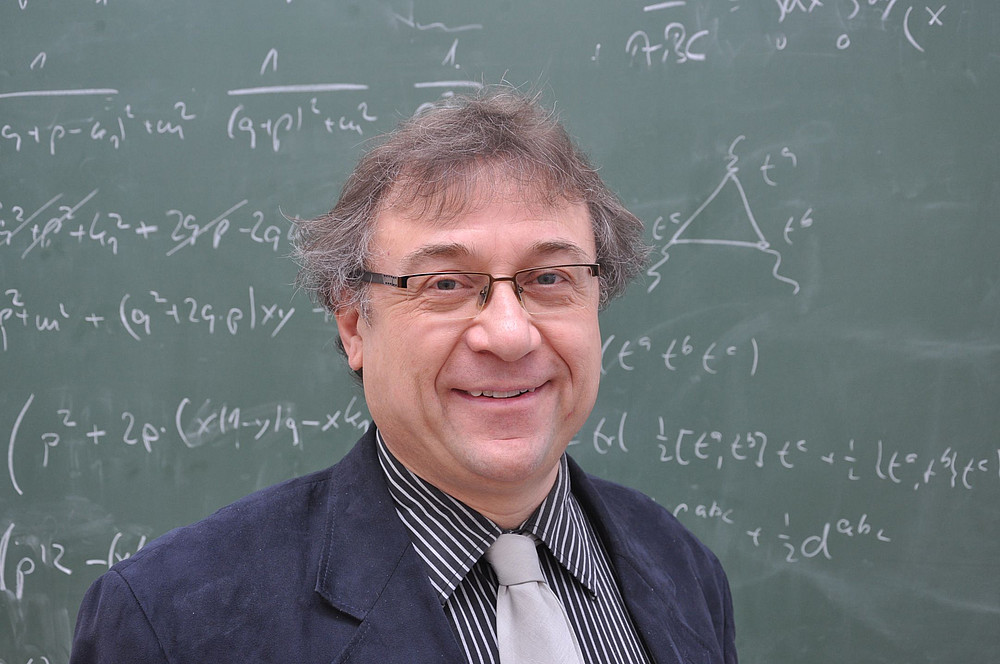
Particle physicist Reinhard Alkofer researches the fundamentals of matter

Particle physicist Reinhard Alkofer researches the fundamentals of matter

Theoretical physicists at the University of Graz and the Helmholtz-Zentrum Dresden-Rossendorf (HZDR) are identifying an extremely short time window in which electrons can be created from strong electric fields in a vacuum.

Mass can be converted into energy and vice versa energy into mass. This basic law of mass–energy equivalence goes back to the Special Relativity, which Albert Einstein established in 1905 and describes with his probably most famous formula E=mc2. Both fission and fusion of atomic nuclei are real examples of how huge amounts of energy can be produced from little mass. However, only a few experiments have so far succeeded in generating mass from energy. A theoretically possible path for the formation of matter in the form of electrons and positrons is opened up by extremely strong electric fields in a vacuum, from which these particles can emerge spontaneously. Matthias Diez and Reinhard Alkofer from the University of Graz, together with Christian Kohlfürst from the Helmholtz-Zentrum Dresden-Rossendorf (HZDR), have now been able to explain precisely this phenomenon in greater detail than before using extremely precise calculations.

An extremely high electrical voltage in a vacuum can cause matter to form in the form of electrons and positrons. This requires electrical voltages of around 1000 quadrillion volts per metre - values that exceed even the high voltage of lightning by many orders of magnitude. But that did not prevent Diez, Alkofer and Kohlfürst from approaching these extreme conditions theoretically with complex models and calculations.

Strong tension fields

The researchers' work shows how the time window can be narrowed down in which matter is created from strong electric fields. "It takes a little while for electrons and positrons to form," explains Kohlfürst, himself an alumnus of the University of Graz. But as extremely strong as the electric voltage fields have to be, these time windows are extremely short. According to the numerical simulations of the three physicists, electrons and positrons do not need longer than one to two zeptoseconds - that is one to two trillionths of a billionth of a second - until they emerge from the void of the vacuum into reality.

Matthias Diez provided the basis for these calculations in his master's thesis. "The results of this thesis are so significant that they prompted me to revise my lecture notes," explains Reinhard Alkofer, professor at the Institute of Physics, who also examined Diez's master's thesis.

"This basic research from the field of quantum electrodynamics can provide impulses for numerous fields," says Alkofer. The applications of these calculations range from solid-state and astrophysics to plasma research for future fusion reactors. Now it is a matter of preparing the basis for further calculations so that a realisation of the theory in experiments is also conceivable. "So far, there is no laser that is strong enough for this," says Alkofer. Further research in the field is needed for this. His student Diez is therefore planning to continue working on the topic in his dissertation at the University of Graz.

Publication:

M. Diez, R. Alkofer, C.Kohlfürst: “Identifying time scales in particle production from fields” Physics Letters B (2023). https://www.sciencedirect.com/science/article/pii/S0370269323003970

created by Roman Vilgut

Related news

Preserving knowledge: Book sponsorship success story cracks the 100,000 euro mark

The special collections of Graz University Library comprise around 300,000 valuable objects from 25 centuries: Papyri, manuscripts, incunabula, maps and printed books. The sensational find from 2023 is also kept here: the Graz Mummy Book, the world's oldest known book fragment in codex form.

Semester abroad without barriers: University of Graz wins award for promoting inclusion

The University of Graz has been awarded the Internationalization Award for its new inclusion initiative. Students with fewer opportunities now also receive financial support for their semester abroad outside Europe.

Fair distribution: Researchers determine just greenhouse gas budgets for all EU regions

Ten years ago, on 12 December 2015, the Paris Climate Agreement was signed at the UN Climate Conference. In order to limit global warming to well below two degrees, only a certain amount of CO2 may be emitted worldwide. While the focus was originally on national emission targets, more than 200 subnational regions and almost 300 cities have now adopted their own targets. But how many emissions are they fairly entitled to? Researchers at the University of Graz have now developed transparent criteria for fair distribution at the subnational level for the first time and determined corresponding greenhouse gas budgets for all European regions. The paper was published today in the scientific journal Nature Communications.

Chemical Christmas show at the University of Graz: An explosive evening at the Schauspielh

At the beginning of December, the University of Graz transformed the theater into a laboratory: as part of “Chemical Life,” teacher training students staged a chemical Christmas show for Styrian school classes—complete with ethanol rockets, nitrogen snow, and glowing effects. An evening designed to inspire interest in studying chemistry.

Begin of page section:
Additional information:

University of Graz
Universitaetsplatz 3
8010 Graz
Austria
  • Contact
  • Web Editors
  • Moodle
  • UNIGRAZonline
  • Imprint
  • Data Protection Declaration
  • Accessibility Declaration
Weatherstation
Uni Graz

End of this page section. Go to overview of page sections

End of this page section. Go to overview of page sections

Begin of page section:

End of this page section. Go to overview of page sections