



Begin of page section:
Page sections:

  • Go to contents (Accesskey 1)
  • Go to position marker (Accesskey 2)
  • Go to main navigation (Accesskey 3)
  • Go to sub navigation (Accesskey 4)
  • Go to additional information (Accesskey 5)
  • Go to page settings (user/language) (Accesskey 8)
  • Go to search (Accesskey 9)

End of this page section. Go to overview of page sections

Begin of page section:
Page settings:

English en
Deutsch de
Search
Login

End of this page section. Go to overview of page sections

Begin of page section:
Search:

Search for details about Uni Graz
Close

End of this page section. Go to overview of page sections


Search

Begin of page section:
Main navigation:

Page navigation:

  • University

    University
    • About the University
    • Organisation
    • Faculties
    • Library
    • Working at University of Graz
    • Campus
    Developing solutions for the world of tomorrow - that is our mission. Our students and our researchers take on the great challenges of society and carry the knowledge out.
  • Research Profile

    Research Profile
    • Our Expertise
    • Research Questions
    • Research Portal
    • Promoting Research
    • Research Transfer
    • Ethics in Research
    • Commission for Scientific Integrity
    Scientific excellence and the courage to break new ground. Research at the University of Graz creates the foundations for making the future worth living.
  • Studies

    Studies
    • Prospective Students
    • Students
  • Community

    Community
    • International
    • Location
    • Research and Business
    • Alumni
    The University of Graz is a hub for international research and brings together scientists and business experts. Moreover, it fosters the exchange and cooperation in study and teaching.
Topics
  • Sustainable University
  • Researchers answer
  • Work for us
Close menu

End of this page section. Go to overview of page sections

Begin of page section:
You are here:

University of Graz News Rekordschmelze

End of this page section. Go to overview of page sections

Friday, 31 March 2023

Rekordschmelze

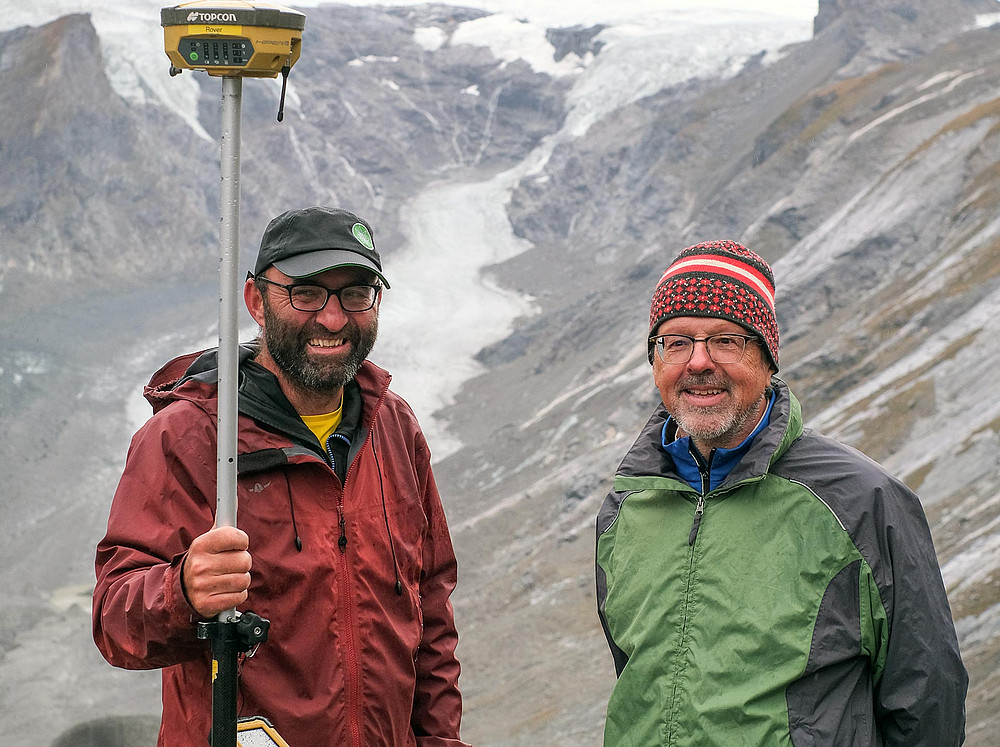
Andreas Kellerer-Pirklbauer und Gerhard Lieb von der Uni Graz mit Messgerät vor einem Gletscher ©Simon Schöpf

Andreas Kellerer-Pirklbauer und Gerhard Lieb (v.l.) von der Uni Graz leiten den Gletschermessdienst des Österreichischen Alpenvereins. Foto: Alpenverein / Simon Schöpf

Aktueller Gletscherbericht belegt rapiden Schwund des Eises in den österreichischen Alpen

Seit 132 Jahren beobachtet der Gletschermessdienst des Österreichischen Alpenvereins das Eis in den heimischen Gebirgsgruppen. Die Aufzeichnungen dokumentieren das rasante Abschmelzen im Zusammenhang mit dem Klimawandel. Der aktuellste Bericht, der am 31. März 2023 im Rahmen einer Online-Pressekonferenz präsentiert wurde, offenbart neue Rekordwerte. Gerhard Karl Lieb und Andreas Kellerer-Pirklbauer vom Institut für Geographie und Raumforschung der Universität Graz, Leiter des Gletschermessdienstes, analysierten die Ursachen für den massiven Schwund im Zeitraum 2021/2022.

Die größte Längenänderung wurde erneut in der Venedigergruppe gemessen, wo sich das Schlatenkees um 89,5 Meter zurückzog. Im Jahr davor waren es 54,5 Meter gewesen. Platz 2 belegt die Pasterze am Großglockner. Sie verlor 87,4 Meter. Im Mittel sind die 89 vom Alpenverein beobachteten österreichischen Gletscher um 28,7 Meter kürzer geworden. „Die enormen Verluste erklären sich aus der Kombination unterdurchschnittlicher Schneemengen im Winter mit einer erneut langen und sehr warmen Schmelzperiode, die schon an der Monatswende Mai/Juni einsetzte und bis in den September hinein andauerte“, analysieren Lieb und Kellerer-Pirklbauer die Ergebnisse.

Die aktuellen Rückzugswerte sind die höchsten seit Beginn der Alpenvereins-Messreihe im Jahr 1891. „Das Schwinden der Gletscher macht unzweifelhaft die Folgen des anthropogen massiv verstärkten Klimawandels deutlich“, so die Forscher. „Die österreichischen Alpen werden in einigen Jahrzehnten so gut wie eisfrei sein – mit ,optimistischer‘ Prognose bis 2075, wahrscheinlich aber deutlich früher.“

Nähere Informationen im >> Gletscherbericht des Österreichischen Alpenvereins 2021/22

created by Gudrun Pichler

Related news

World literature from Austria: Anne-Kathrin Reulecke on Ingeborg Bachmann

On 25 June, Ingeborg Bachmann would have turned 100. To this day, she remains one of the most important German-language authors. Anne-Kathrin Reulecke, Professor of Modern German Literature at the Institute of German Studies, has conducted extensive research into the writer, who died in 1973. The academic explains why Bachmann continues to be influential and what makes her work so special. In addition to her literary analysis, Anne-Kathrin Reulecke shares some reading recommendations.

What matters in the end: moral theologian takes stock of assisted suicide

Since 1 January 2022, assisted suicide has been legal in Austria under certain conditions. This was made possible by a ruling of the Constitutional Court, which overturned the blanket ban on assisting in suicide. Four years on, it is clear that: “Although the legal framework is in place, many pressing questions remain unanswered when it comes to its practical implementation,” says Johann Platzer, a moral theologian at the University of Graz.

Noise is the signal: new simulation method enables secure communication

Researchers from Graz, Vienna and Munich have developed a new simulation method that makes it possible to calculate quantum light using classical software – a step towards secure quantum communication.

Massacre and Memory: University of Graz addresses the wounds of history

A conference on 12 and 13 June 2026 at the Jesuit Refectory will focus on trauma in Eastern and South-Eastern Europe.

Begin of page section:
Additional information:

University of Graz
Universitaetsplatz 3
8010 Graz
Austria
  • Contact
  • Web Editors
  • Moodle
  • UNIGRAZonline
  • Imprint
  • Data Protection Declaration
  • Accessibility Declaration
Weatherstation
Uni Graz

End of this page section. Go to overview of page sections

End of this page section. Go to overview of page sections

Begin of page section:

End of this page section. Go to overview of page sections