Begin of page section:
Page sections:

  • Go to contents (Accesskey 1)
  • Go to position marker (Accesskey 2)
  • Go to main navigation (Accesskey 3)
  • Go to sub navigation (Accesskey 4)
  • Go to additional information (Accesskey 5)
  • Go to page settings (user/language) (Accesskey 8)
  • Go to search (Accesskey 9)

End of this page section. Go to overview of page sections

Begin of page section:
Page settings:

English en
Deutsch de
Search
Login

End of this page section. Go to overview of page sections

Begin of page section:
Search:

Search for details about Uni Graz
Close

End of this page section. Go to overview of page sections


Search

Begin of page section:
Main navigation:

Page navigation:

  • University

    University
    • About the University
    • Organisation
    • Faculties
    • Library
    • Working at University of Graz
    • Campus
    Developing solutions for the world of tomorrow - that is our mission. Our students and our researchers take on the great challenges of society and carry the knowledge out.
  • Research Profile

    Research Profile
    • Our Expertise
    • Research Questions
    • Research Portal
    • Promoting Research
    • Research Transfer
    • Ethics in Research
    • Commission for Scientific Integrity
    Scientific excellence and the courage to break new ground. Research at the University of Graz creates the foundations for making the future worth living.
  • Studies

    Studies
    • Prospective Students
    • Students
    • Registration for Study Programme (Winter semester 2026/27)
  • Community

    Community
    • International
    • Location
    • Research and Business
    • Alumni
    The University of Graz is a hub for international research and brings together scientists and business experts. Moreover, it fosters the exchange and cooperation in study and teaching.
Topics
  • Sustainable University
  • Researchers answer
  • Work for us
Close menu

End of this page section. Go to overview of page sections

Begin of page section:
You are here:

University of Graz News Rechtmäßig restituiert

End of this page section. Go to overview of page sections

Thursday, 05 November 2015

Rechtmäßig restituiert

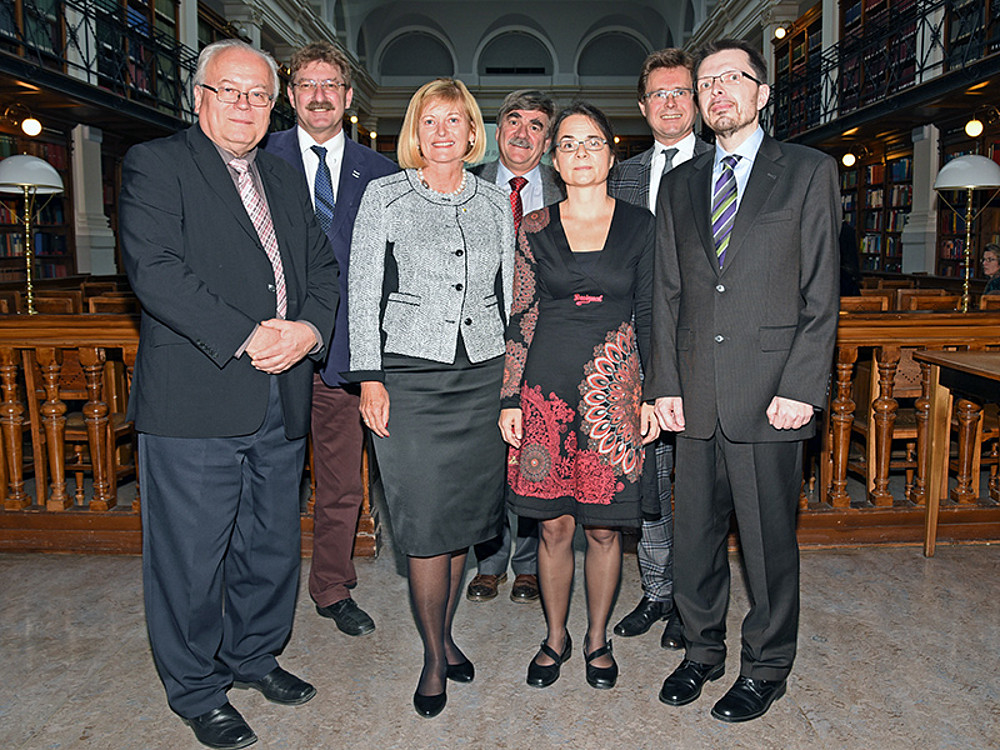
Leist(et)en an der UB einen Beitrag zur Vergangenheitsbewältigung: Historiker Winfried Garscha, Peter Scherrer, Christa Neuper, UB-Leiter Werner Schlacher, ForscherInnen Birgit Scholz und Markus Lenhart, Martin Polaschek. Foto: Uni Graz/Kastrun

Leist(et)en an der UB einen Beitrag zur Vergangenheitsbewältigung: Historiker Winfried Garscha, Peter Scherrer, Christa Neuper, UB-Leiter Werner Schlacher, ForscherInnen Birgit Scholz und Markus Lenhart, Martin Polaschek. Foto: Uni Graz/Kastrun

Forschungsprojekt überprüft Buchbestand der Uni Graz auf Nazi-Raubgut, gestern wurden ein Zwischenstand präsentiert

Nobelpreisträger Otto Loewi oder die erste Landtagsabgeordnete der Steiermark Martha Tausk sind nur zwei Berühmtheiten, die aufgrund ihrer jüdischen Abstammung im Nationalsozialismus ihrer Besitztümer beraubt wurden. Einige ihrer Buchschätze gelangten über Umwege in die Grazer Universitätsbibliothek – und wurden mittlerweile restituiert. Birgit Scholz und Markus Lenhart durchforsten nämlich seit vier Jahren im Rahmen eines von der damaligen Vizerektorin Irmtraud Fischer initiierten Projekts alle Erwerbungen der Hauptbilbiothek der Jahre 1938 bis 19454 sowie alle bis inklusive 1945 erschienenen Bücher von sieben ausgewählten Institutsbibliotheken. 120 Werke von elf VorbesitzerInnen konnten bereits zurückgegeben werden, 63 weitere wurden von den Nachfahren der Universitätsbibliothek als Geschenk überlassen. „Wir sind unter anderem auf Bände von Otto Loewi, Martha Tausk oder der Lehr- und Erziehungsanstalt Sacré Coeur gestoßen. Die ersten wertvollen Stücke konnten wir 2012 restituieren“, berichten die ForscherInnen, die gestern im Lesesaal den aktuellen Stand ihres Projekts präsentierten.

In zahlreichen Fällen konnten noch keine Nachfahren ausgeforscht werden beziehungsweise laufen die Recherchen, ob es sich tatsächlich um Raubgut handelt. „Die Provenienzforschung liegt uns sehr am Herzen. Wir wollen damit einen Beitrag zur Vergangenheitsbewältigung leisten und unrechtmäßig in unseren Bestand geratene Werke so schnell wie möglich wieder zurückgeben“, betont Rektorin Christa Neuper. Das Projekt wird daher noch bis 2017 aus Mitteln der Vizerektoren Martin Polaschek und Peter Scherrer fortgesetzt. Bis dahin sollte der gesamte fragliche Buchbestand restlos geprüft sein.

Im Rahmen der Veranstaltung hielt auch der Historiker Winfried R. Garscha, Ko-Leiter der Zentralen österreichischen Forschungsstelle Nachkriegsjustiz am Dokumentationsarchiv des österreichischen Widerstandes, einen Vortrag über den Volksgerichtsprozess gegen Adolf Hitler im Jahr 1952.


created by Dagmar Eklaude

Related news

Sport beyond the World Cup: the TV channel “Welt der Wunder” features diabetes research from the University of Graz

Keeping blood sugar levels in check during physical exertion is a particular challenge for people with type 1 diabetes. Othmar Moser examines how those affected manage to balance physical activity, sport and their metabolic disorder.

"Mathematics explains the world"

How can life be quantified? And what can science reveal that remains hidden from the naked eye? The 14th European Conference on Mathematical and Theoretical Biology at the University of Graz is dedicated to these questions. From 13 to 17 July, around 1,300 researchers from all over the world will gather on campus to discuss models, biological processes and the future of data-driven medicine. Klemens Fellner, Dean of the Faculty of Natural Sciences and Mathematics and a mathematician, talks about the language that explains the world

Internationally up-to-date: University of Graz offers new degree programmes in art studies

From the Old Masters to AI art – three newly designed degree programmes offer students at the University of Graz fresh perspectives on artistic production. In addition to historical art, the programmes place a greater emphasis on contemporary and global developments. The registration period is open.

The Nazi elite school Napola: Historian seeks memories and personal documents

They were to be brought up to become the future elite of National Socialism: boys and girls aged ten and over who, following the ‘Anschluss’ of Austria to the German Reich, attended a so-called Napola (short for Nationalpolitische Lehranstalt; also known as NPEA, Nationalpolitische Erziehungsanstalt). There were nine such institutions in what is now Austria between 1939 and 1945.

Begin of page section:
Additional information:

University of Graz
Universitaetsplatz 3
8010 Graz
Austria
  • Contact
  • Web Editors
  • Moodle
  • UNIGRAZonline
  • Imprint
  • Data Protection Declaration
  • Accessibility Declaration
Weatherstation
Uni Graz

End of this page section. Go to overview of page sections

End of this page section. Go to overview of page sections

Begin of page section:

End of this page section. Go to overview of page sections