Begin of page section:
Page sections:

  • Go to contents (Accesskey 1)
  • Go to position marker (Accesskey 2)
  • Go to main navigation (Accesskey 3)
  • Go to sub navigation (Accesskey 4)
  • Go to additional information (Accesskey 5)
  • Go to page settings (user/language) (Accesskey 8)
  • Go to search (Accesskey 9)

End of this page section. Go to overview of page sections

Begin of page section:
Page settings:

English en
Deutsch de
Search
Login

End of this page section. Go to overview of page sections

Begin of page section:
Search:

Search for details about Uni Graz
Close

End of this page section. Go to overview of page sections


Search

Begin of page section:
Main navigation:

Page navigation:

  • University

    University
    • About the University
    • Organisation
    • Faculties
    • Library
    • Working at University of Graz
    • Campus
    Developing solutions for the world of tomorrow - that is our mission. Our students and our researchers take on the great challenges of society and carry the knowledge out.
  • Research Profile

    Research Profile
    • Our Expertise
    • Research Questions
    • Research Portal
    • Promoting Research
    • Research Transfer
    • Ethics in Research
    • Commission for Scientific Integrity
    Scientific excellence and the courage to break new ground. Research at the University of Graz creates the foundations for making the future worth living.
  • Studies

    Studies
    • Prospective Students
    • Students
  • Community

    Community
    • International
    • Location
    • Research and Business
    • Alumni
    The University of Graz is a hub for international research and brings together scientists and business experts. Moreover, it fosters the exchange and cooperation in study and teaching.
  • Spotlight
Topics
  • Sustainable University
  • Researchers answer
  • Work for us
Close menu

End of this page section. Go to overview of page sections

Begin of page section:
You are here:

University of Graz News Raus aus der Euro-Krise

End of this page section. Go to overview of page sections

Friday, 13 December 2013

Raus aus der Euro-Krise

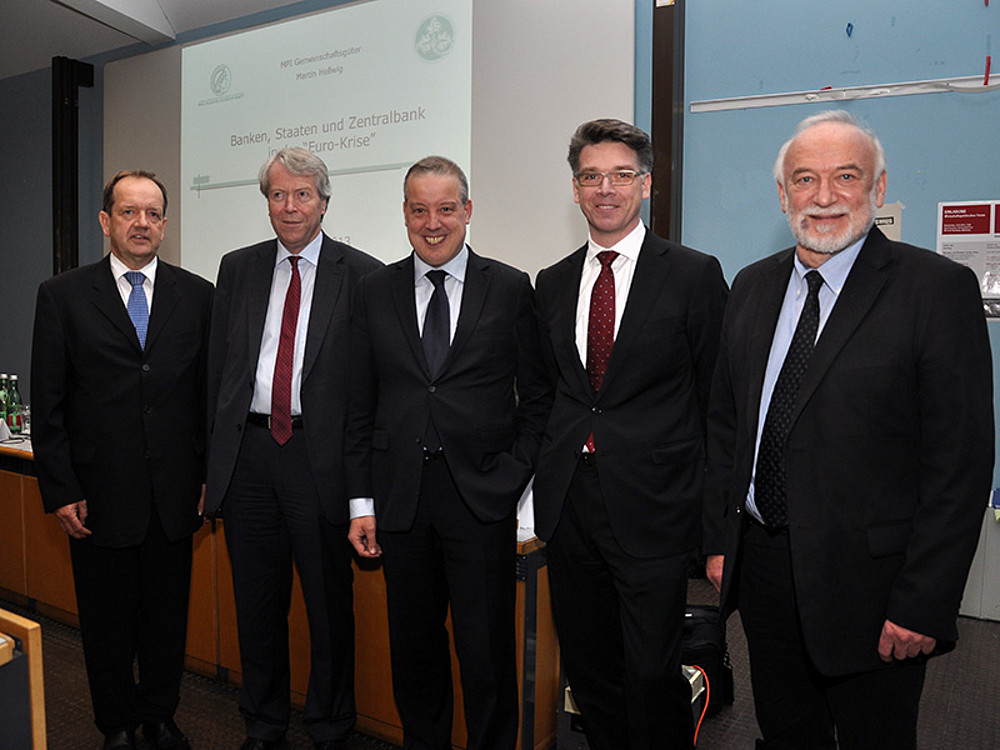
Expertenrunde: Ederer, Hellwig, Summer, Darlap und Kurz (v.l.)

Expertenrunde: Ederer, Hellwig, Summer, Darlap und Kurz (v.l.)

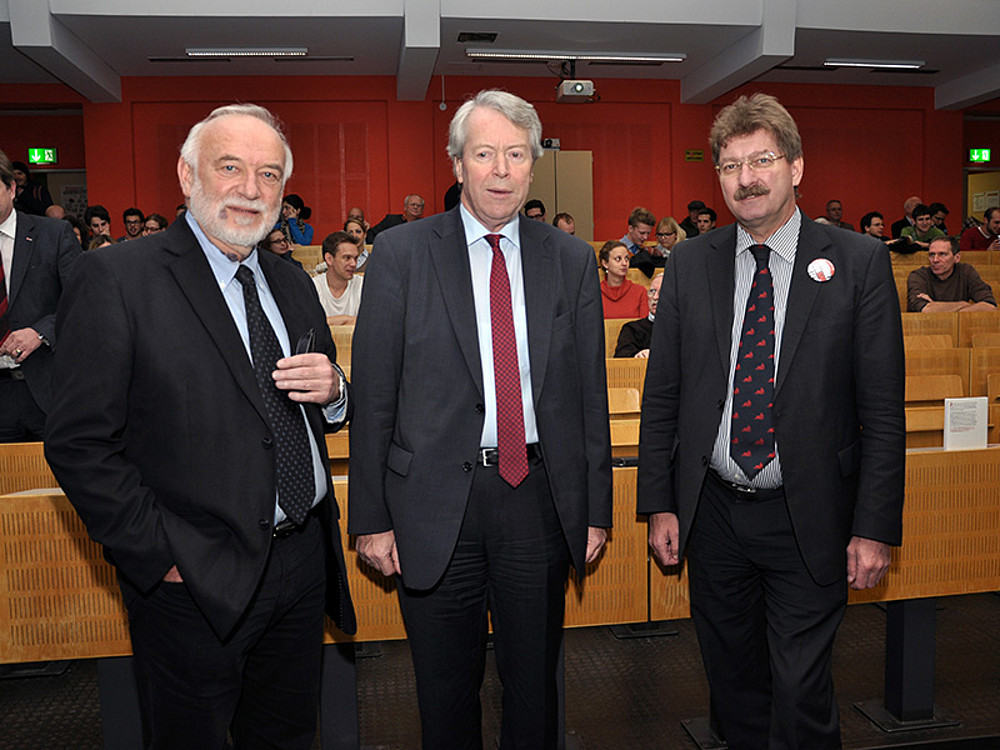
Forschungs-Vizerektor Peter Scherrer (rechts) eröffnete das Forum des Graz Schumpeter Centre

Forschungs-Vizerektor Peter Scherrer (Mitte) eröffnete das Forum des Graz Schumpeter Centre

10. Wirtschaftspolitisches Forum des Graz Schumpeter Centre

„Staaten und Banken in der Krise“ – das brandaktuelle Thema stand am 12. Dezember 2013 beim zehnten Wirtschaftspolitischen Forum des Graz Schumpeter Centre (GSC) im Mittelpunkt. Zentrumsleiter O.Univ.-Prof. Dr. Heinz D. Kurz konnte den international renommierten Ökonomen Prof. Martin Hellwig als Gastreferenten an die Uni Graz holen.
Hellwig ist Wissenschafter vom Max-Planck-Institut zur Erforschung von Gemeinschaftsgütern in Bonn und Mitautor des kürzlich erschienenen Buchs „Des Bankers neue Kleider: Was bei Banken wirklich schief läuft und was sich ändern muss“.


Zerfall ohne Bankenunion

Der Kenner der Finanzwelt referierte im randvollen Hörsaal des Heizhauses über die Ursachen und Wege aus der „Euro-Krise“ und beleuchtete das komplexe Verhältnis zwischen Politik, Banken und Regulierungsbehörden. Staatsschuldenkrisen, etwa in Griechenland, Portugal, Italien, sowie latente Bankenkrisen in Deutschland und Frankreich seien die Ursache für die tiefe Krise des Euro-Raums. Zur Lösung dieser sprach sich Hellwig für eine Bankenunion und die Errichtung supranationaler Institutionen – europäische Aufsichts- und Restrukturierungsbehörde und Einlagensicherung – aus. Nur so, so der Wissenschafter, sei die notwendige Reinigung im Bankensystem möglich. Ohne echte Bankenunion werde die Währungsunion nicht von Dauer sein. „Der Zerfall wird hässlich sein“, so seine Warnung.


Banken in Schieflage

Auf dem Podium bekannte sich auch Dr. Othmar Ederer (Generaldirektor Grazer Wechselseitige) zur Bankenunion und einer einheitlichen europäischen Finanzpolitik. Mag. Patrick Darlap (Abteilungsleiter „Integrierte Finanzmärkte“ der FMA) reflektierte über die Rolle der Finanzmarktaufsicht und das Verhältnis zwischen Finanzmarktinnovationen und Aufsichtsgesetzgebung. Zwar habe man, so  Dr. Martin Summer (Abteilung für Volkswirtschaftliche Studien, OeNB), vor Ausbruch der Schuldenkrise die Instabilität des globalen Bankensystems nur unzureichend erkannt, jedoch haben sich Zentralbanken als effektive Krisenmanager erwiesen.  Notwendig seien nun neue Instrumente zur Abwicklung von Banken in Schieflage. 

created by David Haas & Andreas Schweiger

Related news

Higher Education Strategy 2040: Austria’s universities on course for the future

Austria has 77 higher education institutions, which is above the EU average – but does this really make sense? The new Higher Education Strategy 2040 focuses on cooperation rather than mergers. As one of the six largest universities in Austria, the University of Graz plays a central role in this.

Climate research in Greenland: Old data provides new insights

The polar explorer and University of Graz professor Alfred Wegener left behind a unique collection of climate data from Greenland. A research team from the University of Graz is now analysing this 100-year-old treasure trove of data and comparing it with current measurements.

Diversity in nature and science: How we talk about plants and each other

Ginkgo, kiwi, hemp: they exist as male and female plants. Anyone who paid attention in biology class will confirm this. But is this categorisation, established by Carl von Linné almost 300 years ago, still valid today? An interdisciplinary team at the University of Graz is questioning these attributions and using this as a starting point to provide food for thought for gender-sensitive interaction between students, scientific and teaching staff.

Around the world in eight stops: the Long Night of Research at the University of Graz

On 24 April from 5 pm, you can take a short trip around the globe at the University of Graz, discovering pecularities of foreign countries or new local features in the entrance hall of the University Library. The itinerary takes you through introduced animal species, political attitudes and the omnipotence of algorithms. There will also be a programme in the historic reading hall, as well as at the UniGraz@Museum and the University Archive.

Begin of page section:
Additional information:

University of Graz
Universitaetsplatz 3
8010 Graz
Austria
  • Contact
  • Web Editors
  • Moodle
  • UNIGRAZonline
  • Imprint
  • Data Protection Declaration
  • Accessibility Declaration
Weatherstation
Uni Graz

End of this page section. Go to overview of page sections

End of this page section. Go to overview of page sections

Begin of page section:

End of this page section. Go to overview of page sections