Begin of page section:
Page sections:

  • Go to contents (Accesskey 1)
  • Go to position marker (Accesskey 2)
  • Go to main navigation (Accesskey 3)
  • Go to sub navigation (Accesskey 4)
  • Go to additional information (Accesskey 5)
  • Go to page settings (user/language) (Accesskey 8)
  • Go to search (Accesskey 9)

End of this page section. Go to overview of page sections

Begin of page section:
Page settings:

English en
Deutsch de
Search
Login

End of this page section. Go to overview of page sections

Begin of page section:
Search:

Search for details about Uni Graz
Close

End of this page section. Go to overview of page sections


Search

Begin of page section:
Main navigation:

Page navigation:

  • University

    University
    • About the University
    • Organisation
    • Faculties
    • Library
    • Working at University of Graz
    • Campus
    Developing solutions for the world of tomorrow - that is our mission. Our students and our researchers take on the great challenges of society and carry the knowledge out.
  • Research Profile

    Research Profile
    • Our Expertise
    • Research Questions
    • Research Portal
    • Promoting Research
    • Research Transfer
    • Ethics in Research
    • Commission for Scientific Integrity
    Scientific excellence and the courage to break new ground. Research at the University of Graz creates the foundations for making the future worth living.
  • Studies

    Studies
    • Prospective Students
    • Students
    • Registration for Study Programme (Winter semester 2026/27)
  • Community

    Community
    • International
    • Location
    • Research and Business
    • Alumni
    The University of Graz is a hub for international research and brings together scientists and business experts. Moreover, it fosters the exchange and cooperation in study and teaching.
Topics
  • Sustainable University
  • Researchers answer
  • Work for us
Close menu

End of this page section. Go to overview of page sections

Begin of page section:
You are here:

University of Graz News Raum-Reise

End of this page section. Go to overview of page sections

Friday, 30 November 2018

Raum-Reise

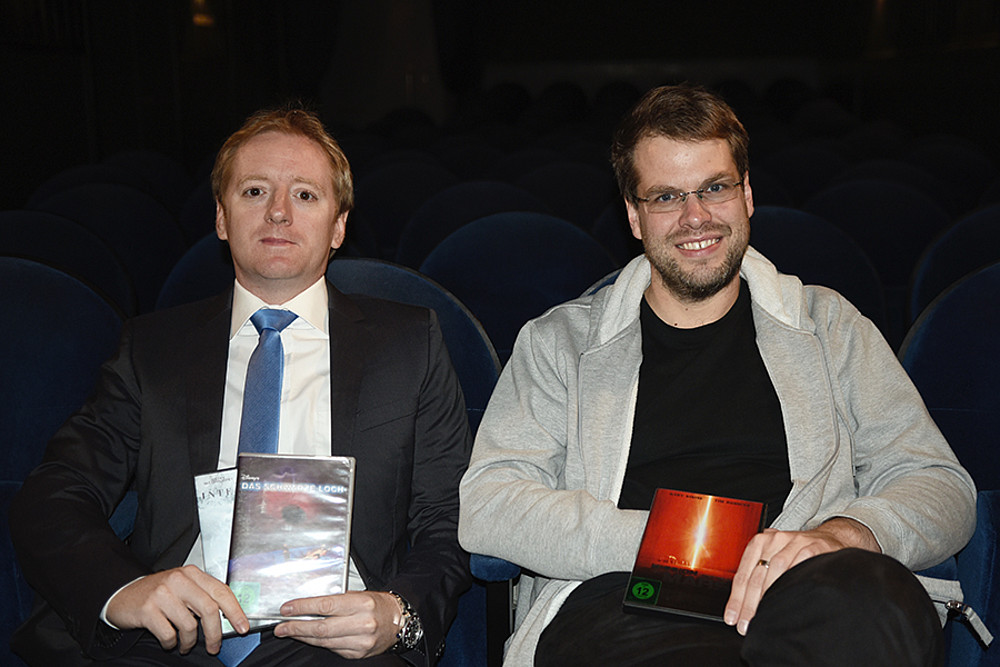
Physiker Axel Maas (rechts) nahm unter der Regie von Fritz Treiber Science-Fiction-Filme unter die Lupe. Foto: Uni Graz/Stingeder

Physiker Axel Maas (rechts) nahm unter der Regie von Fritz Treiber Science-Fiction-Filme unter die Lupe. Foto: Uni Graz/Stingeder

Was sagt die Wissenschaft zu Science Fiction? Universität Graz präsentierte Forschung im Kino mit Physiker Axel Maas

Film ab für Wissenschaft – hieß es wieder am 28. November 2018, als die Universität Graz zu „Science & Cinema“ ins Rechbauerkino lud. Physiker Axel Maas nahm unter der Regie von Fritz Treiber Phänomene unter die Lupe, die speziell in Science Fiction-Filmen Aufsehen erregen: Kann ich im Hyperraum verloren gehen? 
Was sagt die Quantenmechanik zum Thema „beamen“? Ist eine Zeitreise möglich? Beantwortet wurde dies anhand von Szenen aus „Interstellar“, „Zurück in die Zukunft“, „Das schwarze Loch“ und anderen Blockbustern. 

Der Forscher, der sich intensiv mit Elementarteilchen beschäftigt, erklärte anschaulich, was realistisch oder der Fantasie Hollywood-AutorInnen entsprungen ist. So etwa der Plan vom Leben am Mars. „Grundsätzlich ist der Planet sei unwirtlich“, so Axel Maas. Die geringe Gravitation reduziert das Gewicht auf 40 Prozent, und der Boden sei für eine landwirtschaftliche Nutzung nicht geeignet. Für eine potenzielle Besiedlung gebe es zur Erde „in Jahrhunderten gedacht“ vielversprechendere Alternativen – etwa mit der Venus oder Jupitermonden.
Und wie kann sich die Temperatur im Weltall vorstellen? „Eine ,Suppe von Photonen`, die nach dem Urknall frei geworden war, ist wahrscheinlich die beste Möglichkeit eine Art Temperatur zu definieren, die dann etwa minus 268 Grad Celsius wäre. Aber Gebiete in denen es, etwa interstellare Gaswolken gibt, können sehr viel heißer sein“, beschrieb der Forscher. 
Der Idee vom Beamen, analog zu Raumschiff Enterprise, räumte der Teilchenphysiker kurzfristig wenig Chancen auf Verwirklichung ein. Denn was man heute in der Forschung darunter verstehe, sei vielmehr ein Kopieren und erneutes Zusammensetzen von Atomen: „Ähnlich wie bei einem Fax.“ Auch Zeitreisen werden wahrscheinlich weiterhin ein Traum bleiben. „Dass die Ursache vor der Wirkung stattfindet, ist nach gegenwärtigen Theorien nicht möglich.“ Maximal Zeitsprünge in andere Universen wären vorstellbar. 

Aufgrund des großen Erfolgs gibt es im Jänner 2019 ein Da Capo von Science & Cinema unter dem Titel „Materie, Mars und Mr. Spock“:
WANN: 30. Jänner 2019, 18 Uhr
WO: Filmzentrum im Rechbauerkino, Rechbauerstraße 6, 8010 Graz 

Der Eintritt ist frei, Anmeldungen sind bereits möglich: 
Tel.: 0316 83 05 08
E-Mail: filmzentrum(at)filmzentrum.com
created by Andreas Schweiger

Related news

Complying with the norm: Why Do Standards Shape Our Lives, Elisabeth Staudegger?

Standards determine whether a sheet of paper fits in a printer or whether a charging plug can power multiple devices. These standards shape our everyday lives. But who actually sets these standards? Where are the weaknesses, and how could science help to improve them? Elisabeth Staudegger, Head of the ‘Law and IT’ Department at the Institute for Legal Foundations at the University of Graz, host the Academic Standards Day on 16 June. Here she relays how sciences can contribute to the topic of standardisation and reveals her personal favourite standard.

More body awareness than a culture war

In Italy, sex education lessons will in future only be permitted with parental consent, and will be banned entirely in nurseries and primary schools. At the same time, Pride Month highlights why knowledge about the body, relationships, boundaries and diversity is important for young people. A study by the University of Graz shows how important knowledge about the body, contraception, relationship skills and protection against violence is

Will Austria win the World Cup? Mathematician reveals calculation method

Michael Fischer uses the football tournament as a practical example for highschool lessons.

Survival strategies: How plants respond to drought

According to Geosphere Austria, this spring was the driest in Austria since records began around 170 years ago. The low rainfall put particular pressure on the agricultural sector. And climate change is set to make the situation even worse in the coming decades. We asked Johannes Liesche, a professor at the Department of Biology at the University of Graz, how plants react to water shortages and how they survive periods of drought.

Begin of page section:
Additional information:

University of Graz
Universitaetsplatz 3
8010 Graz
Austria
  • Contact
  • Web Editors
  • Moodle
  • UNIGRAZonline
  • Imprint
  • Data Protection Declaration
  • Accessibility Declaration
Weatherstation
Uni Graz

End of this page section. Go to overview of page sections

End of this page section. Go to overview of page sections

Begin of page section:

End of this page section. Go to overview of page sections