Begin of page section:
Page sections:

  • Go to contents (Accesskey 1)
  • Go to position marker (Accesskey 2)
  • Go to main navigation (Accesskey 3)
  • Go to sub navigation (Accesskey 4)
  • Go to additional information (Accesskey 5)
  • Go to page settings (user/language) (Accesskey 8)
  • Go to search (Accesskey 9)

End of this page section. Go to overview of page sections

Begin of page section:
Page settings:

English en
Deutsch de
Search
Login

End of this page section. Go to overview of page sections

Begin of page section:
Search:

Search for details about Uni Graz
Close

End of this page section. Go to overview of page sections


Search

Begin of page section:
Main navigation:

Page navigation:

  • University

    University
    • About the University
    • Organisation
    • Faculties
    • Library
    • Working at University of Graz
    • Campus
    Developing solutions for the world of tomorrow - that is our mission. Our students and our researchers take on the great challenges of society and carry the knowledge out.
  • Research Profile

    Research Profile
    • Our Expertise
    • Research Questions
    • Research Portal
    • Promoting Research
    • Research Transfer
    • Ethics in Research
    Scientific excellence and the courage to break new ground. Research at the University of Graz creates the foundations for making the future worth living.
  • Studies

    Studies
    • Prospective Students
    • Students
  • Community

    Community
    • International
    • Location
    • Research and Business
    • Alumni
    The University of Graz is a hub for international research and brings together scientists and business experts. Moreover, it fosters the exchange and cooperation in study and teaching.
  • Spotlight
Topics
  • Sustainable University
  • Researchers answer
  • Work for us
Close menu

End of this page section. Go to overview of page sections

Begin of page section:
You are here:

University of Graz News Robber Barons and Heroic Deeds

End of this page section. Go to overview of page sections

Thursday, 22 April 2021

Robber Barons and Heroic Deeds

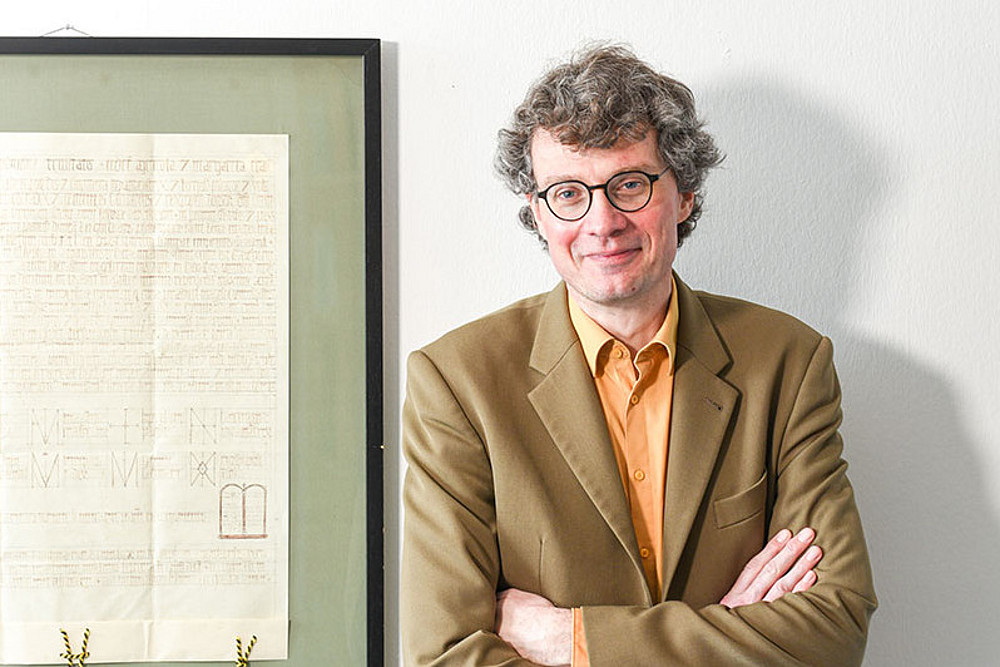
Georg Vogeler is awarded an ERC Advanced Grant for developing an artificial intelligence that researches historical documents. Photo: Uni Graz/Tzivanopoulos

Georg Vogeler is awarded an ERC Advanced Grant for developing an artificial intelligence that researches historical documents. Photo: Uni Graz/Tzivanopoulos

Humanities scholar Georg Vogeler awarded high level of EU funding

Old documents can tell astonishingly modern stories: “They might describe religious differences within families, for instance, or people helping fugitives, as well as robber barons and heroic deeds,” explains Georg Vogeler. As historian and head of the Austrian Centre for Digital Humanities at the University of Graz, he has been awarded an ERC Advanced Grant for his research, with funding of almost three million euros – one of the highest levels of subsidy available from the European Union. He will use the funding to develop an artificial intelligence system to improve the way digitalised historical documents are searched and researched, and to reconstruct their uses and purposes. There are already around 600,000 such stored documents available through the online portal at www.monasterium.net. “Established methods are no longer adequate for analysing the huge volume of documents produced since the 13th century in Europe, and to reveal the history and stories hidden within them,” continues Vogeler.
The EU-funded project DiDip – “From digital to distant diplomatics” – is now creating a virtual research environment for collaboration between people and machines. “The computer programme can search a huge set of records to learn and gather information. To interpret this, however, human creativity and perception are essential,” says the expert in digital humanities, describing the work they will do. He anticipates that this “collaboration” with artificial intelligence will provide new insights into pan-European developments, trends and upheavals, not least – and highly topical in the context of the pandemic – about the Great Plague of 1348/49 and the subsequent economic crisis.

With the first research centre in digital humanities, the first professorship and the first degree programme in Austria, the University of Graz is one of the country’s leading institutions in this discipline. The Centre’s work is highly regarded in the international community: late last year, Vogeler’s colleague Leif Scheuermann was also awarded an ERC grant.


created by Dagmar Eklaude

Related news

Cosmetics in the environment: University of Graz proves danger to ants

Titanium dioxide, which is found in cosmetics, for example, is increasingly entering the environment in the form of nanoparticles. This could also put insects at risk. If ants ingest the substance in combination with the pesticide glyphosate, it disturbs the development of their offspring. Scientists at the University of Graz are drawing attention to the negative consequences of this toxic cocktail.

How are tech companies changing democracy? Uni Graz designs exhibition for schools

Filtered information, conspiracy theories, fake news – certain groups and corporations are using social media and algorithms to try to influence public opinion in their favour. Their goal: to weaken fundamental rights and diversity of opinion and seize power. In a new exhibition, researchers at the University of Graz are working with pupils to explore the impact of social media and AI on democracy. In accompanying workshops, the scientists want to encourage young people to develop their own ideas for a socially and ecologically viable future and to actively help shape it. The exhibition, designed as a travelling exhibition for schools, will open on 9 March 2026 at the Dreihackengasse Gymnasium in Graz.

Step by step: What motivates Mireille van Poppel as a scientist and vice-rector

Improving people's health and eliminating inequalities: Mireille van Poppel pursues these goals both as a public health researcher and as vice-rector for Internationalisation and Equality. In both roles, she pays particular attention to individual needs.

Master's degree in psychotherapy in Graz: registration opens in March

Graz is becoming a hotspot for psychotherapy: from 2026, the University of Graz and the Medical University of Graz will jointly offer the new master's programme. Registration for the admission procedure for the 140 study places will start in March.

Begin of page section:
Additional information:

University of Graz
Universitaetsplatz 3
8010 Graz
Austria
  • Contact
  • Web Editors
  • Moodle
  • UNIGRAZonline
  • Imprint
  • Data Protection Declaration
  • Accessibility Declaration
Weatherstation
Uni Graz

End of this page section. Go to overview of page sections

End of this page section. Go to overview of page sections

Begin of page section:

End of this page section. Go to overview of page sections