Begin of page section:
Page sections:

  • Go to contents (Accesskey 1)
  • Go to position marker (Accesskey 2)
  • Go to main navigation (Accesskey 3)
  • Go to sub navigation (Accesskey 4)
  • Go to additional information (Accesskey 5)
  • Go to page settings (user/language) (Accesskey 8)
  • Go to search (Accesskey 9)

End of this page section. Go to overview of page sections

Begin of page section:
Page settings:

English en
Deutsch de
Search
Login

End of this page section. Go to overview of page sections

Begin of page section:
Search:

Search for details about Uni Graz
Close

End of this page section. Go to overview of page sections


Search

Begin of page section:
Main navigation:

Page navigation:

  • University

    University
    • About the University
    • Organisation
    • Faculties
    • Library
    • Working at University of Graz
    • Campus
    Developing solutions for the world of tomorrow - that is our mission. Our students and our researchers take on the great challenges of society and carry the knowledge out.
  • Research Profile

    Research Profile
    • Our Expertise
    • Research Questions
    • Research Portal
    • Promoting Research
    • Research Transfer
    • Ethics in Research
    Scientific excellence and the courage to break new ground. Research at the University of Graz creates the foundations for making the future worth living.
  • Studies

    Studies
    • Prospective Students
    • Students
  • Community

    Community
    • International
    • Location
    • Research and Business
    • Alumni
    The University of Graz is a hub for international research and brings together scientists and business experts. Moreover, it fosters the exchange and cooperation in study and teaching.
  • Spotlight
Topics
  • Sustainable University
  • Researchers answer
  • Work for us
Close menu

End of this page section. Go to overview of page sections

Begin of page section:
You are here:

University of Graz News At the pulse of climate

End of this page section. Go to overview of page sections

Tuesday, 27 July 2021

At the pulse of climate

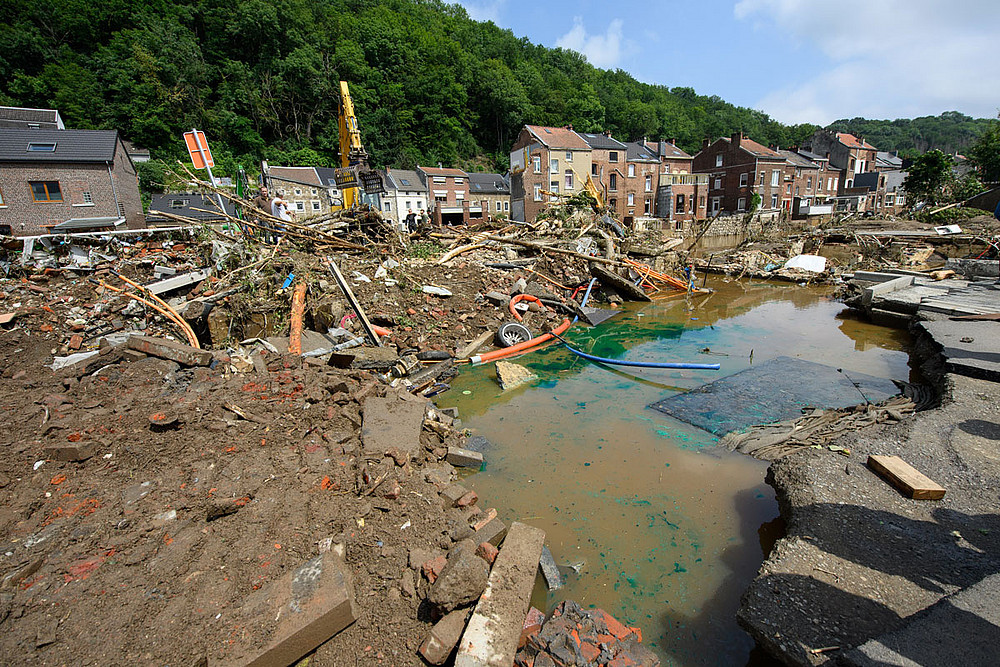
Foto: © EU/Christophe Licoppe via Wikipedia

Foto: © EU/Christophe Licoppe via Wikipedia

New Uni Graz portal for climate change indicators

The heat waves of recent weeks, interrupted by severe weather events with heavy rain and hail as well as the associated floods and major damage across Europe have shown that climate change is on indeed. The University of Graz has now put a new data portal online that displays informative indicators on greenhouse gas emissions and climate change, the so-called “Graz Climate Change Indicators” (GCCI), over the recent decades as well as looking ahead until mid-century.

"This portal not only offers reliable monitoring information for the period from 1960 to 2020 for Austria, Europe, and globally, but also presents future scenarios up to 2050 that are based on the Paris climate goals," says climate researcher Gottfried Kirchengast from the Wegener Center at the University of Graz who designed the GCCI concept and implemented it together with his project team. In the first version, there is a focus on greenhouse gas emissions, which can be readily viewed for Austria and its federal states and as well for the EU and the countries of Europe and the world. “For example, we are showing a GCCI Climate Change Mitigation Index that depicts the necessary reduction in emissions in Austria on the way to climate neutrality by 2040. Through regular updating and extension by short-term predictions, and the possibility of global inter-comparison, these indicators can be a very valuable addition to the official national monitoring,” explains Kirchengast.

Another focus are indicators of global climate warming, such as the increase of the heat content in the atmosphere and oceans as well as the critical Earth energy imbalance due to continued greenhouse gas emissions. “In this way we are also making key results of our own climate research in Graz widely accessible. For example, using the GCCI Global Warming Index, we track the atmospheric heat increase since 1990, which we discovered last year to occur at an unexpected strength and for which further important results are in the pipeline,” describes Kirchengast. As a third focus, climate change indicators on the development of weather and climate extremes will be added later in the course of 2021.

The portal is publicly accessible at gcci.uni-graz.at and is regularly updated. In addition, the University of Graz has developed a solution framework for effective climate protection with its “Carbon Management” program, which empowers actors at all public, institutional and personal levels to make their own fair contribution to reducing greenhouse gas emissions in line with the Paris climate goals. The GCCI data provide important context information for this and are therefore closely linked to the Carbon Management platform carbmanage.uni-graz.at.

The work of the Wegener Center is part of the Field of Excellence “Climate Change” of the University of Graz and made also important contributions to the Intergovernmental Panel on Climate Change (IPCC) Sixth Assessment Report on the physical science basis of climate change that is upcoming soon in August 2021.
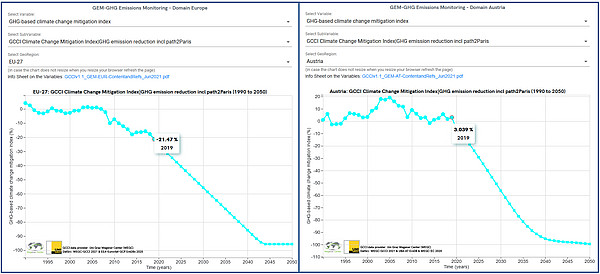
GCCI Climate Change Mitigation Index for the EU and Austria as examples from the data portal: Compared to the mean emissions 1990-1994 (=0 percent), Austria still has the entire greenhouse gas (GHG) emission reduction ahead of it, while the EU in total had already reduced by over 20 percent until 2019. Source: Uni Graz/Wegener Center, 2021.
created by Joachim Hirtenfellner

Related news

Cosmetics in the environment: University of Graz proves danger to ants

Titanium dioxide, which is found in cosmetics, for example, is increasingly entering the environment in the form of nanoparticles. This could also put insects at risk. If ants ingest the substance in combination with the pesticide glyphosate, it disturbs the development of their offspring. Scientists at the University of Graz are drawing attention to the negative consequences of this toxic cocktail.

How are tech companies changing democracy? Uni Graz designs exhibition for schools

Filtered information, conspiracy theories, fake news – certain groups and corporations are using social media and algorithms to try to influence public opinion in their favour. Their goal: to weaken fundamental rights and diversity of opinion and seize power. In a new exhibition, researchers at the University of Graz are working with pupils to explore the impact of social media and AI on democracy. In accompanying workshops, the scientists want to encourage young people to develop their own ideas for a socially and ecologically viable future and to actively help shape it. The exhibition, designed as a travelling exhibition for schools, will open on 9 March 2026 at the Dreihackengasse Gymnasium in Graz.

Step by step: What motivates Mireille van Poppel as a scientist and vice-rector

Improving people's health and eliminating inequalities: Mireille van Poppel pursues these goals both as a public health researcher and as vice-rector for Internationalisation and Equality. In both roles, she pays particular attention to individual needs.

Master's degree in psychotherapy in Graz: registration opens in March

Graz is becoming a hotspot for psychotherapy: from 2026, the University of Graz and the Medical University of Graz will jointly offer the new master's programme. Registration for the admission procedure for the 140 study places will start in March.

Begin of page section:
Additional information:

University of Graz
Universitaetsplatz 3
8010 Graz
Austria
  • Contact
  • Web Editors
  • Moodle
  • UNIGRAZonline
  • Imprint
  • Data Protection Declaration
  • Accessibility Declaration
Weatherstation
Uni Graz

End of this page section. Go to overview of page sections

End of this page section. Go to overview of page sections

Begin of page section:

End of this page section. Go to overview of page sections