Begin of page section:
Page sections:

  • Go to contents (Accesskey 1)
  • Go to position marker (Accesskey 2)
  • Go to main navigation (Accesskey 3)
  • Go to sub navigation (Accesskey 4)
  • Go to additional information (Accesskey 5)
  • Go to page settings (user/language) (Accesskey 8)
  • Go to search (Accesskey 9)

End of this page section. Go to overview of page sections

Begin of page section:
Page settings:

English en
Deutsch de
Search
Login

End of this page section. Go to overview of page sections

Begin of page section:
Search:

Search for details about Uni Graz
Close

End of this page section. Go to overview of page sections


Search

Begin of page section:
Main navigation:

Page navigation:

  • University

    University
    • About the University
    • Organisation
    • Faculties
    • Library
    • Working at University of Graz
    • Campus
    Developing solutions for the world of tomorrow - that is our mission. Our students and our researchers take on the great challenges of society and carry the knowledge out.
  • Research Profile

    Research Profile
    • Our Expertise
    • Research Questions
    • Research Portal
    • Promoting Research
    • Research Transfer
    • Ethics in Research
    Scientific excellence and the courage to break new ground. Research at the University of Graz creates the foundations for making the future worth living.
  • Studies

    Studies
    • Prospective Students
    • Students
  • Community

    Community
    • International
    • Location
    • Research and Business
    • Alumni
    The University of Graz is a hub for international research and brings together scientists and business experts. Moreover, it fosters the exchange and cooperation in study and teaching.
  • Spotlight
Topics
  • Our digital Advent calendar
  • Sustainable University
  • Researchers answer
  • Work for us
Close menu

End of this page section. Go to overview of page sections

Begin of page section:
You are here:

University of Graz News Political scientist Filzmaier provided insights into the voting behaviour of Styrians

End of this page section. Go to overview of page sections

Thursday, 14 November 2024

Political scientist Filzmaier provided insights into the voting behaviour of Styrians

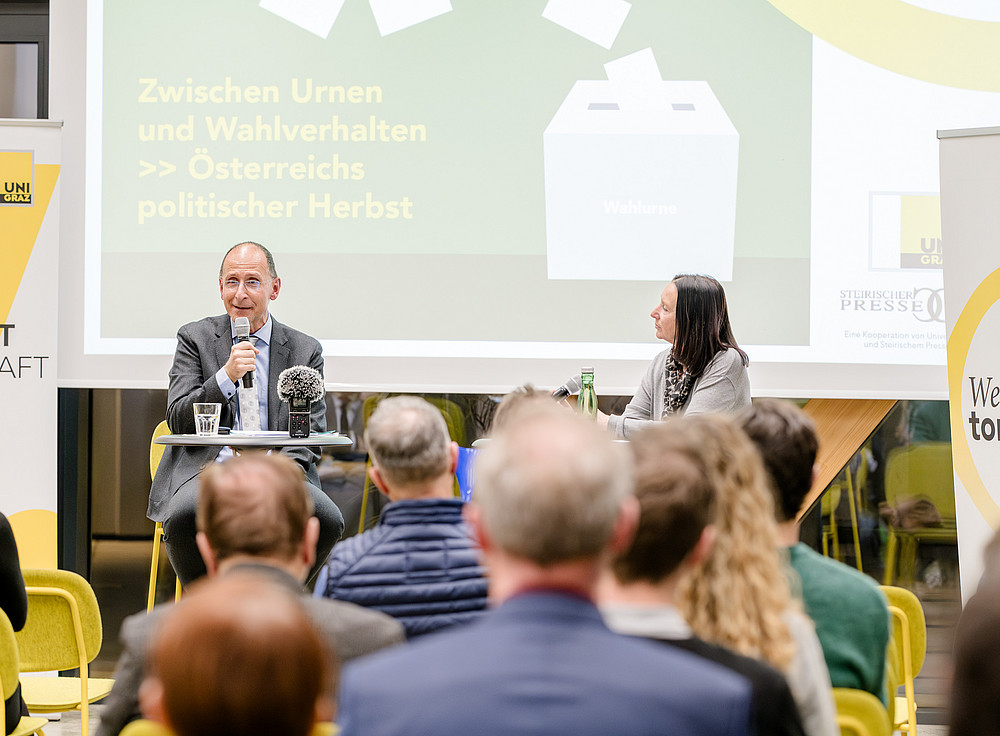
A panel discussion with a leading political analyst and a journalist in an office conference room. The two people are sitting at their desks and speaking to the audience. There are subtle yellow highlights in the background, emphasising important elements such as banners, seating arrangements and the composition of the crowd. ©MICHAELA PFLEGER

Political scientist Peter Filzmaier and Sigrid Hroch, ORF presenter and chairwoman of the Styrian Press Club, discuss voting behaviour in Styria. Photo: Steirischer Presseclub, Mias Photoart

At the University of Graz, Austria's probably most well-known political scientist, Peter Filzmaier, provided a gripping analysis of the 2024 Styrian state elections. In front of a full house at the Unicorn, the professor at the University of Graz explained why social media, times of crisis and voter behaviour have a decisive influence on the outcome of an election – and why boring election campaigns are sometimes the best.

One thing in advance: Peter Filzmaier could not be coaxed into predicting the election result, not even by moderator and Press Club President Sigrid Hroch. Nevertheless, the evening, hosted by the University of Graz and the Styrian Press Club at the Unicorn in Schubertstraße, was a thrilling experience. More than 50 people had accepted the invitation from Rector Peter Riedler and Press Club Managing Director Alexandra Reischl to see Austria's most renowned political scientist in person and to discuss with him.

Filzmaier provided a profound analysis of Styrian and Austrian voting behaviour since 1945, explained why voter flow analyses are much more complicated than one would think (‘many people no longer even know what they voted for four or five years ago’) and which key issues will influence the election outcome in Styria. ‘It's about the development of the country since 2019, but also about people's satisfaction with the state government.’ The latter is likely to be not very high, probably also due to the multiple crises of recent years. He provided surprising details on this, such as the fact that there are more than 1,300 registered parties in Austria.

A compliment for being boring

Other factors that play a decisive role in determining where Styrians will put their cross on 24 November include age, gender and education, the influence of federal politics and the upcoming formation of a government, and the topics that are currently being discussed the most. ‘Inflation, immigration and health were probably the top three topics this time,’ said the political scientist. And he attested the Styrian parties a ‘boring, because issue-oriented election campaign – and that is meant as a compliment’. Whereby the importance of election campaigns themselves is often overestimated. ‘Elections are won in the four years leading up to them, not in the last four weeks before the election,’ says Filzmaier.

Many interesting questions were also raised by the audience, for example, about the social media presence of the individual parties. ‘The FPÖ and the Greens were ahead of the pack from the outset. The established parties fell into the trap between tactics and strategy and did not recognise the importance of social media early enough.’

The fact that this two-hour, in-depth analysis flew by is probably also due to Filzmaier's motto: ‘I believe that, while maintaining the necessary objectivity, you also have to be able to approach politics with humour – a good democracy can withstand both.’

Related news

Semester abroad without barriers: University of Graz wins award for promoting inclusion

The University of Graz has been awarded the Internationalization Award for its new inclusion initiative. Students with fewer opportunities now also receive financial support for their semester abroad outside Europe.

Fair distribution: Researchers determine just greenhouse gas budgets for all EU regions

Ten years ago, on 12 December 2015, the Paris Climate Agreement was signed at the UN Climate Conference. In order to limit global warming to well below two degrees, only a certain amount of CO2 may be emitted worldwide. While the focus was originally on national emission targets, more than 200 subnational regions and almost 300 cities have now adopted their own targets. But how many emissions are they fairly entitled to? Researchers at the University of Graz have now developed transparent criteria for fair distribution at the subnational level for the first time and determined corresponding greenhouse gas budgets for all European regions. The paper was published today in the scientific journal Nature Communications.

Chemical Christmas show at the University of Graz: An explosive evening at the Schauspielh

At the beginning of December, the University of Graz transformed the theater into a laboratory: as part of “Chemical Life,” teacher training students staged a chemical Christmas show for Styrian school classes—complete with ethanol rockets, nitrogen snow, and glowing effects. An evening designed to inspire interest in studying chemistry.

Train by train: Koralm railway accelerates exchange between the Universities

Lectures at the University of Klagenfurt in the morning, seminars at the University of Graz in the afternoon: Austria's longest tunnel and a journey time of around 45 minutes make it easy. The Koralm railway increases the speed of networking between the two university locations. The collaboration builds on existing cooperation - for example in the areas of teacher training, Slavic studies and as employers, the universities are well coordinated.

Begin of page section:
Additional information:

University of Graz
Universitaetsplatz 3
8010 Graz
Austria
  • Contact
  • Web Editors
  • Moodle
  • UNIGRAZonline
  • Imprint
  • Data Protection Declaration
  • Accessibility Declaration
Weatherstation
Uni Graz

End of this page section. Go to overview of page sections

End of this page section. Go to overview of page sections

Begin of page section:

End of this page section. Go to overview of page sections