Begin of page section:
Page sections:

  • Go to contents (Accesskey 1)
  • Go to position marker (Accesskey 2)
  • Go to main navigation (Accesskey 3)
  • Go to sub navigation (Accesskey 4)
  • Go to additional information (Accesskey 5)
  • Go to page settings (user/language) (Accesskey 8)
  • Go to search (Accesskey 9)

End of this page section. Go to overview of page sections

Begin of page section:
Page settings:

English en
Deutsch de
Search
Login

End of this page section. Go to overview of page sections

Begin of page section:
Search:

Search for details about Uni Graz
Close

End of this page section. Go to overview of page sections


Search

Begin of page section:
Main navigation:

Page navigation:

  • University

    University
    • About the University
    • Organisation
    • Faculties
    • Library
    • Working at University of Graz
    • Campus
    Developing solutions for the world of tomorrow - that is our mission. Our students and our researchers take on the great challenges of society and carry the knowledge out.
  • Research Profile

    Research Profile
    • Our Expertise
    • Research Questions
    • Research Portal
    • Promoting Research
    • Research Transfer
    • Ethics in Research
    Scientific excellence and the courage to break new ground. Research at the University of Graz creates the foundations for making the future worth living.
  • Studies

    Studies
    • Prospective Students
    • Students
  • Community

    Community
    • International
    • Location
    • Research and Business
    • Alumni
    The University of Graz is a hub for international research and brings together scientists and business experts. Moreover, it fosters the exchange and cooperation in study and teaching.
  • Spotlight
Topics
  • Sustainable University
  • Researchers answer
  • Work for us
Close menu

End of this page section. Go to overview of page sections

Begin of page section:
You are here:

University of Graz News Politische Praxis trifft Politikwissenschaft
End of this page section. Go to overview of page sections

Monday, 03 December 2012

Politische Praxis trifft Politikwissenschaft

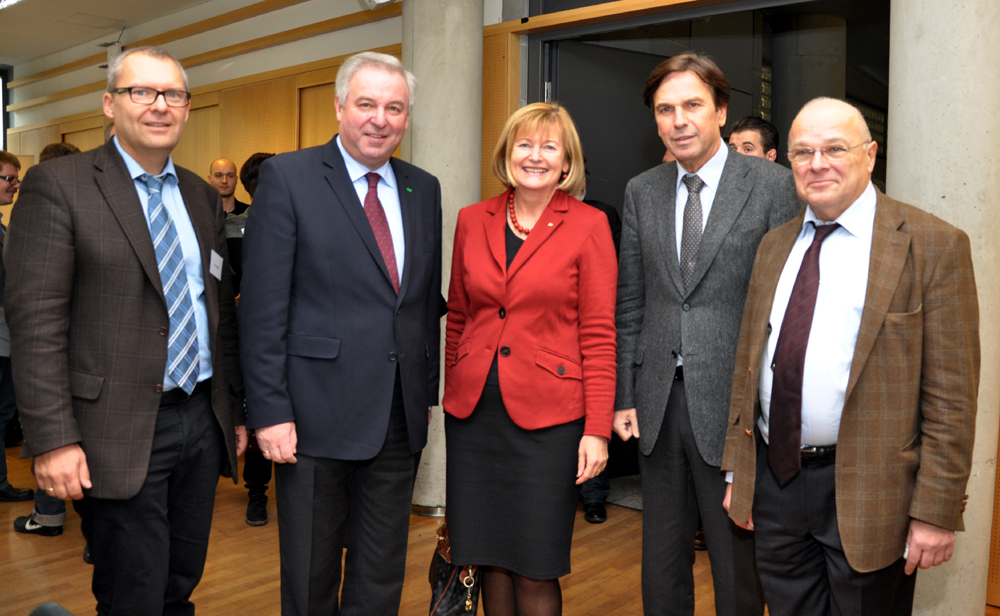
Tagungs-Organisator Klaus Poier, LH-Vize Hermann Schützenhöfer, Rektorin Christa Neuper, LH Franz Voves und Dekan Joseph Marko (v.l.)
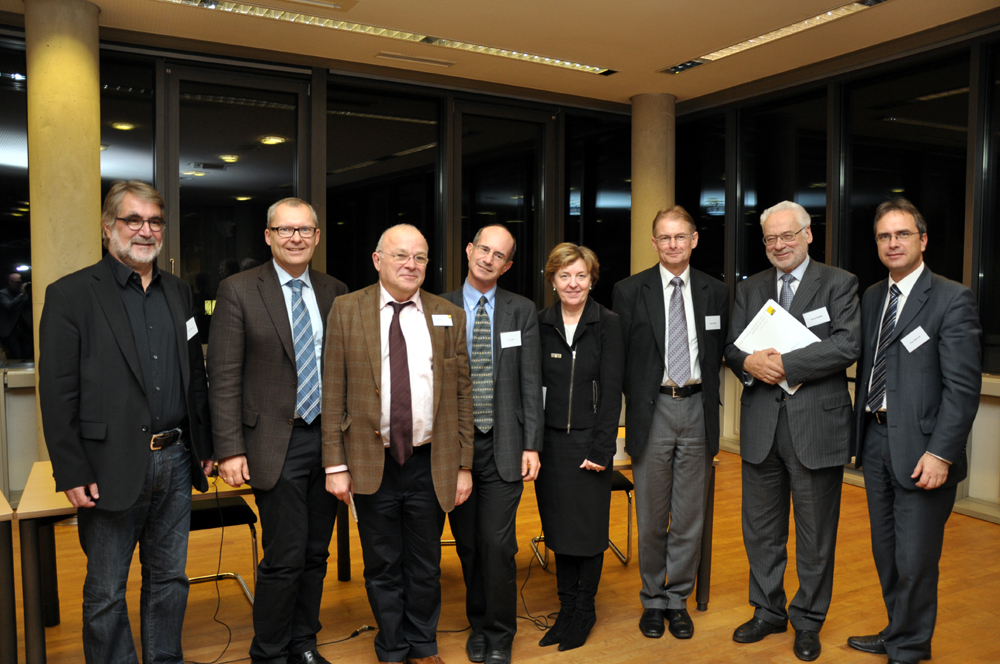
Gilg Seeber (ÖGPW-Vorsitzender), Klaus Poier (Uni Graz), REWI-Dekan Joseph Marko, Eric Frey (Der Standard), Sonja Puntscher-Riekmann (Universität Salzburg), Arthur Benz (Technische Universität Darmstadt), Erhard Busek (Jean Monnet Professor) und Vizerektor Peter Riedler (v.l.)
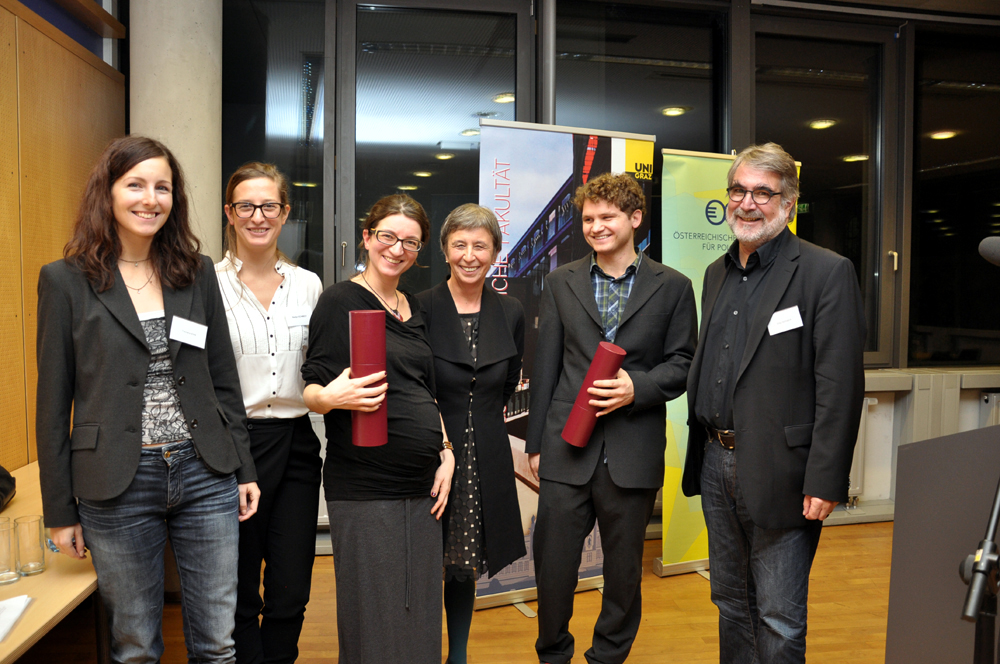
Ausgezeichneter Nachwuchs: stellvertr. ÖGPW-Vorstandsvorsitzende Tamara Ehs, ÖGPW-Generalsekretärin Nadja Schmidt, Preisträgerin Sarah Meyer, Politikwissenschafterin Sieglinde Rosenberger, Preisträger Till Hilmar, ÖGPW-Vorsitzender Gilg Seeber (v.l.)

steirische Landesspitze und hochkarätige ReferentInnen bei Tagung an der Uni Graz

Zu einem Gipfeltreffen von Politikwissenschaft und politischer Praxis kam es am 30. November 2012 an der Uni Graz. Die steirische Landesspitze LH Franz Voves und LH-Vize Hermann Schützenhöfer traf gemeinsam mit Rektorin Christa Neuper auf mehr als 160 PolitologInnen, die sich beim 2. Österreichischen Tag der Politikwissenschaft am 29. und 30. November 2012 an der Karl-Franzens-Universität austauschten. Bei insgesamt mehr als 20 Workshops nahmen sowohl junge ForscherInnen als auch etablierte WissenschafterInnen aus dem In- und Ausland zu aktuellen Themen, wie etwa zu Demokratisierung und EU-Integration des westlichen Balkans, zur Umweltpolitik sowie Finanzkrise, Stellung.

Am Abend zuvor eröffnete ein hochkarätig besetztes Podium – mit Arthur Benz (Institut für Politikwissenschaft, Technische Universität Darmstadt), Erhard Busek (Jean Monnet Professor an der Uni Graz), Sonja Puntscher-Riekmann (Salzburg Centre of European Union Studies, Universität Salzburg) und Eric Frey (Moderation, Der Standard) – mit einer Diskussion unter dem Titel „Governance in Europa“ die Konferenz.

„Politikwissenschaft ist ein gelebter Schwerpunkt an der Universität“, begrüßte Peter Riedler, Vizerektor für Finanzen, Ressourcen und Standortentwicklung, die Tagungsgäste. Joseph Marko, Dekan der Rechtswissenschaftlichen (REWI) Fakultät der Uni Graz, verwies auf die zahlreichen Querverbindungen der REWI zu den Forschungsschwerpunkten: „Im Rahmen von Heterogenität wird etwa der Frage der Einheit von poltischer Gebilden bei gleichzeitiger Wahrung der kulturellen Vielfalt nachgegangen.“

Einen weiteren Höhepunkt bildete die Preisverleihung der ÖGPW, die seit 2004 herausragende Abschlussarbeiten prämiert. Ausgezeichnet wurden die Dissertation von Sarah Meyer, Wien, „EU supporters at a disadvantage? Party politicization of European integration in Austria“ (BetreuerInnen: Sieglinde Rosenberger und Anton Pelinka) sowie die Diplom- bzw. Masterarbeiten von Clarissa Böck, Wien, „,Ostbanden' im ,Sicherfühlland'. Politik im (Un-)Sicherheitsdiskurs vor dem Hintergrund der Transformationsprozesse nach 1989" (Betreuer: Dieter Segert) und von Till Hilmar, Wien, „,Storyboards' der Erinnerung. Eine empirische Fallstudie zu Geschichtsbildern und ästhetischer Wahrnehmung beim Besuch der Gedenkstätte Auschwitz-Birkenau" (Betreuerin: Heidemarie Uhl).

created by Andreas Schweiger

Related news

Diversity buddies at the University of Graz: Support on equal terms

The University of Graz is strengthening its commitment to equal opportunities with its new Diversity Buddies. University members can find easily accessible contact persons here for questions relating to equality and diversity. All employees can get involved and take action.

When parents find it difficult to have a say

In her dissertation, translation scholar Marie Tschurtschenthaler examines how communication between compulsory schools and parents whose first language is not German works – and what role professional language mediation plays in this. Initial insights show that it is not just about language, but also about resources, responsibilities and the institutional framework.

AI in schools: Maria Bertel drafts legal guidelines for teachers

The legal expert and her team analysed the legal situation regarding the use of artificial intelligence in education as part of an EU project and answered open questions from practice.

Cosmetics in the environment: University of Graz proves danger to ants

Titanium dioxide, which is found in cosmetics, for example, is increasingly entering the environment in the form of nanoparticles. This could also put insects at risk. If ants ingest the substance in combination with the pesticide glyphosate, it disturbs the development of their offspring. Scientists at the University of Graz are drawing attention to the negative consequences of this toxic cocktail.

Begin of page section:
Additional information:

University of Graz
Universitaetsplatz 3
8010 Graz
Austria
  • Contact
  • Web Editors
  • Moodle
  • UNIGRAZonline
  • Imprint
  • Data Protection Declaration
  • Accessibility Declaration
Weatherstation
Uni Graz

End of this page section. Go to overview of page sections

End of this page section. Go to overview of page sections

Begin of page section:

End of this page section. Go to overview of page sections