



Begin of page section:
Page sections:

  • Go to contents (Accesskey 1)
  • Go to position marker (Accesskey 2)
  • Go to main navigation (Accesskey 3)
  • Go to sub navigation (Accesskey 4)
  • Go to additional information (Accesskey 5)
  • Go to page settings (user/language) (Accesskey 8)
  • Go to search (Accesskey 9)

End of this page section. Go to overview of page sections

Begin of page section:
Page settings:

English en
Deutsch de
Search
Login

End of this page section. Go to overview of page sections

Begin of page section:
Search:

Search for details about Uni Graz
Close

End of this page section. Go to overview of page sections


Search

Begin of page section:
Main navigation:

Page navigation:

  • University

    University
    • About the University
    • Organisation
    • Faculties
    • Library
    • Working at University of Graz
    • Campus
    Developing solutions for the world of tomorrow - that is our mission. Our students and our researchers take on the great challenges of society and carry the knowledge out.
  • Research Profile

    Research Profile
    • Our Expertise
    • Research Questions
    • Research Portal
    • Promoting Research
    • Research Transfer
    • Ethics in Research
    • Commission for Scientific Integrity
    Scientific excellence and the courage to break new ground. Research at the University of Graz creates the foundations for making the future worth living.
  • Studies

    Studies
    • Prospective Students
    • Students
    • Welcome Weeks for First Year Students
  • Community

    Community
    • International
    • Location
    • Research and Business
    • Alumni
    The University of Graz is a hub for international research and brings together scientists and business experts. Moreover, it fosters the exchange and cooperation in study and teaching.
Topics
  • Sustainable University
  • Researchers answer
  • Work for us
Close menu

End of this page section. Go to overview of page sections

Begin of page section:
You are here:

University of Graz News Plötzlich verwandt

End of this page section. Go to overview of page sections

Thursday, 24 November 2022

Plötzlich verwandt

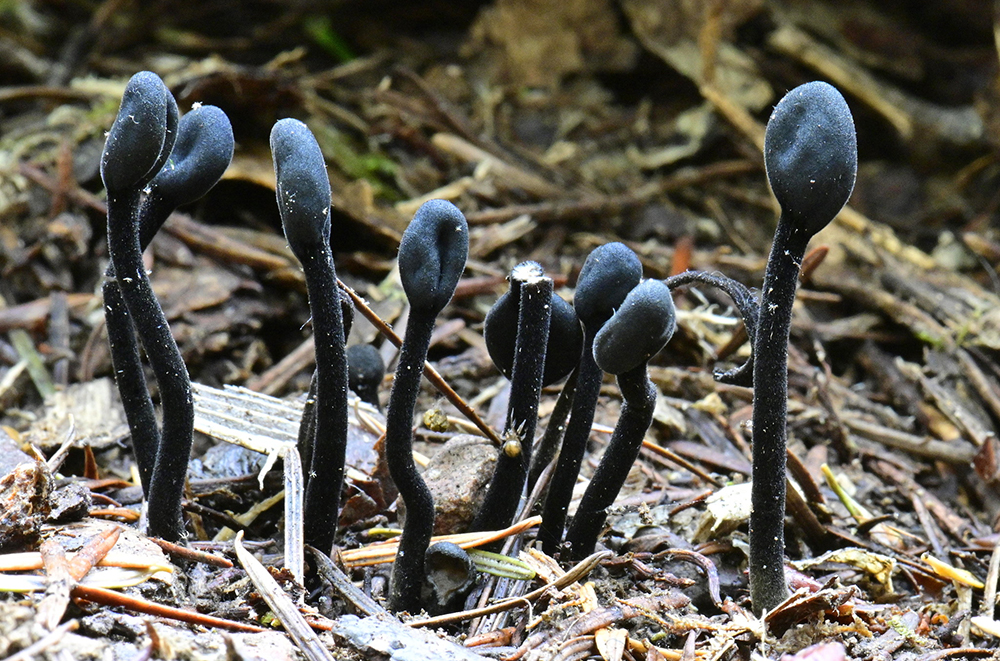
Trichoglossum velutipes Foto: Alan Rockefeller

Trichoglossum velutipes, eine Art aus der Gattung der Haarzungen in Kalifornien. Sie gehören zu jenen „schrägen“ Pilzen, die neu gruppiert werden. Foto: Alan Rockefeller

Biolog:innen schreiben „Familiengeschichte“ von Pilzen neu

Verwandtschaft kann man sich nicht aussuchen. Das gilt auch für eine spezielle Gruppe von Pilzen, die unterschiedlicher nicht sein könnten: Egal ob sie in heimischen Wäldern wachsen, im Darm von Insekten leben oder in Bäumen im Amazonasgebiet vorkommen. Sie galten bislang wegen ihres andersartigen Aussehens und ihrer ungleichen Lebensstrategien als nicht miteinander verwandt. Dabei haben sie gemeinsame Vorfahren wie ein internationales Team mit Wissenschafter:innen der Uni Graz herausgefunden hat. Es hat eine große Übereinstimmung der Erbinformation dieser Pilze entdeckt und schreibt nun deren „Familiengeschichte“ neu.

„Schräge“ Pilze
Nicht einmal auf den zweiten Blick haben sie viel gemein: Schleimige Erdzungen im Moos, winzige Lebewesen im Darm des Brotkäfers oder Teile von Flechten in der Wüste und auf Baumstämmen. Die neue Studie zeigt nun, dass das Erbgut dieser „schrägen“ Pilze viele Gemeinsamkeiten aufweist und dass sie denselben Ursprung haben, der etwa 300 Millionen Jahre zurückliegt. Seitdem entwickeln sie sich weiter, sind über den ganzen Globus verbreitet und haben unterschiedliche Eigenschaften sowie Formen gebildet.

Aus sechs mach eins
Philipp Resl vom Institut für Biologie der Universität Graz hat in Zusammenarbeit mit Kolleg:innen der University of Alberta (Kanada) die enge biologische Verwandtschaft nachgewiesen. Dazu haben sie die Gesamtheit der DNA, also mehrere Genome von vielen Pilzen miteinander verglichen. Letztendlich wurde aus sechs nun eins. „Denn diese, lange als Sonderlinge angesehenen Pilze wurden einst in sechs verschiedene Klassen eingeteilt, die aufgrund unserer neuen Erkenntnisse jetzt in einer großen Klasse zusammengefasst werden können“, erläutert Resl. Eine Klasse ist eine hochrangige Gruppierung im Baum des Lebens, das würde bei Tieren beispielsweise Säugetieren oder Reptilien entsprechen.
„Es ist ein wenig wie mit den Schnabeltieren“, vergleicht Toby Spribille von der University of Alberta, der gemeinsam mit Resl das Forschungsprojekt leitet. Das exotische Wesen legt Eier und sieht wie eine Mischung aus Säugetier und Vogel aus. In Anlehnung daran bezeichnen die Wissenschafter:innen die neue Gruppe als „Schnabeltiere der Pilzwelt“.
Die Biolog:innen erwarten sich unter anderem Aufschlüsse darüber, wie Pilze Enzyme, die Pflanzenmaterial abbauen, vererben. Philipp Resl ist überzeugt: „An der Universität Graz forschen wir intensiv zur Genomik verschiedener Lebewesen, das wird zu weiteren spannenden Entdeckungen führen.“

Die Erkenntnisse wurden am 23. November 2022 in der Zeitschrift Current Biology veröffentlicht.

created by Andreas Schweiger

Related news

Legal scholar Clarissa Groß on European values at the EU’s external borders

The tense situation in the Spanish exclave of Ceuta has been making headlines for weeks. The exodus of thousands of Moroccans has once again placed migration and border policy at the very top of the EU’s agenda. Clarissa Groß, a research assistant at the Institute for European Law, is examining the reform of the Common European Asylum System (CEAS), the design and practical implementation of the new border procedures, and their compatibility with the right to personal liberty as part of her doctoral thesis. She recently visited the Greek island of Lesbos, which remains a migration hotspot, to assess the situation on the ground.

Graz is a magnet for 750 physicists: international conference on campus

Whether in mobile phones, medical devices or solar power systems: physical phenomena are part of our everyday lives. The vast scope of this discipline will be explored at a major conference taking place at the University of Graz from 20 to 25 September 2026. More than 750 scientists will transform the campus into a European hub for physics.

A fresh start, a calling, holidays: what draws people from other career paths to teaching

They used to develop software; now they teach maths in the classroom. Career changers are expected to help address the shortage of qualified teachers in Austria’s schools. In their doctoral theses at the Institute for Educational Research and Teacher Training at the University of Graz, Melanie Gürentz and Claudia Mair examined how these new teachers perceive their new professional roles.

Talent Talks bridge the gap in career guidance

The Styrian Chamber of Commerce (WKO Steiermark), the Styrian Chamber of Labour (AK Steiermark) and the AMS are joining forces when it comes to training young people and, through the “Talent Talks”, are creating a seamless pathway to career guidance. This takes preparation and follow-up support – just in time for the start of the term and the scheme’s tenth anniversary – to a whole new level. A new survey conducted by the Talent Centre among 2,687 former participants to mark the anniversary shows just how important this development is. Of the young people who received follow-up support from the Talent Report, 74.6 per cent stated that they had a good understanding of their own strengths and talents following the Talent Check. Without follow-up support, the figure was 66.5 per cent – a significant difference of 8.1 percentage points.

Begin of page section:
Additional information:

University of Graz
Universitaetsplatz 3
8010 Graz
Austria
  • Contact
  • Web Editors
  • Moodle
  • UNIGRAZonline
  • Imprint
  • Data Protection Declaration
  • Accessibility Declaration
Weatherstation
Uni Graz

End of this page section. Go to overview of page sections

End of this page section. Go to overview of page sections

Begin of page section:

End of this page section. Go to overview of page sections