Begin of page section:
Page sections:

  • Go to contents (Accesskey 1)
  • Go to position marker (Accesskey 2)
  • Go to main navigation (Accesskey 3)
  • Go to sub navigation (Accesskey 4)
  • Go to additional information (Accesskey 5)
  • Go to page settings (user/language) (Accesskey 8)
  • Go to search (Accesskey 9)

End of this page section. Go to overview of page sections

Begin of page section:
Page settings:

English en
Deutsch de
Search
Login

End of this page section. Go to overview of page sections

Begin of page section:
Search:

Search for details about Uni Graz
Close

End of this page section. Go to overview of page sections


Search

Begin of page section:
Main navigation:

Page navigation:

  • University

    University
    • About the University
    • Organisation
    • Faculties
    • Library
    • Working at University of Graz
    • Campus
    Developing solutions for the world of tomorrow - that is our mission. Our students and our researchers take on the great challenges of society and carry the knowledge out.
  • Research Profile

    Research Profile
    • Our Expertise
    • Research Questions
    • Research Portal
    • Promoting Research
    • Research Transfer
    • Ethics in Research
    • Commission for Scientific Integrity
    Scientific excellence and the courage to break new ground. Research at the University of Graz creates the foundations for making the future worth living.
  • Studies

    Studies
    • Prospective Students
    • Students
  • Community

    Community
    • International
    • Location
    • Research and Business
    • Alumni
    The University of Graz is a hub for international research and brings together scientists and business experts. Moreover, it fosters the exchange and cooperation in study and teaching.
Topics
  • Sustainable University
  • Researchers answer
  • Work for us
Close menu

End of this page section. Go to overview of page sections

Begin of page section:
You are here:

University of Graz News PFAS in honey bees: Insects enable monitoring of pollutants in the environment

End of this page section. Go to overview of page sections

Tuesday, 26 August 2025

PFAS in honey bees: Insects enable monitoring of pollutants in the environment

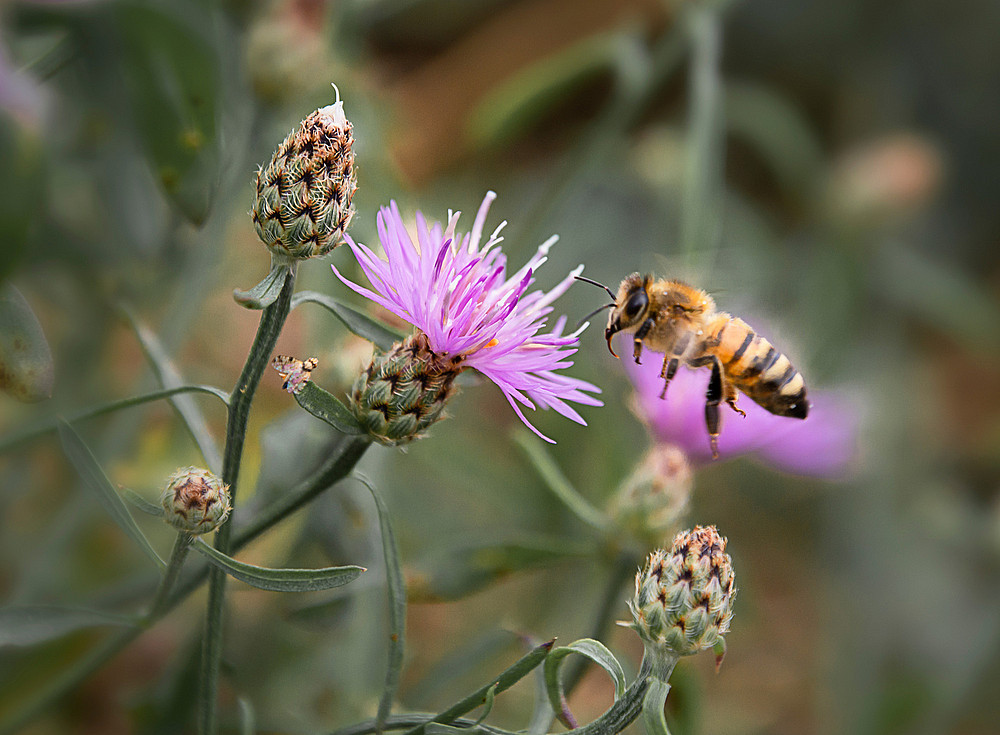
Bee in flight, near a knapweed flower

Bees absorb pollutants from the environment and thus provide up-to-date information about their distribution. Photo: iredman - stock.adobe.com

PFAS – per- and polyfluoroalkyl substances – have increasingly come under scrutiny in recent years as so-called “forever chemicals”. These artificially produced substances are used in the manufacture of many everyday products. They are harmful to the environment and human health, difficult to break down and accumulate everywhere, in flora, fauna and even in humans. Researchers at the University of Graz have now used honeybees to investigate the occurrence of PFAS at different times and in different land use areas. The study shows that bees and the pollen they collect are ideal for monitoring environmental toxins. The insects absorb the pollutants, allowing conclusions to be drawn about their spatial and seasonal distribution.

“PFAS was detected in quantifiable amounts in almost all of the bees and pollen we examined,” reports Jörg Feldmann. The chemist from the University of Graz has also been tracking environmental toxins in wild boars and whale brains. “When it comes to monitoring pollutants, however, bees have a significant advantage over these mammals. Because they only live for a few weeks, the chemicals they absorb cannot accumulate in their bodies over a longer period of time. This means that the measured concentrations always provide up-to-date information about the presence of environmental toxins,” explains biologist Robert Brodschneider.

For their latest study on PFAS in bees and pollen, the researchers collected data from April to August at six locations in Upper Austria, Lower Austria and Styria with different land uses, in urban and semi-urban, rural and agricultural areas. The temporal and spatial differences were remarkable. Site-specific PFAS patterns indicated potential sources of contamination, such as the use of pesticides containing fluorine. No direct correlation was found with the type of land use.

“In total, we detected nine different PFAS in 90 samples,” reports Viktoria Müller, environmental chemist at the University of Graz and the James Hutton Institute in Aberdeen, UK. “Bees in the hive had the highest average total of all concentrations, followed by forager bees and pollen,” the researcher continues. Differences in the occurrence of PFAS between sample types, especially between foragers and hive bees, indicated different routes of exposure, such as uptake via pollen, airborne particles or contaminated surfaces. “We were able to show that forager bees introduce PFAS into the hive either via their bodies or via nectar and pollen,” says Müller. 

“Knowledge of seasonal and location-specific differences in PFAS concentrations is an important prerequisite for creating contamination maps for specific areas,” says Feldmann, explaining the significance of the study. Further research will be needed to clarify which factors are responsible for local and temporal variations.

Publication:
PFAS in the buzz: Seasonal biomonitoring with honey bees (Apis mellifera) and bee-collected pollen
Viktoria Müller, Jörg Feldmann, Eileen Prieler, Robert Brodschneider
Environmental Pollution, Volume 382, 2025, https://doi.org/10.1016/j.envpol.2025.126750

empty picture
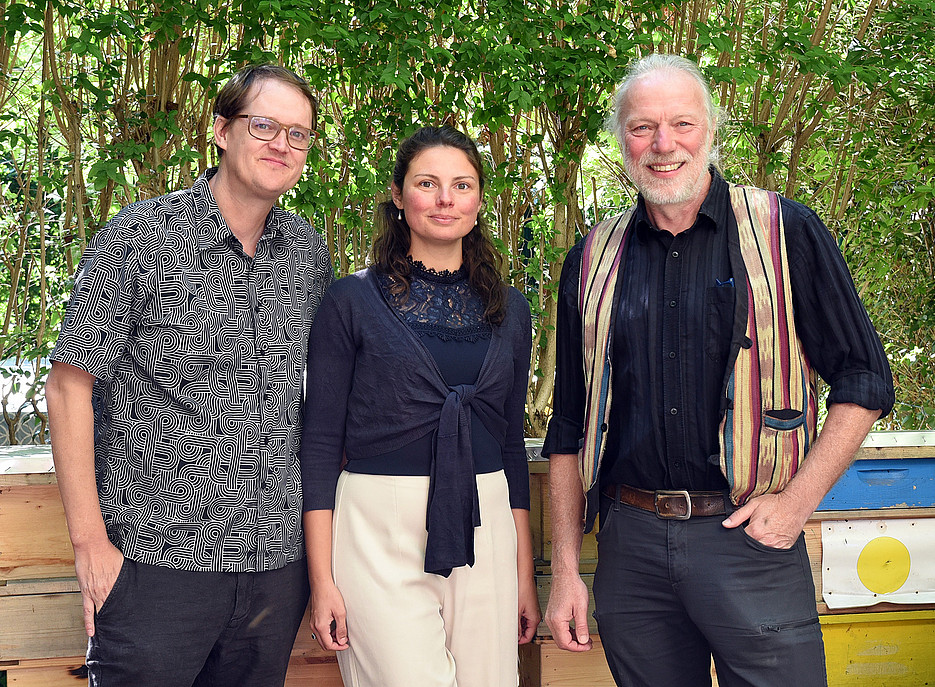
Robert Brodschneider, Viktoria Müller, and Jörg Feldmann standing in front of beehives, with a hedge behind them ©University of Graz / Pichler
©University of Graz / Pichler
Robert Brodschneider, Viktoria Müller, and Jörg Feldmann (from left) investigated the occurrence of the PFAS "forever chemicals" in bees and pollen. Photo: University of Graz / Pichler
created by Gudrun Pichler

Related news

Superti-Furga will becomefounding director of the CORI Institute in Graz

The Austrian Academy of Sciences (ÖAW) is establishing a new flagship centre for research into metabolic diseases in collaboration with the three universities in Graz. This innovative research approach combines mathematics and experimental biology with artificial intelligence

A match for life

Stem cell donations save lives. However, the only way to determine who is ultimately compatible with whom is through a testing process. Pharmacist Marion Mußbacher explains the mechanisms behind this. On 6 May 2026, the ÖH and the charity “Geben für Leben” are calling for people to come forward for typing at the University of Graz.

Mild Research Night: Around 750 visitors travelled around the world at the university

Lovely weather and a wide range of research topics drew visitors to the University of Graz last Friday. Highlights included a journey around the globe in eight stops, a ‘speed-dating’ session with books, insights into Alfred Wegener’s Greenland expedition, and guided tours of the democracy exhibition at the UniGraz@Museum.

Career Booster: How the Research Careers Campus supports researchers

They are innovative, creative and productive – researchers who have not yet been appointed to a professorship make a massive contribution to a university’s research output. To provide them with even better support on their career path, the University of Graz has established the Research Careers Campus. The official launch took place on 22 April 2026 with a ‘festival’.

Begin of page section:
Additional information:

University of Graz
Universitaetsplatz 3
8010 Graz
Austria
  • Contact
  • Web Editors
  • Moodle
  • UNIGRAZonline
  • Imprint
  • Data Protection Declaration
  • Accessibility Declaration
Weatherstation
Uni Graz

End of this page section. Go to overview of page sections

End of this page section. Go to overview of page sections

Begin of page section:

End of this page section. Go to overview of page sections