Begin of page section:
Page sections:

  • Go to contents (Accesskey 1)
  • Go to position marker (Accesskey 2)
  • Go to main navigation (Accesskey 3)
  • Go to sub navigation (Accesskey 4)
  • Go to additional information (Accesskey 5)
  • Go to page settings (user/language) (Accesskey 8)
  • Go to search (Accesskey 9)

End of this page section. Go to overview of page sections

Begin of page section:
Page settings:

English en
Deutsch de
Search
Login

End of this page section. Go to overview of page sections

Begin of page section:
Search:

Search for details about Uni Graz
Close

End of this page section. Go to overview of page sections


Search

Begin of page section:
Main navigation:

Page navigation:

  • University

    University
    • About the University
    • Organisation
    • Faculties
    • Library
    • Working at University of Graz
    • Campus
    Developing solutions for the world of tomorrow - that is our mission. Our students and our researchers take on the great challenges of society and carry the knowledge out.
  • Research Profile

    Research Profile
    • Our Expertise
    • Research Questions
    • Research Portal
    • Promoting Research
    • Research Transfer
    • Ethics in Research
    Scientific excellence and the courage to break new ground. Research at the University of Graz creates the foundations for making the future worth living.
  • Studies

    Studies
    • Prospective Students
    • Students
  • Community

    Community
    • International
    • Location
    • Research and Business
    • Alumni
    The University of Graz is a hub for international research and brings together scientists and business experts. Moreover, it fosters the exchange and cooperation in study and teaching.
  • Spotlight
Topics
  • Our digital Advent calendar
  • Sustainable University
  • Researchers answer
  • Work for us
Close menu

End of this page section. Go to overview of page sections

Begin of page section:
You are here:

University of Graz News Peptides against hospital germs: the long road to market readiness

End of this page section. Go to overview of page sections

Friday, 16 May 2025

Peptides against hospital germs: the long road to market readiness

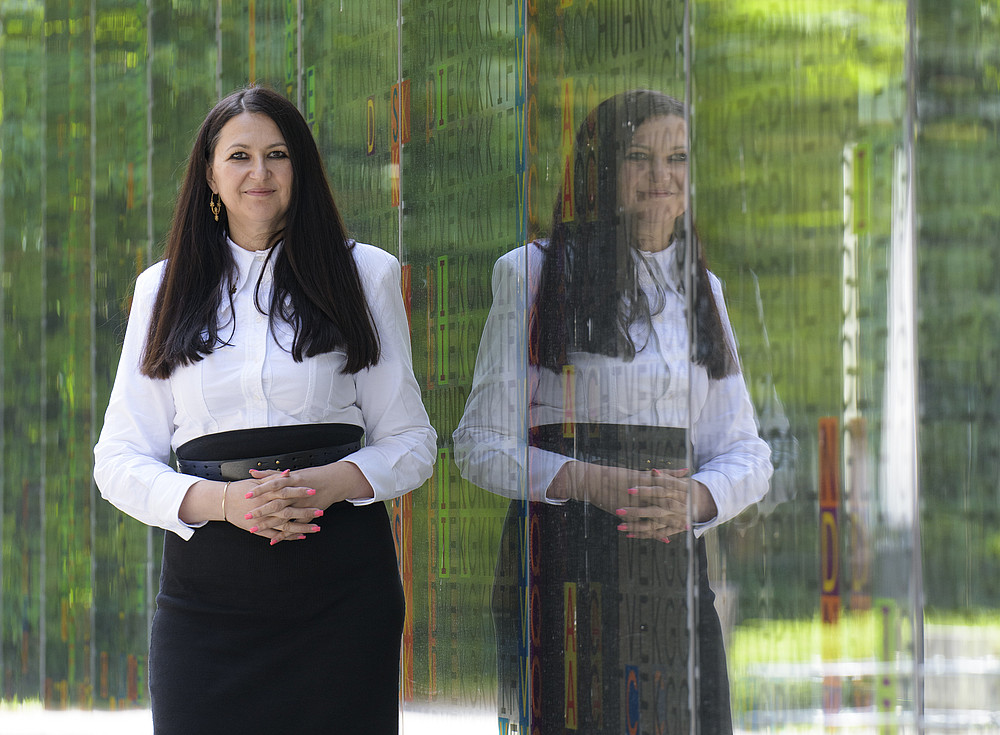
Portrait of a middle-aged woman wearing a white blouse and a black skirt. The image is reflected in the glass of a façade. ©Uni Graz/Tzivanopoulos

Nermina Malanovic is researching active substances against multi-resistant pathogens. Photo: University of Graz/Tzivanopoulos

Multiresistant germs are a threat to global health. At the University of Graz, Nermina Malanovic is researching peptides as a potential new weapon. Thanks to external funding, the preclinical phase for this alternative to conventional antibiotics has been able to start.

For decades, it was unthinkable that a simple infection could suddenly become life-threatening. But according to the World Health Organisation (WHO), this is one of the three greatest threats to public health. The reason: the increasing spread of multiresistant bacteria, which could cause around ten million deaths by 2050. Researchers around the world are therefore searching for new treatments against live threatening hospital germs.

One promising solution is peptides – tiny proteins that Nermina Malanovic is researching at the University of Graz. These small molecules can penetrate the outer wall of cells and break them open. Without this protective skin, bacteria cannot survive. This allows the organisms to be stopped before they cause any damage. Malanovic has already registered two patents for her research.

Preclinical

Thanks to her success, Nermina is often asked where these peptides can be obtained. Unfortunately, the answer is still nowhere. However, that could change soon. "A medical incubator has taken notice of my research," explains Malanovic. The company is financing the preclinical studies with a seven-figure sum – the first step in the development of drugs.

This also presents the researcher with new challenges. "You have to understand the mechanisms of action really well in order to plan the preclinical trials correctly," explains the molecular biologist. She is therefore in constant contact with the incubator's experts. She now also has a team of students at her side to support her in further development.

Cancer research

In addition to combating the dreaded hospital germs, the researcher sees another possible application. "One of the patents also focuses on the treatment of cancer cells," says Malanovic. The results of studies to date make her confident that peptides are also capable of destroying the outer shell of malignant tumour cells. "That would be a completely new approach to cancer therapy," says Malanovic.

There is still a long way to go before her research can be turned into marketable active ingredients. Once the preclinical challenges have been overcome, the most difficult phase begins: clinical trials on humans. This will require additional investors. But that is still a long way off. "For now, the motto is: Grind, grind, grind," emphasises Malanovic.

created by Roman Vilgut

Related news

Chemical Christmas show at the University of Graz: An explosive evening at the Schauspielh

At the beginning of December, the University of Graz transformed the theater into a laboratory: as part of “Chemical Life,” teacher training students staged a chemical Christmas show for Styrian school classes—complete with ethanol rockets, nitrogen snow, and glowing effects. An evening designed to inspire interest in studying chemistry.

Train by train: Koralm railway accelerates exchange between the Universities

Lectures at the University of Klagenfurt in the morning, seminars at the University of Graz in the afternoon: Austria's longest tunnel and a journey time of around 45 minutes make it easy. The Koralm railway increases the speed of networking between the two university locations. The collaboration builds on existing cooperation - for example in the areas of teacher training, Slavic studies and as employers, the universities are well coordinated.

On the trail of the Big Bang: University of Graz receives 1.5 million euros for doctoral programmes

The Austrian Science Fund FWF has selected the Doctoral Programme in Theoretical Particle Physics at the University of Graz for funding from the Doc.funds. Six young scientists will be funded for 3.5 years. They will gain fundamentally new insights into the origins of the world.

From trans women and knee prostheses: sports science prizes awarded

Walking better with a prosthesis, successfully getting rid of excess weight, training more effectively, more fairness for trans people in sport: these were the topics addressed by the students at the University of Graz who were awarded the sports science prizes for their Master's theses on 3 December 2025.

Begin of page section:
Additional information:

University of Graz
Universitaetsplatz 3
8010 Graz
Austria
  • Contact
  • Web Editors
  • Moodle
  • UNIGRAZonline
  • Imprint
  • Data Protection Declaration
  • Accessibility Declaration
Weatherstation
Uni Graz

End of this page section. Go to overview of page sections

End of this page section. Go to overview of page sections

Begin of page section:

End of this page section. Go to overview of page sections