



Begin of page section:
Page sections:

  • Go to contents (Accesskey 1)
  • Go to position marker (Accesskey 2)
  • Go to main navigation (Accesskey 3)
  • Go to sub navigation (Accesskey 4)
  • Go to additional information (Accesskey 5)
  • Go to page settings (user/language) (Accesskey 8)
  • Go to search (Accesskey 9)

End of this page section. Go to overview of page sections

Begin of page section:
Page settings:

English en
Deutsch de
Search
Login

End of this page section. Go to overview of page sections

Begin of page section:
Search:

Search for details about Uni Graz
Close

End of this page section. Go to overview of page sections


Search

Begin of page section:
Main navigation:

Page navigation:

  • University

    University
    • About the University
    • Organisation
    • Faculties
    • Library
    • Working at University of Graz
    • Campus
    Developing solutions for the world of tomorrow - that is our mission. Our students and our researchers take on the great challenges of society and carry the knowledge out.
  • Research Profile

    Research Profile
    • Our Expertise
    • Research Questions
    • Research Portal
    • Promoting Research
    • Research Transfer
    • Ethics in Research
    • Commission for Scientific Integrity
    Scientific excellence and the courage to break new ground. Research at the University of Graz creates the foundations for making the future worth living.
  • Studies

    Studies
    • Prospective Students
    • Students
    • Welcome Weeks for First Year Students
  • Community

    Community
    • International
    • Location
    • Research and Business
    • Alumni
    The University of Graz is a hub for international research and brings together scientists and business experts. Moreover, it fosters the exchange and cooperation in study and teaching.
Topics
  • Sustainable University
  • Researchers answer
  • Work for us
Close menu

End of this page section. Go to overview of page sections

Begin of page section:
You are here:

University of Graz News Optimierte Industrie

End of this page section. Go to overview of page sections

Friday, 07 July 2017

Optimierte Industrie
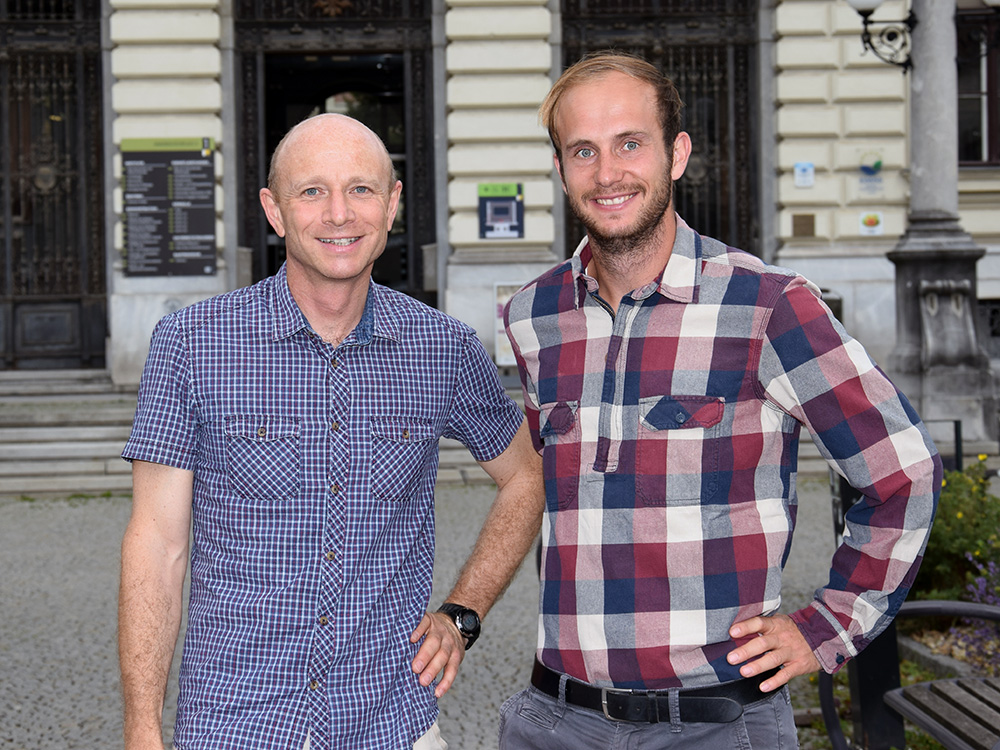
Liefern Unternehmen optimiertes Wissen: Ulrich Pferschy und Tobias Kreiter. Foto: Uni Graz

Liefern Unternehmen optimiertes Wissen: Ulrich Pferschy und Tobias Kreiter. Foto: Uni Graz

Projekt des Instituts für Statistik und Operations Research hilft der Automatisierung auf die Sprünge

Industrie 4.0 ist das Schlagwort für die moderne, automatisierte Herstellung. „Die Vision dahinter ist, dass sich ein Werkstück, beispielsweise ein Motor, auf einem mobilen Materialträger seinen Weg durch die Produktionshalle bahnt und sich dabei, abhängig von freien Kapazitäten, selbst die nächste Bearbeitungsstelle sucht“, schildert Ulrich Pferschy, Leiter des Instituts für Statistik und Operations Research. Die große Herausforderung dabei ist das Management der Komplexität. „Es müssen so viele Parameter berücksichtigt werden, dass diese Arbeit ohne Computereinsatz nicht mehr leistbar ist“, erklärt der Wirtschaftswissenschafter. Entsprechende Standard-Softwaresysteme sind allerdings nicht immer gut durchschaubar. Tobias Kreiter untersucht im Rahmen seiner Dissertation für ein Unternehmen, welche Potenziale beziehungsweise Grenzen eine bestimmte Software für den Einsatz in der Industrie hat. „Um ihre Leistungsfähigkeit zu evaluieren, errechnen wir mit mathematischen Methoden das tatsächlich Optimum für unterschiedliche Vorgaben und vergleichen es mit den Werten des Computerprogramms“, schildert der Doktorand. Konkret geht es um eine Anwendung für ein Motorenwerk, das verschiedene Modelle gleichzeitig fertigen möchte. Bislang wurde in mehreren Schichten ein Produkt hergestellt, um die Kosten für Werkzeugwechsel und Reinigung gering zu halten. „Das bringt für die Kundschaft längere Wartezeiten, außerdem wird der Wunsch nach individualisierten Produkten immer größer“, beschreibt Pferschy. Kurzfristige Änderungen gehören also bereits zum Tagesgeschäft. Die flexiblere Produktion bringt aber auch den Industriebetrieben Vorteile: „Die abwechslungsreichere Tätigkeit erhöht Konzentration und Motivation der MitarbeiterInnen“, unterstreicht Kreiter.
Das Projekt wird von der scc EDV-Beratung AG finanziert, mit der das Institut bereits seit 1997 in zahlreichen Vorhaben kooperiert und die mittlerweile mehrere AbsolventInnen der Karl-Franzens-Universität angestellt hat. Auch der Dissertant ist in Teilzeit dort beschäftigt. „Die Zusammenarbeit mit Industrie und Wirtschaft ist ein wichtiger Teil der Ausbildung und gewährleistet für unsere Studierende die Nähe zur Praxis“, betont Pferschy.

created by Dagmar Eklaude

Related news

Jurassic Sounds: Biologist reconstructs insect songs from 165 million years ago

It was apparently not just the roars of the dinosaurs that made up the soundscape of the animal world during the Jurassic period. Crickets and grasshoppers communicated through a variety of songs and high-pitched sounds, as Thorin Jonsson from the Institute of Biology at the University of Graz discovered together with colleagues from the universities of Lincoln, Bristol (UK), Beijing (China) and Tempe (USA). The findings on what are so far the oldest traces of sound on Earth have just been published in the journal PNAS.

EU funding boosts international exchange between universities

The University of Graz is further expanding its international study opportunities through the European university alliance Arqus and is taking the lead in two key projects. In future, students will benefit from even more joint degree programmes and from simplified recognition of academic achievements through the Joint European Degree Label.

Rescue and risks: Researchers have surveyed public perceptions of AI

The use of artificial intelligence has had to be made transparent since 2 August 2026. The EU’s AI Act, which has been in force since then, also sets out how risky an application is and which security measures apply as a result. However, the assessment of risks by the legislation differs in some cases significantly from the perceptions of the Austrian public. This is the finding of a representative study carried out by data scientist Stefan Thalmann from the University of Graz and his team.

The Healing Sea: Researchers discover new approaches to treating chronic inflammation in sponges

Chronic inflammation plays a key role in many diseases, ranging from metabolic disorders and cardiovascular diseases to tissue damage following injuries or infections. “Normally, the body is able to resolve inflammation on its own. If this process becomes unbalanced, immune cells remain permanently active and continue to drive negative changes in the tissue,” explains Andreas Koeberle, a pharmacist at the University of Graz.

Begin of page section:
Additional information:

University of Graz
Universitaetsplatz 3
8010 Graz
Austria
  • Contact
  • Web Editors
  • Moodle
  • UNIGRAZonline
  • Imprint
  • Data Protection Declaration
  • Accessibility Declaration
Weatherstation
Uni Graz

End of this page section. Go to overview of page sections

End of this page section. Go to overview of page sections

Begin of page section:

End of this page section. Go to overview of page sections


