Begin of page section:
Page sections:

  • Go to contents (Accesskey 1)
  • Go to position marker (Accesskey 2)
  • Go to main navigation (Accesskey 3)
  • Go to sub navigation (Accesskey 4)
  • Go to additional information (Accesskey 5)
  • Go to page settings (user/language) (Accesskey 8)
  • Go to search (Accesskey 9)

End of this page section. Go to overview of page sections

Begin of page section:
Page settings:

English en
Deutsch de
Search
Login

End of this page section. Go to overview of page sections

Begin of page section:
Search:

Search for details about Uni Graz
Close

End of this page section. Go to overview of page sections


Search

Begin of page section:
Main navigation:

Page navigation:

  • University

    University
    • About the University
    • Organisation
    • Faculties
    • Library
    • Working at University of Graz
    • Campus
    Developing solutions for the world of tomorrow - that is our mission. Our students and our researchers take on the great challenges of society and carry the knowledge out.
  • Research Profile

    Research Profile
    • Our Expertise
    • Research Questions
    • Research Portal
    • Promoting Research
    • Research Transfer
    • Ethics in Research
    Scientific excellence and the courage to break new ground. Research at the University of Graz creates the foundations for making the future worth living.
  • Studies

    Studies
    • Prospective Students
    • Students
  • Community

    Community
    • International
    • Location
    • Research and Business
    • Alumni
    The University of Graz is a hub for international research and brings together scientists and business experts. Moreover, it fosters the exchange and cooperation in study and teaching.
  • Spotlight
Topics
  • Our digital Advent calendar
  • Sustainable University
  • Researchers answer
  • Work for us
Close menu

End of this page section. Go to overview of page sections

Begin of page section:
You are here:

University of Graz News Nuremberg Trials: The beginning of international justice

End of this page section. Go to overview of page sections

Wednesday, 19 November 2025

Nuremberg Trials: The beginning of international justice

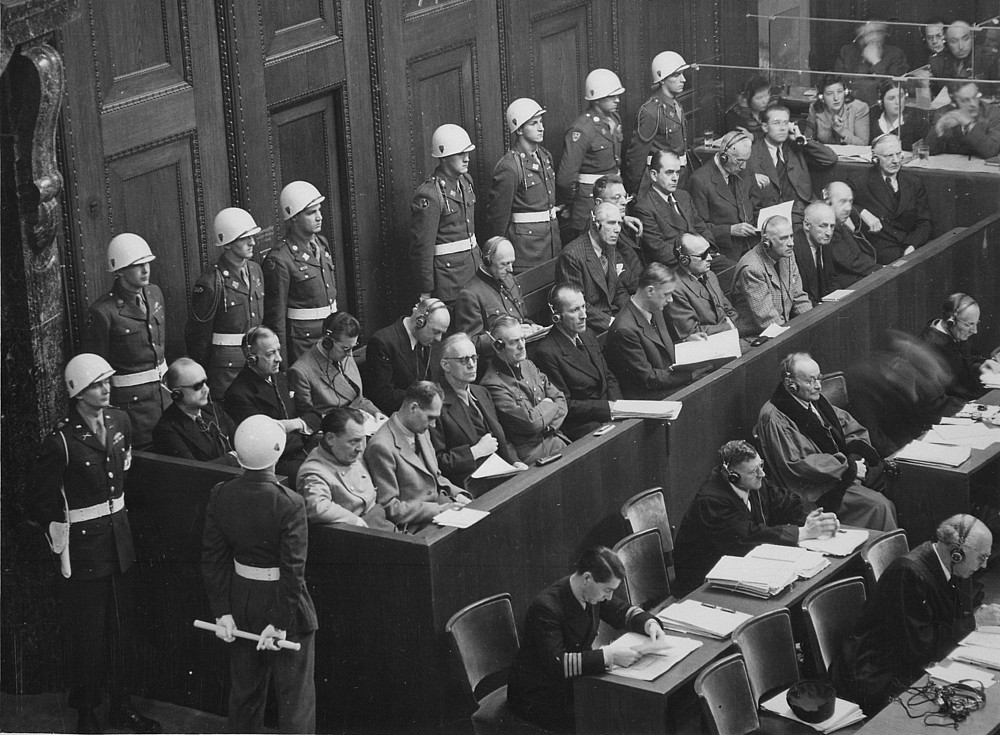
Black and white photograph of a courtroom during the Nuremberg trials. Defendants sit in the upper row, guarded by soldiers with helmets. In front of them are defence lawyers and other people at tables with documents.

The dock with Nazi criminals at the main trial in Nuremberg in 1945. Photo: Ray D'Addario, Public domain, via Wikimedia Commons

Exactly 80 years ago, a criminal trial began in Nuremberg that shed new light on the understanding of justice. The focus was not on the revenge of the victors, but on the responsibility of the perpetrators - the elite of the Nazi regime.

Nuremberg, 20 November 1945: Six months after the end of the Second World War, a criminal trial begins in a bombed-out city, but in a largely intact palace of justice with a large prison attached. 24 major war criminals of the Nazi regime, including Martin Bormann, Karl Dönitz, Hermann Göring, Rudolf Hess, Wilhelm Keitel and Rudolf Speer, are tried before an international military tribunal. The four Allied victorious powers - England, France, Russia and the USA - thus achieve something previously unthinkable: an entire government team is put on trial.

"This had never happened before in this form," says legal historian Martin Polaschek. "For the first time, not only the perpetrators on the ground were prosecuted, but also those who gave orders and made political decisions - in other words, the architects of the system." The legal foundations were laid with the so-called London Statute: War of aggression, crimes against humanity and war crimes were defined as separate offences. The Allies thus created a supranational criminal law for the first time - a revolutionary step that later became the basis of international criminal law.

For the first time, not only the perpetrators on the ground were prosecuted, but also the architects of the system.

Despite these ground-breaking innovations, criticism was inevitable. Observers criticised the one-sided selection of defendants and spoke of "victor's justice". Crimes committed by the Allies - such as the bombing of civilian targets like in Dresden - were not part of the trial. In any case, the trial set standards - legally, morally and in terms of media history. It was meticulously documented, simultaneous translators made multilingual proceedings possible for the first time, and thousands of evidence documents revealed the crimes of the Nazi regime. Work was carried out under high pressure, because the fresher the offence, the more impressive the prosecution. "The Nuremberg Trial is a central source of contemporary history," says Polaschek. "It brought the extent of the atrocities committed by the Nazi regime to light in a structured way for the first time." The indictment, the minutes and other documents have been preserved for posterity in four languages, each in 42 volumes. 
 

A total of 13 trials from 1945 to 1949

The main trial from November 1945 to October 1946 was held against 24 defendants. It was the only one in Europe before an International Military Tribunal and ended with twelve death sentences, seven prison sentences and three acquittals.

In the following years, twelve further trials were held before national American tribunals against doctors, lawyers, entrepreneurs and SS officers. However, interest ebbed away with the beginning of the Cold War. Many perpetrators were not prosecuted, others found new roles - especially if their knowledge was useful in the emerging East-West conflict.

The Nuremberg trials remain a milestone. They established that no one can invoke a "necessity to obey orders" when committing crimes - and that even statesmen are not above the law. This principle still applies today, for example in the International Criminal Court in The Hague. "The signal from Nuremberg was clear," summarises Polaschek. "Even the commander is responsible - and no one should believe that his power and the actions associated with it guarantee him impunity."

created by Konstantin Tzivanopoulos

Related news

Chemical Christmas show at the University of Graz: An explosive evening at the Schauspielh

At the beginning of December, the University of Graz transformed the theater into a laboratory: as part of “Chemical Life,” teacher training students staged a chemical Christmas show for Styrian school classes—complete with ethanol rockets, nitrogen snow, and glowing effects. An evening designed to inspire interest in studying chemistry.

Train by train: Koralm railway accelerates exchange between the Universities

Lectures at the University of Klagenfurt in the morning, seminars at the University of Graz in the afternoon: Austria's longest tunnel and a journey time of around 45 minutes make it easy. The Koralm railway increases the speed of networking between the two university locations. The collaboration builds on existing cooperation - for example in the areas of teacher training, Slavic studies and as employers, the universities are well coordinated.

On the trail of the Big Bang: University of Graz receives 1.5 million euros for doctoral programmes

The Austrian Science Fund FWF has selected the Doctoral Programme in Theoretical Particle Physics at the University of Graz for funding from the Doc.funds. Six young scientists will be funded for 3.5 years. They will gain fundamentally new insights into the origins of the world.

From trans women and knee prostheses: sports science prizes awarded

Walking better with a prosthesis, successfully getting rid of excess weight, training more effectively, more fairness for trans people in sport: these were the topics addressed by the students at the University of Graz who were awarded the sports science prizes for their Master's theses on 3 December 2025.

Begin of page section:
Additional information:

University of Graz
Universitaetsplatz 3
8010 Graz
Austria
  • Contact
  • Web Editors
  • Moodle
  • UNIGRAZonline
  • Imprint
  • Data Protection Declaration
  • Accessibility Declaration
Weatherstation
Uni Graz

End of this page section. Go to overview of page sections

End of this page section. Go to overview of page sections

Begin of page section:

End of this page section. Go to overview of page sections