Begin of page section:
Page sections:

  • Go to contents (Accesskey 1)
  • Go to position marker (Accesskey 2)
  • Go to main navigation (Accesskey 3)
  • Go to sub navigation (Accesskey 4)
  • Go to additional information (Accesskey 5)
  • Go to page settings (user/language) (Accesskey 8)
  • Go to search (Accesskey 9)

End of this page section. Go to overview of page sections

Begin of page section:
Page settings:

English en
Deutsch de
Search
Login

End of this page section. Go to overview of page sections

Begin of page section:
Search:

Search for details about Uni Graz
Close

End of this page section. Go to overview of page sections


Search

Begin of page section:
Main navigation:

Page navigation:

  • University

    University
    • About the University
    • Organisation
    • Faculties
    • Library
    • Working at University of Graz
    • Campus
    Developing solutions for the world of tomorrow - that is our mission. Our students and our researchers take on the great challenges of society and carry the knowledge out.
  • Research Profile

    Research Profile
    • Our Expertise
    • Research Questions
    • Research Portal
    • Promoting Research
    • Research Transfer
    • Ethics in Research
    • Commission for Scientific Integrity
    Scientific excellence and the courage to break new ground. Research at the University of Graz creates the foundations for making the future worth living.
  • Studies

    Studies
    • Prospective Students
    • Students
    • Welcome Weeks for First Year Students
  • Community

    Community
    • International
    • Location
    • Research and Business
    • Alumni
    The University of Graz is a hub for international research and brings together scientists and business experts. Moreover, it fosters the exchange and cooperation in study and teaching.
Topics
  • Sustainable University
  • Researchers answer
  • Work for us
Close menu

End of this page section. Go to overview of page sections

Begin of page section:
You are here:

University of Graz News Neues in Grün

End of this page section. Go to overview of page sections

Thursday, 11 December 2014

Neues in Grün

Bakterien der Gattung Bacillus liefern einen Biokatalysator für ein neues Verfahren zur Herstellung des wichtigsten Nylonbausteins. Foto: Dr. Sahay, <a href="http://upload.wikimedia.org/wikipedia/commons/9/9f/Bacillus_species.jpg">Wikimedia Commons</a>

Bakterien der Gattung Bacillus liefern einen Biokatalysator für ein neues Verfahren zur Herstellung des wichtigsten Nylonbausteins. Foto: Dr. Sahay, <a href="http://upload.wikimedia.org/wikipedia/commons/9/9f/Bacillus_species.jpg">Wikimedia Commons</a>

ChemikerInnen der Uni Graz entwickelten umweltfreundliches Verfahren zur Herstellung des Grundbausteins für Nylon

ChemikerInnen der Uni Graz haben ein neues, kostengünstigeres und umweltfreundlicheres Verfahren zur Herstellung des wichtigsten Grundbausteins für Nylon-6 entwickelt. Mit Hilfe sechs verschiedener Enzyme aus der Natur, sogenannter Biokatalysatoren, kann der Nylonbaustein ohne den Einsatz konzentrierter Säuren und Wasserstoffperoxid erzeugt werden. Die „grüne“ Methode wurde in der aktuellen Ausgabe der renommierten Fachzeitschrift „Angewandte Chemie“ veröffentlicht.


4,2 Millionen Tonnen des Polymerbausteins epsilon-Caprolactam werden jährlich produziert, um damit Nylon-6 herzustellen. Ausgangsbasis dafür ist Erdöl. Bei der Erzeugung kommen konzentrierte Säuren zur Anwendung und es fallen giftige Abfallprodukte an. Am Institut für Chemie der Karl-Franzens-Universität Graz hat nun ein Team unter der Leitung von Univ.-Prof. Dr. Wolfgang Kroutil eine Lösung gefunden, wie sich ein alternativer Nylonbaustein umweltfreundlicher und gleichzeitig kosten- und ressourcensparender produzieren lässt. „Wir haben einen Reaktionsweg konstruiert, bei dem unter Einsatz von sechs verschiedenen Enzymen der Polymerbaustein entsteht“, erklärt Kroutil. Die Biokatalysatoren lösen eine Kaskadenreaktion aus – sechs Reaktionen, die alle gleichzeitig in einem einzigen Gefäß ablaufen.

„Der große Vorteil der neuen Methode ist, dass deutlich weniger Abfall- und Nebenprodukte entstehen und vor allem der Einsatz konzentrierter Säuren vermieden werden kann“, so Kroutil. Während im herkömmlichen Verfahren Wasserstoffperoxid als Reaktionsmittel verwendet wird, kommt die Biokatalyse in diesem Fall mit Sauerstoff und Ammoniak aus. Die benötigten Enzyme stammen aus verschiedenen ungefährlichen Bakterien, von denen fünf überall in der Umwelt zu finden sind und eines in heißen Quellen vorkommt. Ein weiterer Vorteil des neuen Verfahrens: Unter Anwendung der Biokatalyse kann der Nylon-Baustein sowohl aus Erdöl als auch auf Basis nachwachsender Rohstoffe hergestellt werden.

Industriepartner der Grazer ChemikerInnen ist das deutsche Unternehmen Evonik, das die neue Methode bereits international zum Patent angemeldet hat.

Die Entwicklung ist das Ergebnis von Forschungen aus dem mittlerweile abgeschlossenen EU-Projekt AMBIOCAS. Einige Mitarbeiter aus diesem Projekt sind jetzt bei acib – Austrian Center of Industrial Biotechnology in Graz tätig.


Publikation:
Introducing an In Situ Capping Strategy in Systems Biocatalysis To Access 6-Aminohexanoic acid
Johann H. Sattler, Michael Fuchs, Francesco G. Mutti, Barbara Grischek, Philip Engel, Jan Pfeffer, John M. Woodley und Wolfgang Kroutil
Angewandte Chemie International Edition, Volume 53, Issue 51, December 15, 2014. DOI: 10.1002/anie.201409227

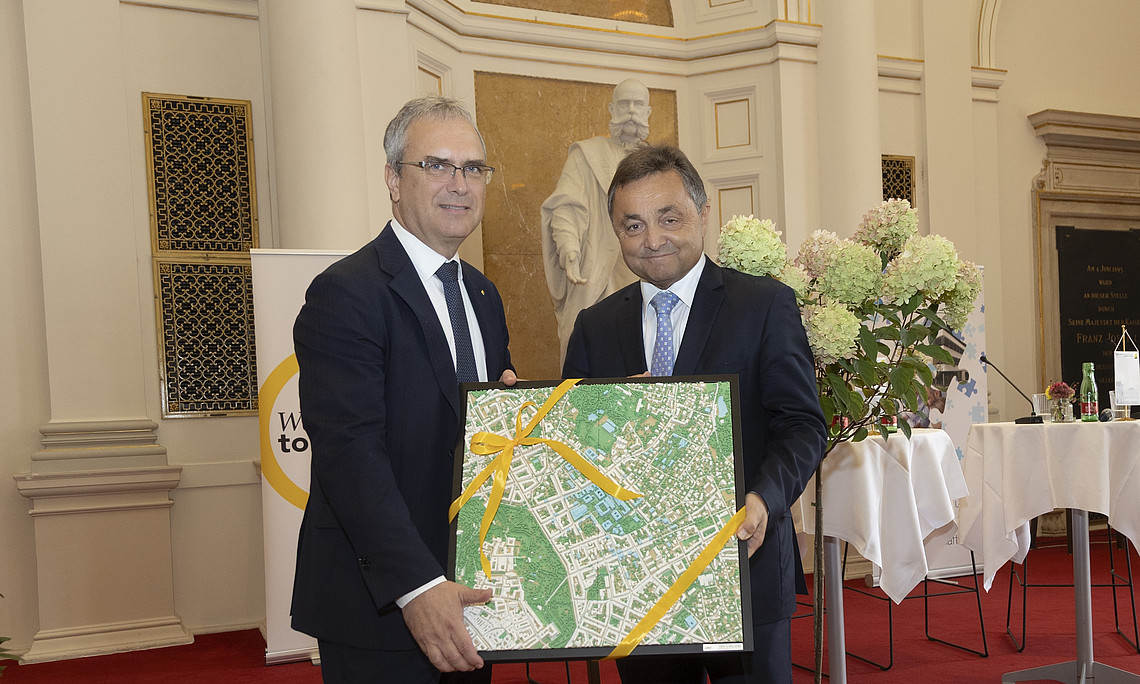
created by Gudrun Pichler

Related news

Jurassic Sounds: Biologist reconstructs insect songs from 165 million years ago

It was apparently not just the roars of the dinosaurs that made up the soundscape of the animal world during the Jurassic period. Crickets and grasshoppers communicated through a variety of songs and high-pitched sounds, as Thorin Jonsson from the Institute of Biology at the University of Graz discovered together with colleagues from the universities of Lincoln, Bristol (UK), Beijing (China) and Tempe (USA). The findings on what are so far the oldest traces of sound on Earth have just been published in the journal PNAS.

EU funding boosts international exchange between universities

The University of Graz is further expanding its international study opportunities through the European university alliance Arqus and is taking the lead in two key projects. In future, students will benefit from even more joint degree programmes and from simplified recognition of academic achievements through the Joint European Degree Label.

Rescue and risks: Researchers have surveyed public perceptions of AI

The use of artificial intelligence has had to be made transparent since 2 August 2026. The EU’s AI Act, which has been in force since then, also sets out how risky an application is and which security measures apply as a result. However, the assessment of risks by the legislation differs in some cases significantly from the perceptions of the Austrian public. This is the finding of a representative study carried out by data scientist Stefan Thalmann from the University of Graz and his team.

The Healing Sea: Researchers discover new approaches to treating chronic inflammation in sponges

Chronic inflammation plays a key role in many diseases, ranging from metabolic disorders and cardiovascular diseases to tissue damage following injuries or infections. “Normally, the body is able to resolve inflammation on its own. If this process becomes unbalanced, immune cells remain permanently active and continue to drive negative changes in the tissue,” explains Andreas Koeberle, a pharmacist at the University of Graz.

Begin of page section:
Additional information:

University of Graz
Universitaetsplatz 3
8010 Graz
Austria
  • Contact
  • Web Editors
  • Moodle
  • UNIGRAZonline
  • Imprint
  • Data Protection Declaration
  • Accessibility Declaration
Weatherstation
Uni Graz

End of this page section. Go to overview of page sections

End of this page section. Go to overview of page sections

Begin of page section:

End of this page section. Go to overview of page sections