Begin of page section:
Page sections:

  • Go to contents (Accesskey 1)
  • Go to position marker (Accesskey 2)
  • Go to main navigation (Accesskey 3)
  • Go to sub navigation (Accesskey 4)
  • Go to additional information (Accesskey 5)
  • Go to page settings (user/language) (Accesskey 8)
  • Go to search (Accesskey 9)

End of this page section. Go to overview of page sections

Begin of page section:
Page settings:

English en
Deutsch de
Search
Login

End of this page section. Go to overview of page sections

Begin of page section:
Search:

Search for details about Uni Graz
Close

End of this page section. Go to overview of page sections


Search

Begin of page section:
Main navigation:

Page navigation:

  • University

    University
    • About the University
    • Organisation
    • Faculties
    • Library
    • Working at University of Graz
    • Campus
    Developing solutions for the world of tomorrow - that is our mission. Our students and our researchers take on the great challenges of society and carry the knowledge out.
  • Research Profile

    Research Profile
    • Our Expertise
    • Research Questions
    • Research Portal
    • Promoting Research
    • Research Transfer
    • Ethics in Research
    Scientific excellence and the courage to break new ground. Research at the University of Graz creates the foundations for making the future worth living.
  • Studies

    Studies
    • Prospective Students
    • Students
  • Community

    Community
    • International
    • Location
    • Research and Business
    • Alumni
    The University of Graz is a hub for international research and brings together scientists and business experts. Moreover, it fosters the exchange and cooperation in study and teaching.
  • Spotlight
Topics
  • Sustainable University
  • Researchers answer
  • Work for us
Close menu

End of this page section. Go to overview of page sections

Begin of page section:
You are here:

University of Graz News Natur verstehen

End of this page section. Go to overview of page sections

Tuesday, 08 March 2022

Natur verstehen

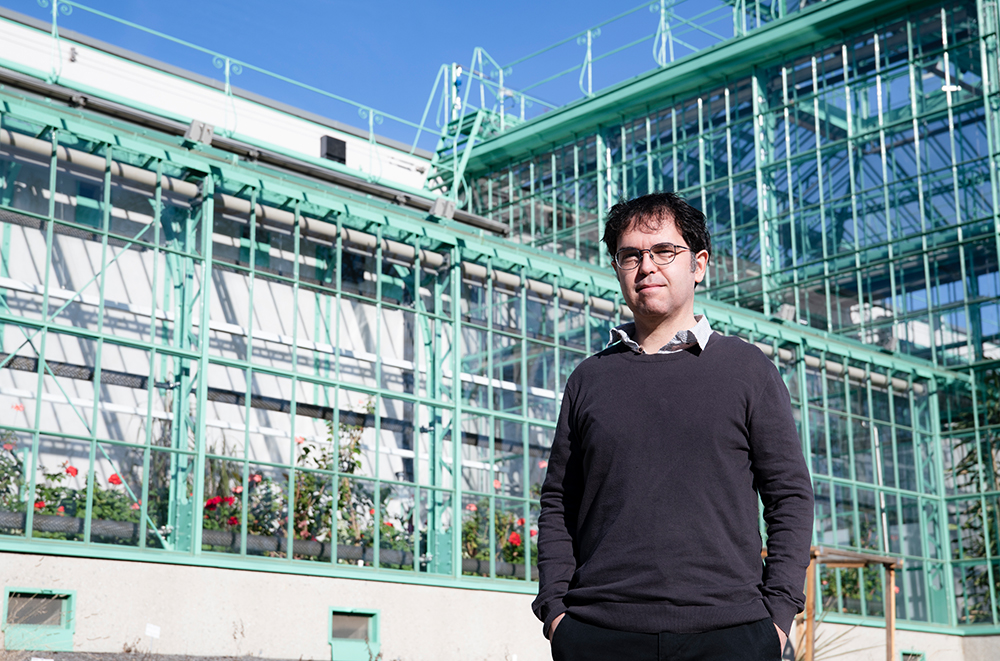
Komplexitätsforscher Bernat Corominas-Murtra ist neuer Assistenz-Professor am Institut für Biologie. Foto: Uni Graz/Tzivanopoulos ©Uni Graz/Tzivanopoulos

Komplexitätsforscher Bernat Corominas-Murtra ist neuer Assistenz-Professor am Institut für Biologie. Foto: Uni Graz/Tzivanopoulos

Gibt es einen großen Plan des Lebens? Komplexitätsforscher Bernat Corominas-Murtra ist neuer Assistenz-Professor am Institut für Biologie

Komplex scheint sein wissenschaftlicher Weg. Vielseitig interessiert ist er jedenfalls. „Ich bin beinahe schon krankhaft neugierig“, schmunzelt Bernat Corominas-Murtra. Er hat Physik studiert, Mathematik und außerdem noch Sprachwissenschaft. Seit kurzem ist er Assistenz-Professor am Institut für Biologie. Biologie? Denn er beschäftigt sich mit dem großen Plan von Leben. Schon vom Ursprung weg. „Wie kann aus einer Zelle ein gesamter Organismus entstehen. Das ist erstaunlich“, schildert Corominas-Murtra fasziniert. Damit aber nicht genug.

„Denn wenn das komplexe System gebildet ist, überlebt es noch jahrelang.“ Wie und warum die Natur so arbeitet, sind zentrale Fragen, denen sich der Komplexitätsforscher seit dem Vorjahr an der Universität Graz widmet. Und warum gerade hier? Die stark interdisziplinäre Ausrichtung einer Allgemein-Universität hat den gebürtigen Katalanen vom renommierten Forschungsinstitut IST Austria in Klosterneuburg in den Süden Österreichs geführt: „Der Profilbildende Bereich COLIBRI bildete für mich eine interessante Option, die mir zugleich für meine Arbeit individuellen Spielraum offenlässt.“ Diesen will er mit seiner Forschungsgruppe nutzen, um zu klären, welche Prinzipien biologische Komplexität überhaupt möglich machen. „Denn wenn sich aus einer einzelnen Zelle ein Embryo entwickelt, scheint das gegen jede physikalische Regel zu verstoßen“, so der Forscher. Er ist überzeugt: „Es muss irgendwo eine Art mathematischer Pfad verankert sein.“

Corominas-Murtra arbeitet hauptsächlich mathematisch auf Basis der Computermodellierung. Gar nicht theoretisch ist das weiterführende Ziel seiner Forschung: „Wenn wir die dynamischen Mechanismen im Gewebe besser verstehen, haben wir mehr Möglichkeiten, Krankheiten wie Krebs zu bekämpfen.“


created by Andreas Schweiger

Related news

Cosmetics in the environment: University of Graz proves danger to ants

Titanium dioxide, which is found in cosmetics, for example, is increasingly entering the environment in the form of nanoparticles. This could also put insects at risk. If ants ingest the substance in combination with the pesticide glyphosate, it disturbs the development of their offspring. Scientists at the University of Graz are drawing attention to the negative consequences of this toxic cocktail.

How are tech companies changing democracy? Uni Graz designs exhibition for schools

Filtered information, conspiracy theories, fake news – certain groups and corporations are using social media and algorithms to try to influence public opinion in their favour. Their goal: to weaken fundamental rights and diversity of opinion and seize power. In a new exhibition, researchers at the University of Graz are working with pupils to explore the impact of social media and AI on democracy. In accompanying workshops, the scientists want to encourage young people to develop their own ideas for a socially and ecologically viable future and to actively help shape it. The exhibition, designed as a travelling exhibition for schools, will open on 9 March 2026 at the Dreihackengasse Gymnasium in Graz.

Step by step: What motivates Mireille van Poppel as a scientist and vice-rector

Improving people's health and eliminating inequalities: Mireille van Poppel pursues these goals both as a public health researcher and as vice-rector for Internationalisation and Equality. In both roles, she pays particular attention to individual needs.

Master's degree in psychotherapy in Graz: registration opens in March

Graz is becoming a hotspot for psychotherapy: from 2026, the University of Graz and the Medical University of Graz will jointly offer the new master's programme. Registration for the admission procedure for the 140 study places will start in March.

Begin of page section:
Additional information:

University of Graz
Universitaetsplatz 3
8010 Graz
Austria
  • Contact
  • Web Editors
  • Moodle
  • UNIGRAZonline
  • Imprint
  • Data Protection Declaration
  • Accessibility Declaration
Weatherstation
Uni Graz

End of this page section. Go to overview of page sections

End of this page section. Go to overview of page sections

Begin of page section:

End of this page section. Go to overview of page sections