



Begin of page section:
Page sections:

  • Go to contents (Accesskey 1)
  • Go to position marker (Accesskey 2)
  • Go to main navigation (Accesskey 3)
  • Go to sub navigation (Accesskey 4)
  • Go to additional information (Accesskey 5)
  • Go to page settings (user/language) (Accesskey 8)
  • Go to search (Accesskey 9)

End of this page section. Go to overview of page sections

Begin of page section:
Page settings:

English en
Deutsch de
Search
Login

End of this page section. Go to overview of page sections

Begin of page section:
Search:

Search for details about Uni Graz
Close

End of this page section. Go to overview of page sections


Search

Begin of page section:
Main navigation:

Page navigation:

  • University

    University
    • About the University
    • Organisation
    • Faculties
    • Library
    • Working at University of Graz
    • Campus
    Developing solutions for the world of tomorrow - that is our mission. Our students and our researchers take on the great challenges of society and carry the knowledge out.
  • Research Profile

    Research Profile
    • Our Expertise
    • Research Questions
    • Research Portal
    • Promoting Research
    • Research Transfer
    • Ethics in Research
    • Commission for Scientific Integrity
    Scientific excellence and the courage to break new ground. Research at the University of Graz creates the foundations for making the future worth living.
  • Studies

    Studies
    • Prospective Students
    • Students
    • Welcome Weeks for First Year Students
  • Community

    Community
    • International
    • Location
    • Research and Business
    • Alumni
    The University of Graz is a hub for international research and brings together scientists and business experts. Moreover, it fosters the exchange and cooperation in study and teaching.
Topics
  • Sustainable University
  • Researchers answer
  • Work for us
Close menu

End of this page section. Go to overview of page sections

Begin of page section:
You are here:

University of Graz News Nachwuchs in der Naturwissenschaft

End of this page section. Go to overview of page sections

Thursday, 07 July 2016

Nachwuchs in der Naturwissenschaft

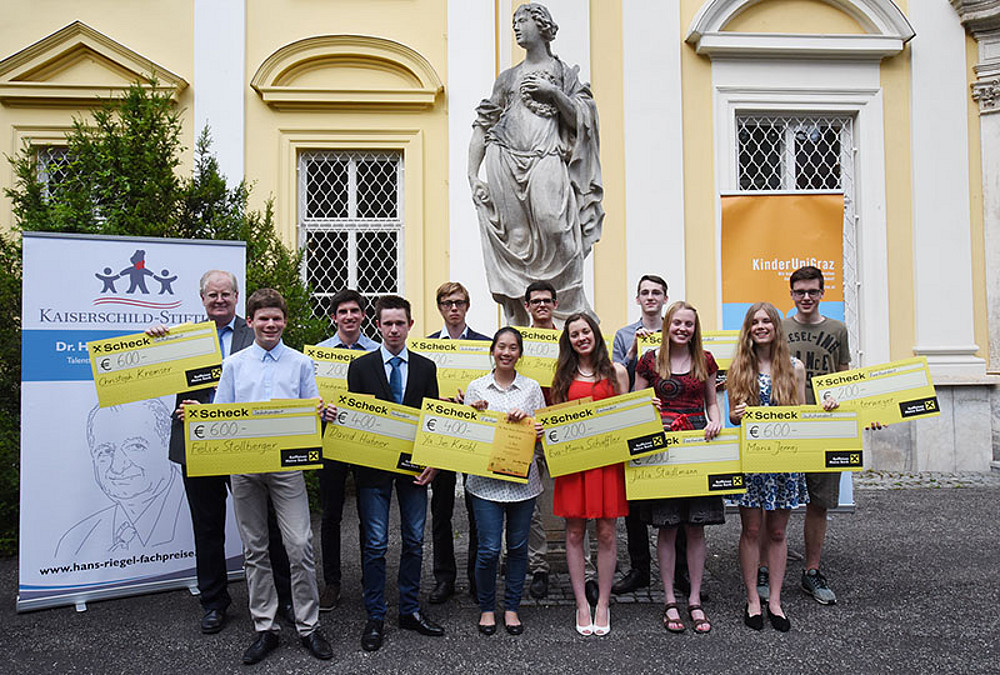
Ausgezeichnte Nachwuchs-NaturwissenschafterInnen: Die GewinnerInnen der Dr. Hans Riegel-Fachpreise für herausragende vorwissenschaftliche Arbeiten. Foto: Uni Graz/Kastrun.

Ausgezeichnte Nachwuchs-NaturwissenschafterInnen: Die GewinnerInnen der Dr. Hans Riegel-Fachpreise für herausragende vorwissenschaftliche Arbeiten. Foto: Uni Graz/Kastrun.

Dr. Hans Riegel Fachpreise für herausragende vorwissenschaftliche Arbeiten vergeben

Wer wissen will, wie man Pfeilgiftfrösche im Terrarium artgerecht hält; wer die Wahrheit über Luminol, einer Substanz, die in der Kriminalistik zur Spurensuche verwendet wird, erfahren möchte; wer zudem herausfinden will, wie man Objekte mit einer 3D-Kamera lokalisiert und sich auch dafür interessiert, was hinter der LED-Technologie steckt, sollte sich die vorwissenschaftlichen Arbeiten, die mit den diesjährigen Dr. Hans-Riegel-Fachpreisen ausgezeichnet wurden, zu Gemüte führen.

Zwölf steirische MaturantInnen sind in ihren vorwissenschaftlichen Arbeiten in den Fächern Biologie, Chemie, Mathematik und Physik diesen Themen auf den Grund gegangen. Für ihre kritische Auseinandersetzung sowie eigenständigen Recherchen und Analysen erhielten die SchülerInnen am Mittwoch, 6. Juli 2016, an der Karl-Franzens-Universität Graz die Dr. Hans Riegel-Fachpreise. Verliehen wird die Auszeichnung, die mit heuer einem Gesamtwert von 5.800 Euro dotiert ist, von der Gemeinnützigen Privatstiftung Kaiserschild, gegründet von Dr. Hans Riegel, dem Erben des Haribo-Süßwarenkonzerns. In der Steiermark organisiert den Wettbewerb die KinderUniGraz.

Die ersten Plätze sind mit jeweils 600 Euro dotiert, die zweiten mit 400 Euro und die dritten mit 300 Euro. Die Schulen der erstplatzierten SchülerInnen erhalten zudem einen Gutschein im Wert von 250 Euro zur Förderung des naturwissenschaftlichen Unterrichts.


Die PreisträgerInnen 2016 sind:

Biologie:

  • Felix Stollberger (BG/BRG Seebacher): „Künstliche Beleuchtung von Pflanzen – Biologische Grundlagen, Auswirkung und Umsetzung“
  • David Hubner (BORG Eisenerz): „Die Haltung und Aufzucht von Pfeilgiftfröschen im Terrarium“
  • Eva-Maria Schaffler (BG Rein): „Gegenüberstellung verschiedener Ernährungsweisen: Auswirkungen einer Umstellung der Ernährung auf den menschlichen Körper und Geist“


Chemie:

  • Christoph Kremser (BG/BRG/BORG Köflach): „Herstellung und Eigenschaften der Aminosäure Glycin
  • Ya Jie Knöbl (BRG Petersgasse): Wahrheiten und Mythen über Luminol in der Spurenuntersuchung
  • Elias Hashemian Nik (BG/BRG Seebacher): „Chromatographische Untersuchung zur qualitativen Bestimmung der Zucker in Geränken“


Mathematik:

  • Johannes Carl Droschl (BG Leibnitz): „Die Gödelschen Unvollständigkeitssätze“
  • Felix Breuß (BRG Kepler): „Lokalisierung von Objekten mit einer 3D-Kamera“
  •  Julia Stadlmann (BG/BRG Judenburg): „Elementare Lösungsmethoden für Diophantische Gleichungen“


Physik:

  • Maria Jernej (Akademisches Gymnasium Graz): „Ein Komet unter dem Mikroskop MIDAS“
  • Elias Krois (BORG Deutschlandsberg): „Radioaktive Kontamination der Koralpe im Bezirk Deutschlandsberg am Beispiel von Pilzen
  • Stefan Unterweger (Bischöfliches Gymnasium Graz): „LED – Innovation in Elektronik und Beleuchtungstechnik“
created by Gerhild Kastrun

Related news

Jurassic Sounds: Biologist reconstructs insect songs from 165 million years ago

It was apparently not just the roars of the dinosaurs that made up the soundscape of the animal world during the Jurassic period. Crickets and grasshoppers communicated through a variety of songs and high-pitched sounds, as Thorin Jonsson from the Institute of Biology at the University of Graz discovered together with colleagues from the universities of Lincoln, Bristol (UK), Beijing (China) and Tempe (USA). The findings on what are so far the oldest traces of sound on Earth have just been published in the journal PNAS.

EU funding boosts international exchange between universities

The University of Graz is further expanding its international study opportunities through the European university alliance Arqus and is taking the lead in two key projects. In future, students will benefit from even more joint degree programmes and from simplified recognition of academic achievements through the Joint European Degree Label.

Rescue and risks: Researchers have surveyed public perceptions of AI

The use of artificial intelligence has had to be made transparent since 2 August 2026. The EU’s AI Act, which has been in force since then, also sets out how risky an application is and which security measures apply as a result. However, the assessment of risks by the legislation differs in some cases significantly from the perceptions of the Austrian public. This is the finding of a representative study carried out by data scientist Stefan Thalmann from the University of Graz and his team.

The Healing Sea: Researchers discover new approaches to treating chronic inflammation in sponges

Chronic inflammation plays a key role in many diseases, ranging from metabolic disorders and cardiovascular diseases to tissue damage following injuries or infections. “Normally, the body is able to resolve inflammation on its own. If this process becomes unbalanced, immune cells remain permanently active and continue to drive negative changes in the tissue,” explains Andreas Koeberle, a pharmacist at the University of Graz.

Begin of page section:
Additional information:

University of Graz
Universitaetsplatz 3
8010 Graz
Austria
  • Contact
  • Web Editors
  • Moodle
  • UNIGRAZonline
  • Imprint
  • Data Protection Declaration
  • Accessibility Declaration
Weatherstation
Uni Graz

End of this page section. Go to overview of page sections

End of this page section. Go to overview of page sections

Begin of page section:

End of this page section. Go to overview of page sections