



Begin of page section:
Page sections:

  • Go to contents (Accesskey 1)
  • Go to position marker (Accesskey 2)
  • Go to main navigation (Accesskey 3)
  • Go to sub navigation (Accesskey 4)
  • Go to additional information (Accesskey 5)
  • Go to page settings (user/language) (Accesskey 8)
  • Go to search (Accesskey 9)

End of this page section. Go to overview of page sections

Begin of page section:
Page settings:

English en
Deutsch de
Search
Login

End of this page section. Go to overview of page sections

Begin of page section:
Search:

Search for details about Uni Graz
Close

End of this page section. Go to overview of page sections


Search

Begin of page section:
Main navigation:

Page navigation:

  • University

    University
    • About the University
    • Organisation
    • Faculties
    • Library
    • Working at University of Graz
    • Campus
    Developing solutions for the world of tomorrow - that is our mission. Our students and our researchers take on the great challenges of society and carry the knowledge out.
  • Research Profile

    Research Profile
    • Our Expertise
    • Research Questions
    • Research Portal
    • Promoting Research
    • Research Transfer
    • Ethics in Research
    • Commission for Scientific Integrity
    Scientific excellence and the courage to break new ground. Research at the University of Graz creates the foundations for making the future worth living.
  • Studies

    Studies
    • Prospective Students
    • Students
    • Registration for Study Programme (Winter semester 2026/27)
    • Study Days 22-26 June 2026
  • Community

    Community
    • International
    • Location
    • Research and Business
    • Alumni
    The University of Graz is a hub for international research and brings together scientists and business experts. Moreover, it fosters the exchange and cooperation in study and teaching.
Topics
  • Sustainable University
  • Researchers answer
  • Work for us
Close menu

End of this page section. Go to overview of page sections

Begin of page section:
You are here:

University of Graz News Musik, Migration und Macht

End of this page section. Go to overview of page sections

Wednesday, 31 January 2018

Musik, Migration und Macht

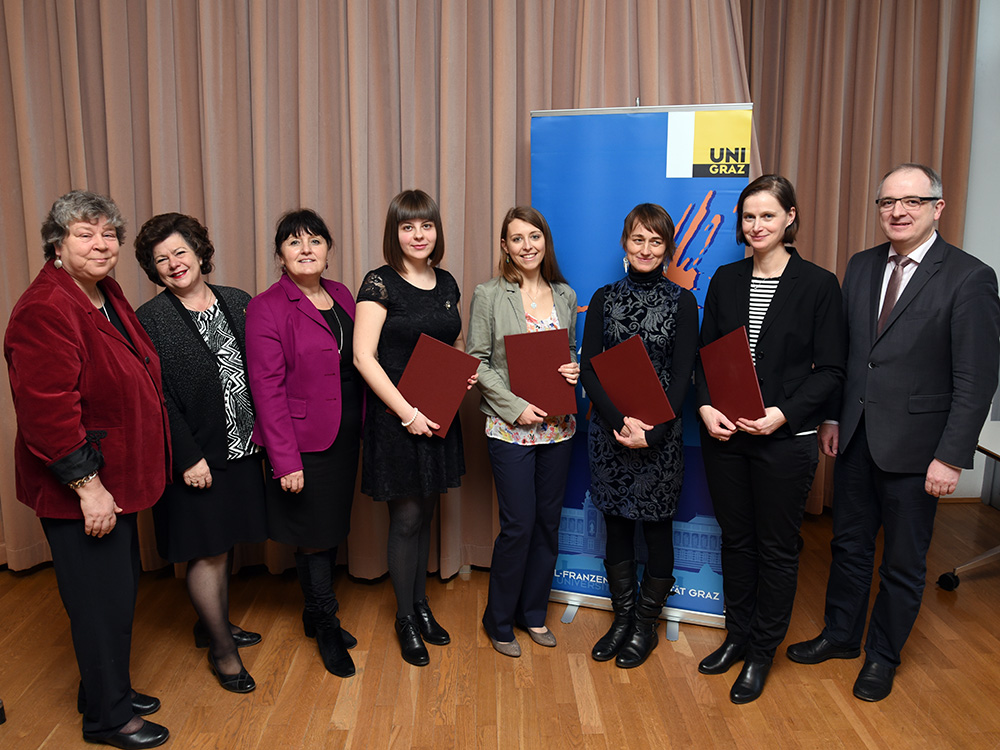
Verleihung der Elisabeth-Gössmann-Preise: Ulrike Bechmann, Elisabeth Potzinger, Manuela Khom, Valeryia Saulevich, Dagmar Giglleitner, Barbara Velik-Frank, Andrea Qualbrink, Christoph Heil (v. l.) Foto: Uni Graz/Tzivanopoulos

Verleihung der Elisabeth-Gössmann-Preise: Ulrike Bechmann, Elisabeth Potzinger, Manuela Khom, Valeryia Saulevich, Dagmar Giglleitner, Barbara Velik-Frank, Andrea Qualbrink, Christoph Heil (v. l.) Foto: Uni Graz/Tzivanopoulos

Die Katholisch-Theologische Fakultät verlieh die Elisabeth-Gössmann-Preise für Arbeiten zur Frauen- und Geschlechterforschung

Dagmar Giglleitner, Andrea Qualbrink, Valeryia Saulevich und Barbara Velik-Frank sind die Trägerinnen der heurigen Elisabeth-Gössmann-Preise. Sie wurden am 30. Jänner 2018 im Rahmen eines Festaktes am Universitätszentrum Theolgie von Dekan Christoph Heil und der Juryvorsitzenden Ulrike Bechmann überreicht. Heil strich hervor, dass die Fakultät eine offene, gegenwartsorientierte und kritische Theologie betreibt, was sich auch in den Arbeiten der Preisträgerinnen widerspiegelt. Manuela Khom, die als Vertreterin des Landtags an der Feier teilnahm, dankte der Uni Graz für den Preis und lobte die kreativen Neuentwürfe zur Problemlösung, die in den Ausschreibungsbedingungen festgehalten sind. Gemeinderätin Sissy Potzinger verwies in ihrem Grußwort auf die Tradition der Frauenforschung und ihre Pionierin Irmtraud Fischer.

Die Ausgezeichneten
Giglleitner befasst sich in ihrer Masterarbeit mit der biblischen Erzählung über den Regenten Jiftach, dessen Opferung der eigenen Tochter über Jahrhuderte Anlass für eine vielfältige Auseinandersetzung war, und ihre musikalische Rezeption in Georg Friedrich Händels Oratorium Jephtha.

Saulevich untersucht in ihrer Masterarbeit die Körperwahrnehmungen russisch-orthodoxer Migrantinnen im kirchlichen Kontext vor und nach der Einwanderung in Österreich.

Andrea Qualbrink thematisiert in ihrer Dissertation Aufstiegs- und Führungserfahrungen von Frauen in hohen Leitungspositionen in Ordinariaten deutscher Bistümer.

Barbara Velik-Frank beschäftigt sich in ihrer Dissertation mit dem Phänomen der sieben katholisch sozialisierten "Donaufrauen", die sich 2002 gegen das bestehende kirchliche Gesetz zu katholischen Priesterinnen weihen ließen.

Die Preise
Die Elisabeth-Gössmann-Preise werden für hervorragende Arbeiten auf dem Gebiet der Frauen- und Geschlechterforschung seit 2001 regelmäßig vergeben und dienen der Nachwuchsförderung.
Die Arbeiten müssen an einer der theologischen Fakultäten oder -Hochschulen in Österreich angenommen worden sein und ein theologisches oder religionswissenschaftliches Thema behandeln und sich kritisch mit frauen- und geschlechterspezifischen Fragen in den christlichen oder anderen religiösen beziehungsweise weltanschaulichen Traditionen auseinandersetzen. 
created by Dagmar Eklaude

Related news

Full effort in the heat: the Sports Centre was in full swing at the Kleeblattlauf

On 19 June 2026, 2,000 runners and hundreds of supporters made their way to the Rosenhain for a sporting end-of-term event.

Save, invest or guarantee: What Austrians expect from the state

Austria needs to make savings. But where? And what should the Republic actually be spending its money on? The answers are provided by the initial findings of a major study involving the University of Graz. 99 per cent of those surveyed are in favour of the state ensuring healthcare provision. Almost three-quarters would like to see more public funding for education, whilst only around three per cent are in favour of cuts in this sector.

Complying with the norm: Why Do Standards Shape Our Lives, Elisabeth Staudegger?

Standards determine whether a sheet of paper fits in a printer or whether a charging plug can power multiple devices. These standards shape our everyday lives. But who actually sets these standards? Where are the weaknesses, and how could science help to improve them? Elisabeth Staudegger, Head of the ‘Law and IT’ Department at the Institute for Legal Foundations at the University of Graz, host the Academic Standards Day on 16 June. Here she relays how sciences can contribute to the topic of standardisation and reveals her personal favourite standard.

More body awareness than a culture war

In Italy, sex education lessons will in future only be permitted with parental consent, and will be banned entirely in nurseries and primary schools. At the same time, Pride Month highlights why knowledge about the body, relationships, boundaries and diversity is important for young people. A study by the University of Graz shows how important knowledge about the body, contraception, relationship skills and protection against violence is

Begin of page section:
Additional information:

University of Graz
Universitaetsplatz 3
8010 Graz
Austria
  • Contact
  • Web Editors
  • Moodle
  • UNIGRAZonline
  • Imprint
  • Data Protection Declaration
  • Accessibility Declaration
Weatherstation
Uni Graz

End of this page section. Go to overview of page sections

End of this page section. Go to overview of page sections

Begin of page section:

End of this page section. Go to overview of page sections


