



Begin of page section:
Page sections:

  • Go to contents (Accesskey 1)
  • Go to position marker (Accesskey 2)
  • Go to main navigation (Accesskey 3)
  • Go to sub navigation (Accesskey 4)
  • Go to additional information (Accesskey 5)
  • Go to page settings (user/language) (Accesskey 8)
  • Go to search (Accesskey 9)

End of this page section. Go to overview of page sections

Begin of page section:
Page settings:

English en
Deutsch de
Search
Login

End of this page section. Go to overview of page sections

Begin of page section:
Search:

Search for details about Uni Graz
Close

End of this page section. Go to overview of page sections


Search

Begin of page section:
Main navigation:

Page navigation:

  • University

    University
    • About the University
    • Organisation
    • Faculties
    • Library
    • Working at University of Graz
    • Campus
    Developing solutions for the world of tomorrow - that is our mission. Our students and our researchers take on the great challenges of society and carry the knowledge out.
  • Research Profile

    Research Profile
    • Our Expertise
    • Research Questions
    • Research Portal
    • Promoting Research
    • Research Transfer
    • Ethics in Research
    • Commission for Scientific Integrity
    Scientific excellence and the courage to break new ground. Research at the University of Graz creates the foundations for making the future worth living.
  • Studies

    Studies
    • Prospective Students
    • Students
  • Community

    Community
    • International
    • Location
    • Research and Business
    • Alumni
    The University of Graz is a hub for international research and brings together scientists and business experts. Moreover, it fosters the exchange and cooperation in study and teaching.
  • Spotlight
Topics
  • Sustainable University
  • Researchers answer
  • Work for us
Close menu

End of this page section. Go to overview of page sections

Begin of page section:
You are here:

University of Graz News Molekulare Alleskönner

End of this page section. Go to overview of page sections

Friday, 25 August 2017

Molekulare Alleskönner
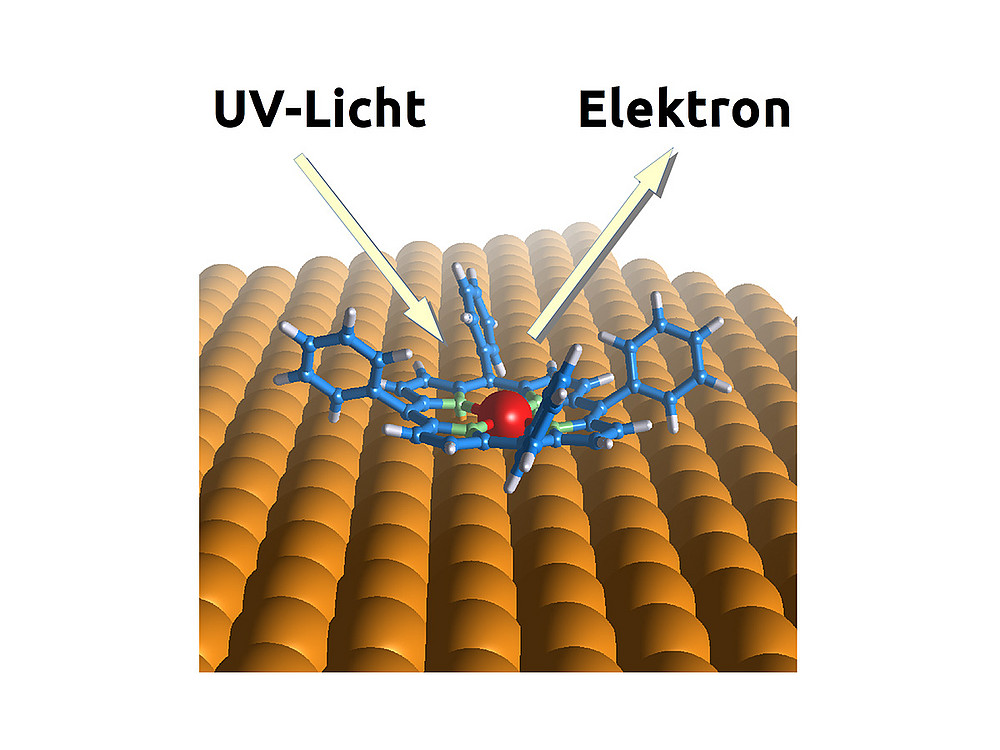
Ein Nickel-Porphyrin-Molekül auf einer Kupferoberfläche: Die Pfeile sympolisieren das Experiment von Peter Puschnig und Daniel Lüftner. Grafik: Puschnig, Lüftner
Ein Nickel-Porphyrin-Molekül auf einer Kupferoberfläche: Die Pfeile sympolisieren das Experiment von Peter Puschnig und Daniel Lüftner. Grafik: Puschnig, Lüftner

Porphyrine als optimale organische Halbleiter

Am Institut für Physik der Karl-Franzens-Universität Graz forschen Dr. Daniel Lüftner und Assoz.-Prof. Dr. Peter Puschnig seit Jahren an den Grundlagen für neue Halbleitertechnologien. Die Grazer Wissenschafter testen dabei gemeinsam mit KollegInnen des deutschen Forschungszentrums Jülich sowie der Universität Triest organische Moleküle auf deren elektronische Eigenschaften. In den Modellberechnungen und in Experimenten hat sich nun gezeigt, dass die organischen Moleküle „Porphyrine“ – bekannt als Farbstoff in biologischen Systemen – in der Verbindung mit Nickel, einem sogenannten Nickel-Porphyrin–Komplex, besondere elektronische Eigenschaften aufweisen.
Die WissenschafterInnen konnten zeigen, wie sich die atomare Struktur des Moleküls durch die Anlagerung auf dem Kupfersubstrat ändert und sie beobachteten einen unerwartet großen Ladungstransfer von dem metallischen Substrat zum Porphyrin-Molekül. Diese Eigenschaften tragen Wesentliches zum Design künftiger Solarzellen bei. Die Ergebnisse wurden nun in der renommierten Fachzeitschrift Nature Communications publiziert.
Porphyrine spielen in biologischen Systemen eine wichtige Rolle. So sind Eisen-Porphyrine ein wesentlicher Bestandteil des Hämoglobins und damit verantwortlich für den Sauerstofftransport im menschlichen Körper. „Inspiriert durch diese biologische Funktion werden Porphyrinen aber auch vielfältige technologische Anwendungsmöglichkeiten zugesprochen. Diese reichen von organischen Solarzellen über Gassensoren und Einzelmolekül-Schaltern bis hin zu Spin-Filtern“, erzählt Dr. Peter Puschnig. Insbesondere beeinflusst die atomare Struktur der Grenzschicht sowie die Wechselwirkung zwischen Molekül und Metall letztendlich die erwünschte Funktionalität. Das Verhalten der Elektronen in Grenzschichten und der Ladungstransfer zwischen den beiden Teilsystemen ist noch nicht eindeutig geklärt. In einem Experiment haben die WissenschafterInnen nun eine ultradünne Schicht (kleiner als ein Nanometer) von Nickel-Tetraphenyl-Porphyrin auf ein Kupfersubstrat aufgedampft. Die atomare Struktur wurde mithilfe eines Rastertunnelmikroskops untersucht. Die nicht erreichbaren Bereiche des Moleküls wurden mithilfe der Photoemissions-Tomografie betrachtet. Diese Technik, die in den vergangenen Jahren in Graz und Jülich entwickelt worden ist, ermöglicht die detaillierte Bestimmung der energetischen Lage sowie der räumlichen Struktur einzelner Molekülorbitale „Die Analyse unserer quantenmechanischen Berechnungen ergab einen unerwartet großen Elektronenübertrag vom Metall auf das Molekül“, erklärt dazu der Grazer Physiker Daniel Lüftner und führt aus: „Die Resultate belegen, dass Porphyrine – trotz der jahrelangen wissenschaftlichen Auseinandersetzung mit diesem Molekül – noch immer neue Fragen aufwerfen und zu neuen Erkenntnissen führen.“ Inwiefern diese Grundlagenforschung in technologische Anwendungen, wie etwa im Bau von Solarzellen, münden kann, sollen aufbauende Untersuchungen zeigen. Unterstützt wird das Projekt vom FWF.

Publikation:
G. Zamborlini, D. Lüftner, Zh. Feng, B. Kollmann, P. Puschnig, C. Dri, M. Panighel G. Di Santo, A. Goldoni, G. Comelli, M. Jugovac, V. Feyer, and C. M. Schneider, Multi-orbital charge transfer at highly oriented organic/metal interfaces, Nature Communications (2017)

created by Konstantin Tzivanopoulos

Related news

Higher Education Strategy 2040: Austria’s universities on course for the future

Austria has 77 higher education institutions, which is above the EU average – but does this really make sense? The new Higher Education Strategy 2040 focuses on cooperation rather than mergers. As one of the six largest universities in Austria, the University of Graz plays a central role in this.

Climate research in Greenland: Old data provides new insights

The polar explorer and University of Graz professor Alfred Wegener left behind a unique collection of climate data from Greenland. A research team from the University of Graz is now analysing this 100-year-old treasure trove of data and comparing it with current measurements.

Diversity in nature and science: How we talk about plants and each other

Ginkgo, kiwi, hemp: they exist as male and female plants. Anyone who paid attention in biology class will confirm this. But is this categorisation, established by Carl von Linné almost 300 years ago, still valid today? An interdisciplinary team at the University of Graz is questioning these attributions and using this as a starting point to provide food for thought for gender-sensitive interaction between students, scientific and teaching staff.

Around the world in eight stops: the Long Night of Research at the University of Graz

On 24 April from 5 pm, you can take a short trip around the globe at the University of Graz, discovering pecularities of foreign countries or new local features in the entrance hall of the University Library. The itinerary takes you through introduced animal species, political attitudes and the omnipotence of algorithms. There will also be a programme in the historic reading hall, as well as at the UniGraz@Museum and the University Archive.

Begin of page section:
Additional information:

University of Graz
Universitaetsplatz 3
8010 Graz
Austria
  • Contact
  • Web Editors
  • Moodle
  • UNIGRAZonline
  • Imprint
  • Data Protection Declaration
  • Accessibility Declaration
Weatherstation
Uni Graz

End of this page section. Go to overview of page sections

End of this page section. Go to overview of page sections

Begin of page section:

End of this page section. Go to overview of page sections


