Begin of page section:
Page sections:

  • Go to contents (Accesskey 1)
  • Go to position marker (Accesskey 2)
  • Go to main navigation (Accesskey 3)
  • Go to sub navigation (Accesskey 4)
  • Go to additional information (Accesskey 5)
  • Go to page settings (user/language) (Accesskey 8)
  • Go to search (Accesskey 9)

End of this page section. Go to overview of page sections

Begin of page section:
Page settings:

English en
Deutsch de
Search
Login

End of this page section. Go to overview of page sections

Begin of page section:
Search:

Search for details about Uni Graz
Close

End of this page section. Go to overview of page sections


Search

Begin of page section:
Main navigation:

Page navigation:

  • University

    University
    • About the University
    • Organisation
    • Faculties
    • Library
    • Working at University of Graz
    • Campus
    Developing solutions for the world of tomorrow - that is our mission. Our students and our researchers take on the great challenges of society and carry the knowledge out.
  • Research Profile

    Research Profile
    • Our Expertise
    • Research Questions
    • Research Portal
    • Promoting Research
    • Research Transfer
    • Ethics in Research
    • Commission for Scientific Integrity
    Scientific excellence and the courage to break new ground. Research at the University of Graz creates the foundations for making the future worth living.
  • Studies

    Studies
    • Prospective Students
    • Students
  • Community

    Community
    • International
    • Location
    • Research and Business
    • Alumni
    The University of Graz is a hub for international research and brings together scientists and business experts. Moreover, it fosters the exchange and cooperation in study and teaching.
  • Spotlight
Topics
  • Sustainable University
  • Researchers answer
  • Work for us
Close menu

End of this page section. Go to overview of page sections

Begin of page section:
You are here:

University of Graz News Molekül-Motoren mit Licht-Antrieb

End of this page section. Go to overview of page sections

Monday, 07 November 2016

Molekül-Motoren mit Licht-Antrieb
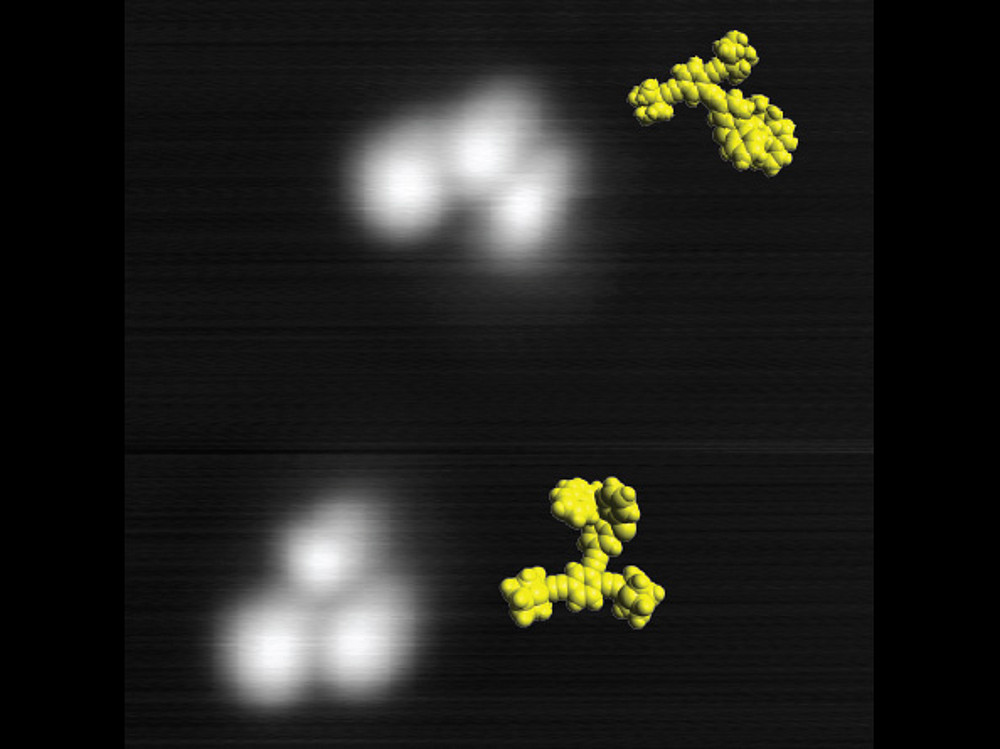
Bahnbrechende Entwicklung: Zwei Nano-Maschinen (weiß) auf einer 8x8 Nanometer großen Kupferoberfläche (grau), aufgenommen bei -267° mit einem Rastertunnelmikroskop. In Gelb die Molekül-Modelle der Maschinen. Foto: Uni Graz/Grill

Bahnbrechende Entwicklung: Zwei Nano-Maschinen (weiß) auf einer 8x8 Nanometer großen Kupferoberfläche (grau), aufgenommen bei -267° mit einem Rastertunnelmikroskop. In Gelb die Molekül-Modelle der Maschinen. Foto: Uni Graz/Grill

ForscherInnen der Uni Graz steuern Nano-Maschinen auf Oberflächen

Ferngesteuerte Nano-Maschinen, angetrieben von einem Lichtstrahl, reinigen Oberflächen, bringen spezielle Pharmazeutika im Körper an ihren Zielort oder bauen elektronische Strukturen aus einzelnen Atomen. Dieser Zukunftsvision ist die Arbeitsgruppe von Univ.-Prof. Dr. Leonhard Grill vom Institut für Chemie der Karl-Franzens-Universität Graz einen großen Schritt nähergekommen: Dem Team ist es gelungen, einzelne molekulare Maschinen durch Laserlicht gezielt auf einer Oberfläche zu bewegen und währenddessen zu beobachten. Die Ergebnisse der Studie werden in der nächsten Ausgabe des Magazins „ACS  Nano“ publiziert und sind online bereits veröffentlicht.

Eine nur zwei Millionstel Millimeter große Maschine mit eingebautem Molekül-Motor hat Leonhard Grill, Leiter der Arbeitsgruppe „Single-Molecule Chemistry“ in Zusammenarbeit mit Prof. James Tour von der Rice University in Houston, USA, entwickelt. „Die große Herausforderung war, die Moleküle anzutreiben und nachzuweisen, dass tatsächlich der interne Motor für die Bewegung verantwortlich ist“, berichtet Grill. Das haben die PhysikerInnen nun erstmals geschafft. Als „Treibstoff“ dient Licht, was gleich mehrere Vorteile bietet: „Damit können wir die Maschinen aus der Ferne aktivieren und außerdem extrem viele Moleküle gleichzeitig bewegen – in Zukunft möglicherweise zum gezielten Transport von Atomen oder Molekülen“, schildert der Wissenschafter. Müsste man die Mini-Motoren für die Energiezufuhr verkabeln, würden sie wesentliche Eigenschaften und ihre Freiheiten verlieren.
 
In den Experimenten untersuchte das Team mit höchster Präzision die Position einzelner Moleküle auf einer Metalloberfläche vor und nach der Bestrahlung mit Laserlicht. Die Mini-Maschinen legten in einer Stunde Distanzen von mehr als 20 Nanometern zurück. Außerdem konnten die Besonderheiten des Motors für eine selektive Steuerung genutzt werden. „Je nachdem, welche Farbe – also welche Wellenlänge – des Lichts wir einsetzten, konnten wir die Bewegung dirigieren“, so Grill. Diese photochemische Empfindlichkeit ist eine wesentliche Grundlage für weitere Entwicklungen: „Man könnte in Zukunft vielleicht verschiedene Motoren in ein und derselben Nano-Maschine gezielt ansteuern und damit vollkommen neue Funktionen erreichen.“ Das wäre für eine Vielzahl an Anwendungen in der Nanotechnologie und Medizin von Interesse. Molekulare Motoren sind ein äußerst zukunftsträchtiges Feld, das heuer auch mit dem Nobelpreis prämiert wurde.

Publikation:
ACS Nano: „Light-Induced Translation of Motorized Molecules on a Surface”,  Alex Saywell, Anne Bakker, Johannes Mielke, Takashi Kumagai, Martin Wolf, Víctor García-López, Pinn-Tsong Chiang, James M. Tour, Leonhard Grill
DOI: 10.1021/acsnano.6b05650
http://pubs.acs.org/doi/abs/10.1021/acsnano.6b05650

created by Dagmar Eklaude

Related news

Studying at the University of Graz: How to enrol

Ready for a new chapter in your life with the start of your studies at the University of Graz in the winter semester 2026/27? Here you will find information on deadlines, admission procedures, registration, and everything else you need to successfully start your studies in the fall.

Interpreting data: Why studies sometimes get it wrong

Hilmar Brohmer and Ziva Korda from the Institute of Psychology, together with 500 international colleagues, have re-evaluated a hundred scientific publications and have often come to different conclusions.

Crystal-clear: AI method revolutionises solar observation

The Sun makes life on Earth possible. However, its magnetic fields can also cause massive disruption. This makes it all the more important to gain a better understanding of the processes taking place on our nearest star. A research team from the University of Graz and the High Altitude Observatory in Boulder (USA) has succeeded in doing just that. The astrophysicists have developed an AI-supported method that makes even the smallest structures on the Sun visible. The scientists are convinced that this will bring about a lasting change in solar observation and that the new method can be used for the planned European Solar Telescope.

Long Night of Research: How many languages are there in the world?

From a linguistic perspective, there are worlds of difference between Bern, Berlin and Vienna. A dialect impersonator will demonstrate live just how varied German can sound. How many languages are there in the world? What are their distinctive features? Which of these are spoken in Austria? These and other questions will be answered during the Long Night of Research at the University of Graz: on Friday, 24 April 2025, from 5 pm to 11 pm, in the University Library. Visitors can immerse themselves in the diversity of languages without travelling far by taking part in a quiz at the station.

Begin of page section:
Additional information:

University of Graz
Universitaetsplatz 3
8010 Graz
Austria
  • Contact
  • Web Editors
  • Moodle
  • UNIGRAZonline
  • Imprint
  • Data Protection Declaration
  • Accessibility Declaration
Weatherstation
Uni Graz

End of this page section. Go to overview of page sections

End of this page section. Go to overview of page sections

Begin of page section:

End of this page section. Go to overview of page sections