



Begin of page section:
Page sections:

  • Go to contents (Accesskey 1)
  • Go to position marker (Accesskey 2)
  • Go to main navigation (Accesskey 3)
  • Go to sub navigation (Accesskey 4)
  • Go to additional information (Accesskey 5)
  • Go to page settings (user/language) (Accesskey 8)
  • Go to search (Accesskey 9)

End of this page section. Go to overview of page sections

Begin of page section:
Page settings:

English en
Deutsch de
Search
Login

End of this page section. Go to overview of page sections

Begin of page section:
Search:

Search for details about Uni Graz
Close

End of this page section. Go to overview of page sections


Search

Begin of page section:
Main navigation:

Page navigation:

  • University

    University
    • About the University
    • Organisation
    • Faculties
    • Library
    • Working at University of Graz
    • Campus
    Developing solutions for the world of tomorrow - that is our mission. Our students and our researchers take on the great challenges of society and carry the knowledge out.
  • Research Profile

    Research Profile
    • Our Expertise
    • Research Questions
    • Research Portal
    • Promoting Research
    • Research Transfer
    • Ethics in Research
    • Commission for Scientific Integrity
    Scientific excellence and the courage to break new ground. Research at the University of Graz creates the foundations for making the future worth living.
  • Studies

    Studies
    • Prospective Students
    • Students
    • Registration for Study Programme (Winter semester 2026/27)
  • Community

    Community
    • International
    • Location
    • Research and Business
    • Alumni
    The University of Graz is a hub for international research and brings together scientists and business experts. Moreover, it fosters the exchange and cooperation in study and teaching.
Topics
  • Sustainable University
  • Researchers answer
  • Work for us
Close menu

End of this page section. Go to overview of page sections

Begin of page section:
You are here:

University of Graz News Möglichkeiten und Grenzen der EU

End of this page section. Go to overview of page sections

Wednesday, 07 December 2016

Möglichkeiten und Grenzen der EU

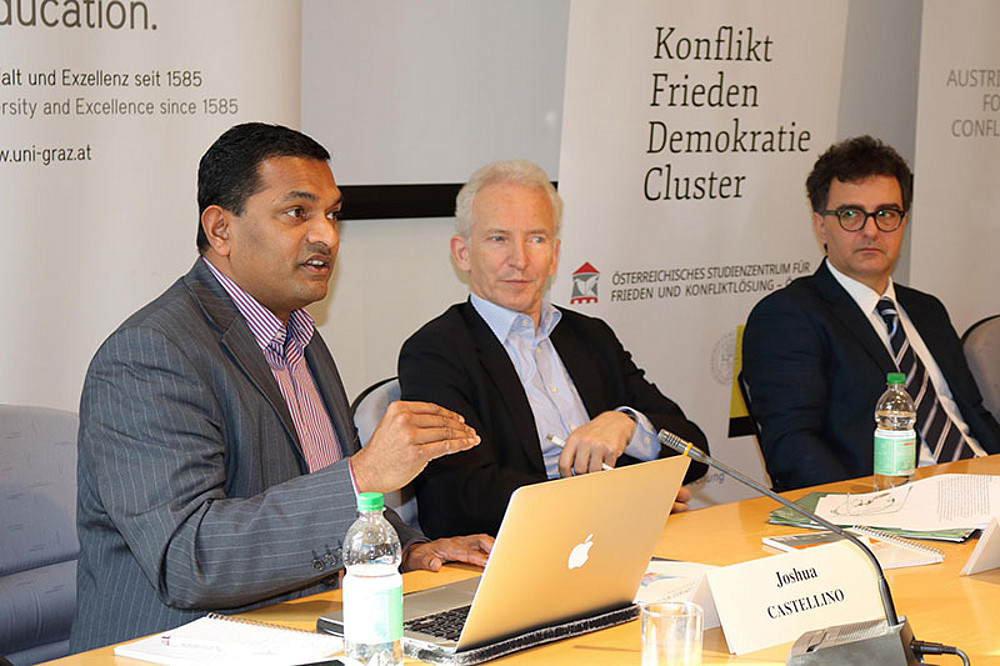
Joshua Castellino, Stefan Lehne und Claudio Corradetti (v.l.)...

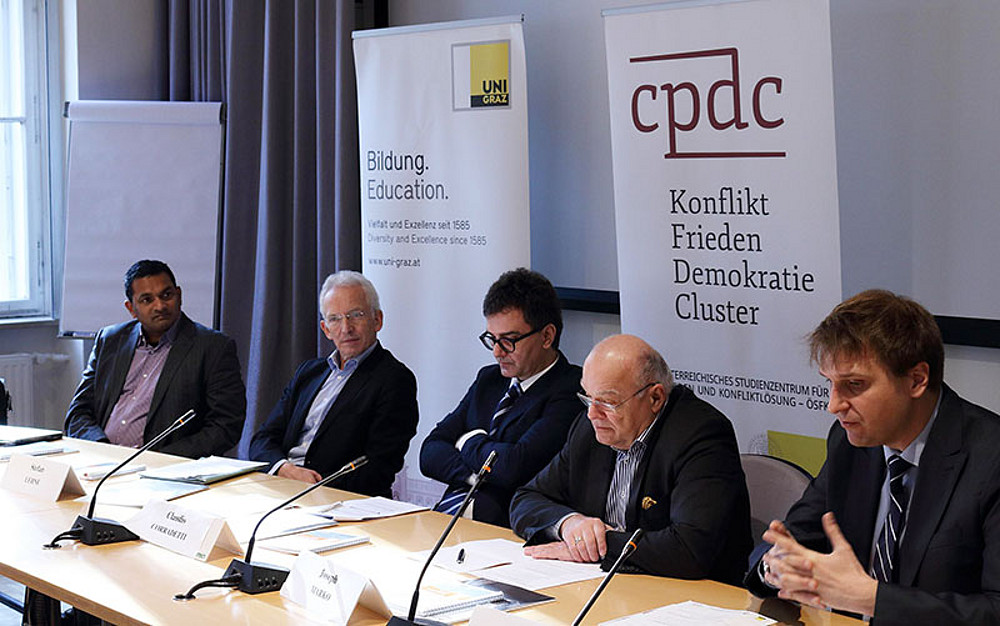
Joshua Castellino, Stefan Lehne und Claudio Corradetti (v.l.)...

... disktuierten mit Joseph Marko und Benedikt Harzl (2. und 1.v.r.). Fotos: ÖSFK.

... disktuierten mit Joseph Marko und Benedikt Harzl (2. und 1.v.r.). Fotos: ÖSFK.

Die State of Peace-Konferenz zu internationalen Konflikten und Lösungsstrategien fand erstmals an der Uni Graz statt

Von 23. bis 25. November 2016 fand an der Universität Graz die State of Peace-Konferenz zum Thema “EU Action and Global Justice” statt. Dabei diskutierten international renommierte Expertinnen und Experten die Möglichkeiten und Grenzen der Europäischen Union, die politischen, wirtschaftlichen und sozialen Entwicklungen ihrer Nachbarschaft zu beeinflussen. Die State of Peace-Konferenz zu Themen rund um internationale Konflikte und Lösungsstrategien wird seit über 30 Jahren vom Österreichischen Studienzentrum für Frieden und Konfliktlösung (ÖSFK) an der Burg Schlaining veranstaltet, fand aber heuer erstmals in Graz – dank der Anbindung des Conflict, Peace and Democracy Clusters an die juristische Fakultät der Karl-Franzens-Universität – statt.


Am ersten Panel zum Thema historische Hintergründe und gegenwärtige Rolle von Normen und Werten in der EU-Innen- und Außenpolitik saßen Stefan Lehne, Carnegie Europe, Claudio Corradetti, Universität Rom, und Joshua Castellino, Middlesex University. Das zweite Panel nahm den thematischen Faden auf und diskutierte die Problematik an regionalen Beispielen: Russland nahm Prof. Mikhail Antonov von der St. Petersburg State University unter die Lupe, die Türkei beleuchtete Univ.-Prof. Dr. Kerem Öktem und den Balkan diskutierte Univ.-Prof. Dr. Florian Bieber, beide Zentrum für Südosteuropastudien der Universität Graz.


Schließlich sprach Andrea Warnecke, Österreichisches Studienzentrum für Frieden und Konfliktlösung, über wertgeleitete Politik und deren strategische Formulierung. Der Fokus lag in diesem Teil der Veranstaltung außerdem einerseits auf marginalisierten Gruppen, die am Beispiel des Libanon diskutiert wurden, sowie andererseits auf staatlichen sozialen Absicherungen. Wiederkehrende Themen waren das gespannte Verhältnis zwischen idealistischen und pragmatischen Konzeptionen des Normtransfers sowie die Problematik widerstreitender Wertvorstellungen staatlicher und nicht-staatlicher AkteurInnen. Eine weitere Diskussion betraf die jüngsten Auswirkungen geostrategischer und innenpolitischer Interessen verschiedener EU-Staaten auf die (Um-)Gestaltung der EU als Wert- und Norm-geleiteter Akteur.


Bei der öffentlichen Podiumsdiskussion im Palais Kottulinsky diskutierten Stefan Lehne mit Ao.Univ.-Prof. Dr. Hubert Isak, Universität Graz, und Dr. Benedikt Harzl MA, Johns Hopkins University.

created by Maximilian Lakitsch & Gerhild Kastrun

Related news

Heat-resistant: Eva Preinfalk explains how cities can protect their residents

Certain demographic and some occupational groups are particularly vulnerable to high temperatures. A range of measures is needed to provide relief for everyone, explains climate economist Eva Preinfalk.

Baby health: University of Graz is seeking study participants to investigate early risk factors

Why does the body composition of babies vary so much? Some children gain a significant amount of fat mass within a few weeks, whilst others show hardly any change over the same period. “At the same time, initial observations suggest that fat distribution in all babies may follow a similar pattern, regardless of their total body fat,” explains Marco Höfler from the Institute of Movement Sciences, Sport and Health at the University of Graz. He is coordinating the research project ‘Small Bodies – Big Questions’, for which participants are currently still being sought: pregnant women and babies up to four weeks old.

In hot water: New Report reveals record losses in glaciers, permafrost and snow cover

Climate change is driving up temperatures not only in summer. Winters are also getting warmer – with dramatic consequences for glaciers, permafrost, snow cover and the freezing of lakes. The recently published cryosphere report provides specific figures for Austria. “Our monitoring shows a clear trend with record losses of ice and snow,” says project leader Wolfgang Schöner from the University of Graz.

Theologian at the University of Graz: What the excommunication of the Society of St Pius X

Following the schism involving the Society of St Pius X, there is a need for discussion. Bernd Hillebrand from the University of Graz explains why the Vatican took this step, what role anti-democratic tendencies play, and why the Society’s sacraments are no longer recognised as valid under canon law for Catholics with immediate effect.

Begin of page section:
Additional information:

University of Graz
Universitaetsplatz 3
8010 Graz
Austria
  • Contact
  • Web Editors
  • Moodle
  • UNIGRAZonline
  • Imprint
  • Data Protection Declaration
  • Accessibility Declaration
Weatherstation
Uni Graz

End of this page section. Go to overview of page sections

End of this page section. Go to overview of page sections

Begin of page section:

End of this page section. Go to overview of page sections