



Begin of page section:
Page sections:

  • Go to contents (Accesskey 1)
  • Go to position marker (Accesskey 2)
  • Go to main navigation (Accesskey 3)
  • Go to sub navigation (Accesskey 4)
  • Go to additional information (Accesskey 5)
  • Go to page settings (user/language) (Accesskey 8)
  • Go to search (Accesskey 9)

End of this page section. Go to overview of page sections

Begin of page section:
Page settings:

English en
Deutsch de
Search
Login

End of this page section. Go to overview of page sections

Begin of page section:
Search:

Search for details about Uni Graz
Close

End of this page section. Go to overview of page sections


Search

Begin of page section:
Main navigation:

Page navigation:

  • University

    University
    • About the University
    • Organisation
    • Faculties
    • Library
    • Working at University of Graz
    • Campus
    Developing solutions for the world of tomorrow - that is our mission. Our students and our researchers take on the great challenges of society and carry the knowledge out.
  • Research Profile

    Research Profile
    • Our Expertise
    • Research Questions
    • Research Portal
    • Promoting Research
    • Research Transfer
    • Ethics in Research
    • Commission for Scientific Integrity
    Scientific excellence and the courage to break new ground. Research at the University of Graz creates the foundations for making the future worth living.
  • Studies

    Studies
    • Prospective Students
    • Students
    • Welcome Weeks for First Year Students
  • Community

    Community
    • International
    • Location
    • Research and Business
    • Alumni
    The University of Graz is a hub for international research and brings together scientists and business experts. Moreover, it fosters the exchange and cooperation in study and teaching.
Topics
  • Sustainable University
  • Researchers answer
  • Work for us
Close menu

End of this page section. Go to overview of page sections

Begin of page section:
You are here:

University of Graz News Modellierung, Maßsysteme und Magie

End of this page section. Go to overview of page sections

Thursday, 09 February 2017

Modellierung, Maßsysteme und Magie

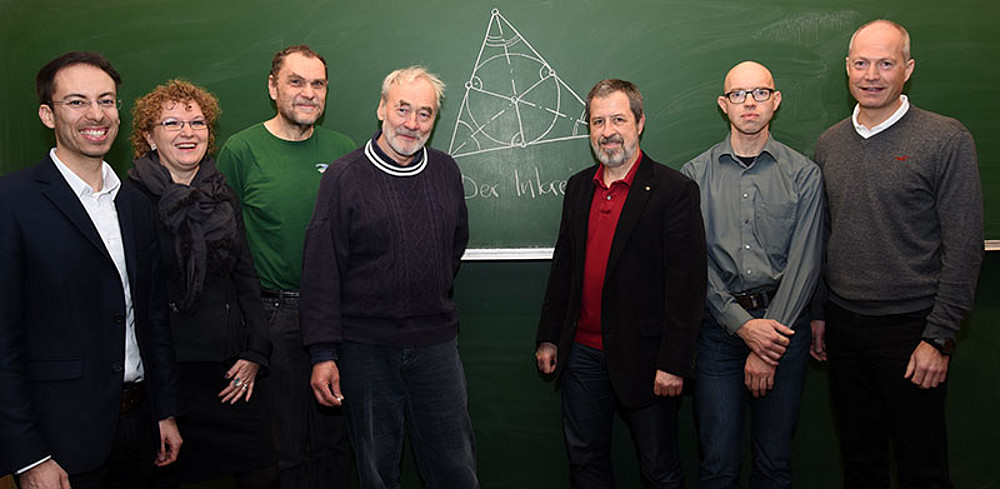
Robert Schütky, Michaela Kraker, Robert Geretschläger, Hans Walser, Bernd Thaller, Johannes Wallner und Günter Maresch. Foto: Uni Graz/Kastrun.

Robert Schütky, Michaela Kraker, Fachinspektorin für Mathematik und Angewandte Mathematik des Landesschulrat für Steiermark, Robert Geretschläger, Hans Walser, Bernd Thaller, Johannes Wallner und Günter Maresch. Foto: Uni Graz/Kastrun.

ForscherInnen und Lehrende werfen Licht auf mathematische Fragestellungen

Seit mehr als 10 Jahren findet der Tag der Mathematik als Fortbildungsveranstaltung für Lehrende aus dem Pflichtschulbereich sowie von allgemein bildenden höheren Schulen (AHS) und berufsbildenden höhere Schulen (BHS) alternierend entweder an der TU Graz oder an der Karl-Franzens-Universität statt. „Dabei stehen sowohl mathematische Fragestellungen als auch deren Vermittlung im Unterricht im Mittelpunkt“, erklärt Organisator Ao.Univ.-Prof. Dr. Bernd Thaller, Institut für Mathematik und Wissenschaftliches Rechnen der Uni Graz und Regionales Fachdidaktikzentrum für Mathematik und Geometrie. Rund 150 TeilnehmerInnen werden heute, am diesjährigen Tag der Mathematik, erwartet.

Nach der Eröffnung durch Landesschulinspektor Mag. Bernd Steiner widmet sich der der Plenarvortrag des Schweizers Dr. Hans Walser dem Inkreis. Danach geht Univ.-Prof. Dr. Johannes Wallner, Institut für Geometrie der TU Graz, auf Erdvermessung und Kugelgeometrie ein. Im Anschluss diskutiert Assoz.-Prof. Dr. Günter Maresch, Universität Salzburg, Ansätze und Theorien für Differenzierung und Individualisierung im naturwissenschaftlichen Unterricht. Dr. Robert Geretschläger, Uni Graz und BRG Kepler, der auch als Moderator der Veranstaltung fungiert, widmet sich Schachbrettaufgaben des Wettbewerbs „Mathematisches Duell“, bei dem SchülerInnen rein durch elementar-logisches Denken zur Lösung einer Aufgabenstellung gelangen können.

In einem weiteren Vortrag spricht Dr. Robert Schütky, KPH Graz, zur Entstehung und Vereinheitlichung von Maßsystemen. Am Nachmittag wird Ao.Univ.-Prof. Dr. Jürgen Maaß, Universität Linz, Beispiele für Modellieren im Mathematikunterricht präsentieren. Das dialogische Lernen ebenda wird Gegenstand des Vortrags von Dr. Christine Fischer, Lachdesfachkoordinatorin für Mathematik für NMS in der Steiermark, sein. Den „magischen“ Abschluss der Veranstaltung bildet der Vortrag von Mag. Dieter Kadan, Kollegium Kalksberg in Wien und ehemaliger Vizestaatsmeister der Zauberkunst: Er wird aufzeigen, wie Mathematik die Zauberei erklärbar macht.

created by Gerhild Kastrun

Related news

University of Graz: Working together to make Styria a sustainable centre of learning

Round table calls for sustainable funding for the 2028–2030 performance agreement period between the five Styrian universities and the federal government.

How can we teach using YouTube and AI? The University of Graz is strengthening media education in schools

A journey through the blood vessels using VR headsets brings biology lessons to life. An interactive quiz brings physics to life. The YouTube video explains the First World War. Whilst mobile phones are increasingly being banned from the classroom, social media platforms, apps and AI are playing an ever-greater role in knowledge transfer at school. But how can teaching with media be made even more effective? What are the challenges in media-based teaching? At the University of Graz, researchers are discussing these issues at a conference being held in Austria for the first time.

Jurassic Sounds: Biologist reconstructs insect songs from 165 million years ago

It was apparently not just the roars of the dinosaurs that made up the soundscape of the animal world during the Jurassic period. Crickets and grasshoppers communicated through a variety of songs and high-pitched sounds, as Thorin Jonsson from the Institute of Biology at the University of Graz discovered together with colleagues from the universities of Lincoln, Bristol (UK), Beijing (China) and Tempe (USA). The findings on what are so far the oldest traces of sound on Earth have just been published in the journal PNAS.

EU funding boosts international exchange between universities

The University of Graz is further expanding its international study opportunities through the European university alliance Arqus and is taking the lead in two key projects. In future, students will benefit from even more joint degree programmes and from simplified recognition of academic achievements through the Joint European Degree Label.

Begin of page section:
Additional information:

University of Graz
Universitaetsplatz 3
8010 Graz
Austria
  • Contact
  • Web Editors
  • Moodle
  • UNIGRAZonline
  • Imprint
  • Data Protection Declaration
  • Accessibility Declaration
Weatherstation
Uni Graz

End of this page section. Go to overview of page sections

End of this page section. Go to overview of page sections

Begin of page section:

End of this page section. Go to overview of page sections